http://groups.google.com/group/sci.electronics.repair?hl=en
sci.electronics.repair@googlegroups.com
Today's topics:
* See Hot Sexy Star Aishwarya Rai Videos In All Angles. - 3 messages, 3
authors
http://groups.google.com/group/sci.electronics.repair/t/19f39e70e3794266?hl=en
* Schematics & standards - 9 messages, 6 authors
http://groups.google.com/group/sci.electronics.repair/t/c62344a753d9d652?hl=en
* Need a little help troubleshooting a tv - 1 messages, 1 author
http://groups.google.com/group/sci.electronics.repair/t/80843d498adc82ad?hl=en
* Surge Protectors - 6 messages, 5 authors
http://groups.google.com/group/sci.electronics.repair/t/9a42e9c9a84828d9?hl=en
* Sound Technology ST-1700B distortion analyzer measurement pegs meter on low
range. - 2 messages, 2 authors
http://groups.google.com/group/sci.electronics.repair/t/c424590bd89f618b?hl=en
* MAKE UPTO $5000 PER MONTH! $2000 IN FIRST 20 DAYS! - 1 messages, 1 author
http://groups.google.com/group/sci.electronics.repair/t/2a2e5b605f78588a?hl=en
==============================================================================
TOPIC: See Hot Sexy Star Aishwarya Rai Videos In All Angles.
http://groups.google.com/group/sci.electronics.repair/t/19f39e70e3794266?hl=en
==============================================================================
== 1 of 3 ==
Date: Sat, Jun 19 2010 11:14 am
From: Jeffrey D Angus
KAJOL wrote:
> See Hot Sexy Star Aishwarya Rai Videos In All Angles.
> at http://ukcitygirls.co.cc
>
> Due to high sex content,i have hidden the videos in an image. in that
> website on left side below search box click on image and watch
> videos in all angles.please dont tell to anyone.
That's funny, this is almost the exact same wording as the "Bring $1500
into your home" posting.
> Simple hack to get $1500 to your home at http://lifeisbeatiful.co.cc
>
> Due to high security risks,i have hidden the cheque link in an
> image. in that website on left side below search box, click on image
> and enter your name and address where you want to receive your
> cheque.please dont tell to anyone.
And a little bit amusing to see that .cc is also used by a lot
of churches. "Who knew?"
Wanna guess there's some malicious script hiding in the image?
Jeff
--
"Egotism is the anesthetic that dulls the pain of stupidity."
Frank Leahy, Head coach, Notre Dame 1941-1954
== 2 of 3 ==
Date: Sat, Jun 19 2010 6:22 pm
From: Allodoxaphobia
On Sat, 19 Jun 2010 13:14:04 -0500, Jeffrey D Angus wrote:
> <-snip ->
> Wanna guess there's some malicious script hiding in the image?
So, that's why you felt compelled to repost the spammer's
entire piece of excrement -- including his URL?
== 3 of 3 ==
Date: Sat, Jun 19 2010 10:52 pm
From: John Robertson
Allodoxaphobia wrote:
> On Sat, 19 Jun 2010 13:14:04 -0500, Jeffrey D Angus wrote:
>> <-snip ->
>
>> Wanna guess there's some malicious script hiding in the image?
>
> So, that's why you felt compelled to repost the spammer's
> entire piece of excrement -- including his URL?
More efficient to simply expose all the headers and forward to the abuse
email of the source - in the first iteration groups-abuse@google.com.
I'm just doing that now with any spam I see in any of the groups I
frequent. It might annoy the people at Google-groups (and others) to do
something about this problem.
I recommend that everyone that knows how to expose all the headers (in
Eudora you simply pull down "View - Headers - All") and then forward away.
John :-#(#
==============================================================================
TOPIC: Schematics & standards
http://groups.google.com/group/sci.electronics.repair/t/c62344a753d9d652?hl=en
==============================================================================
== 1 of 9 ==
Date: Sat, Jun 19 2010 1:19 pm
From: adrian@poppyrecords.invalid.invalid (Adrian Tuddenham)
David Nebenzahl <nobody@but.us.chickens> wrote:
> On 6/19/2010 8:35 AM Adrian Tuddenham spake thus:
>
> > David Nebenzahl <nobody@but.us.chickens> wrote:
> >
> >> Someone else made a comment in another thread here about weird
> >> schematics (like for home appliances).
> >>
> > [...]
> >>... wire-connecting/jumping convention: here I much prefer the
> >> modern approach, which is to use a dot for a connection and no dot for
> >> no connection, rather than the clumsy "loop" to indicate one wire
> >> jumping over another with no connection.
> >
> > I find the 'gap' convention is easy to draw (with a computer) and
> > extremely easy to read. It also looks tidy. Four-way junctions which
> > could be mistaken for crossings should never be used, they should be
> > staggered instead.
> >
> > e.g.
> > http://www.poppyrecords.co.uk/compton/images/BassAmplifier.gif
>
> BZZZZZZT! Fail.
>
> While the gap thing looks OK for non-crossing wires, I have to ding the
> drafts-person of that schematic for the following:
>
> o Idiosyncratic symbols for electrolytic cazapitors...
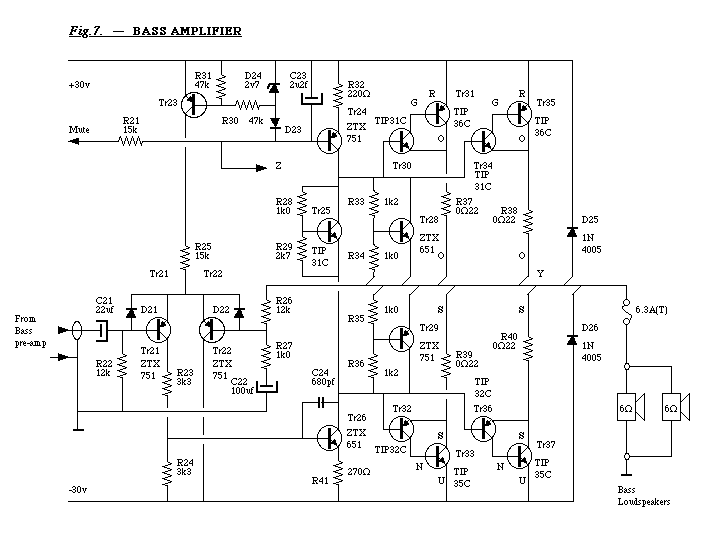
It appears that you had no difficulty identifying them, so they
succeeded as symbols. The polarity is also a lot more 'intuitive' than
the conventional symbol.
> o Idiosyncratic ground symbol (one horizontal line????)
Again, you recognised it without ambiguity and it isn't all that
unusual:
<http://www.ortodoxism.ro/datasheets2/a/0scgel8exqr094jlw9qfjx9qjc3y.pdf
>
> o And no, I disagree about those offsets for connecting wires.
>
> That's totally unnecessary here: it would be quite obvious that all
> those vertical wires connect to what is obviously a bus or rail. A
> well-drawn dot is all that's needed there.
That's your preference, but I prefer offsets because they are utterly
unambiguous, even in a poorly copied drawing.
> (And I don't much like their transistor symbols either)
For junction transistors they are incorrect, I agree, but I have become
used to them. I find it takes me a while to get my mind around the
correct symbols because they are so rarely used nowadays
Just for fun, I've replaced the point-contact symbols in that drawing
with the correct junction ones:
http://www.poppyrecords.co.uk/compton/images/BassAmplifier2.gif
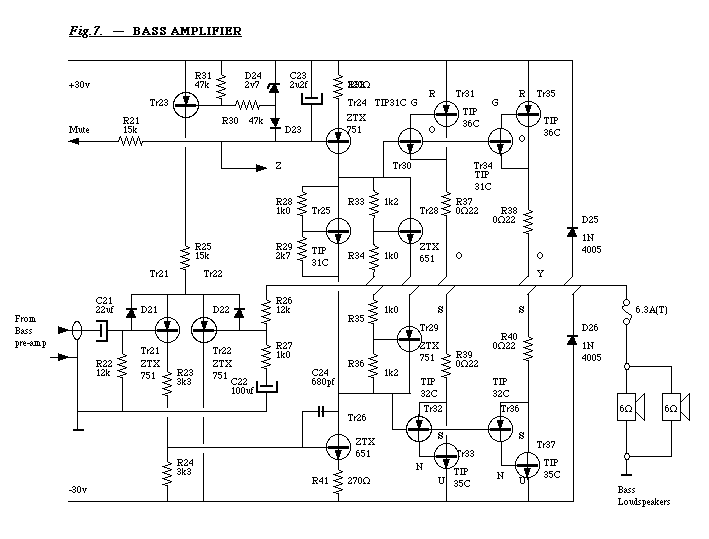
The wrong symbols have become so well-estabilshed nowadays that I doubt
if most people even noticed they were wrong.
--
~ Adrian Tuddenham ~
(Remove the ".invalid"s and add ".co.uk" to reply)
www.poppyrecords.co.uk
== 2 of 9 ==
Date: Sat, Jun 19 2010 1:56 pm
From: David Nebenzahl
On 6/19/2010 1:19 PM Adrian Tuddenham spake thus:
> David Nebenzahl <nobody@but.us.chickens> wrote:
>
>> (And I don't much like their transistor symbols either)
>
> For junction transistors they are incorrect, I agree, but I have become
> used to them. I find it takes me a while to get my mind around the
> correct symbols because they are so rarely used nowadays
>
> Just for fun, I've replaced the point-contact symbols in that drawing
> with the correct junction ones:
>
> http://www.poppyrecords.co.uk/compton/images/BassAmplifier2.gif
>
> The wrong symbols have become so well-estabilshed nowadays that I doubt
> if most people even noticed they were wrong.
Now that's just plain *weird*.
Since when are the *conventional* symbols for (junction) transistors
considered to be for the old, obsolete point-contact ones? Every single
schematic that uses transistors--modern silicon ones, not ancient
point-contact germanium ones--uses the conventional symbols, like the
ones in the first drawing you posted.
I've *never* seen symbols like the ones in your "new, improved" drawing.
Those are just plain idiosyncratic, non-standard and weird. They look
kind of like diodes with an elongated anode.
I'll stick with the tried and true standard symbols, thank you very much.
--
The fashion in killing has an insouciant, flirty style this spring,
with the flaunting of well-defined muscle, wrapped in flags.
- Comment from an article on Antiwar.com (http://antiwar.com)
== 3 of 9 ==
Date: Sat, Jun 19 2010 2:50 pm
From: adrian@poppyrecords.invalid.invalid (Adrian Tuddenham)
David Nebenzahl <nobody@but.us.chickens> wrote:
> On 6/19/2010 1:19 PM Adrian Tuddenham spake thus:
>
> > David Nebenzahl <nobody@but.us.chickens> wrote:
> >
> >> (And I don't much like their transistor symbols either)
> >
> > For junction transistors they are incorrect, I agree, but I have become
> > used to them. I find it takes me a while to get my mind around the
> > correct symbols because they are so rarely used nowadays
> >
> > Just for fun, I've replaced the point-contact symbols in that drawing
> > with the correct junction ones:
> >
> > http://www.poppyrecords.co.uk/compton/images/BassAmplifier2.gif
> >
> > The wrong symbols have become so well-estabilshed nowadays that I doubt
> > if most people even noticed they were wrong.
>
> Now that's just plain *weird*.
I thought you would find them interesting.
> Since when are the *conventional* symbols for (junction) transistors
> considered to be for the old, obsolete point-contact ones?
When junction transistors were first introduced there was a need for a
new symbol to distinguish them from the point-contact type which the
'conventional' symbol represented. Several eminent journals and text
books changed over to the new 'junction' symbol, but, by then, the
point-contact symbol was so well established that the change never
caught on.
>Every single
> schematic that uses transistors--modern silicon ones, not ancient
> point-contact germanium ones--uses the conventional symbols, like the
> ones in the first drawing you posted.
You will find the 'junction' symbols in some Acoustical Quad circuit
diagrams, Peter Walker was a stickler for getting things right. They
also appeared in Wireless World for a while and are used in "The
Foundations of Wireless" by M.G. Scroggie (8th Edition) specifically to
distinguish the two different types of transistor.
>
> I've *never* seen symbols like the ones in your "new, improved" drawing.
> Those are just plain idiosyncratic, non-standard and weird. They look
> kind of like diodes with an elongated anode.
They certainly look strange when you have been used to the
point-contact symbol, but you must admit they give a clear
representation of a junction transistor.
>
> I'll stick with the tried and true standard symbols, thank you very much.
At least you will be able to recognise the other types if you ever
encounter them again.
--
~ Adrian Tuddenham ~
(Remove the ".invalid"s and add ".co.uk" to reply)
www.poppyrecords.co.uk
== 4 of 9 ==
Date: Sat, Jun 19 2010 3:29 pm
From: PlainBill47@yahoo.com
On Fri, 18 Jun 2010 13:18:41 -0700, David Nebenzahl
<nobody@but.us.chickens> wrote:
>Someone else made a comment in another thread here about weird
>schematics (like for home appliances).
>
>Wanted to get a small discussion going on that topic. My take: there are
>good and bad standards for schematics. Personally, I can't stand the
>ones that use rectangle shapes for resistors, instead of the traditional
>zigzag that [insert name of deity here] intended to be used. (And even
>here there are lots of variations, like old-fashioned schematics that
>took this symbol rather literally and sometimes had ten or twelve zigs
>and zags, as if an actual resistor was being constructed on paper).
>
>Likewise the wire-connecting/jumping convention: here I much prefer the
>modern approach, which is to use a dot for a connection and no dot for
>no connection, rather than the clumsy "loop" to indicate one wire
>jumping over another with no connection.
>
>Regarding resistor values: Who the hell came up with that new way of
>specifying resistance values, like "10R" "or 5K6" or whatever? And why
>use this system? I've always used the plain value of the resistance: 10,
>56, 5.6K, 56K, etc. Simple, obvious, requires no interpretation. Is this
>some kind of Euro thing?
>
>In general, some schematics just look and feel nicer than others. A
>well-drawn schematic is a pleasure to read. A bad one--lines too thin or
>too thick, misshapen symbols, idiosyncratic interpretations, etc., just
>don't look right.
>
>Feel free to add your own schematic pet peeves here.
Well, the worst schematics of all are those which you cannot find.
Even the most miserable scratching on a crumpled piece of paper is
better.
While I learned using the 3.3K style, I fiend the 3K3 eminently
satisfactory, especially because of the redundancy. As was
mentioned,, this is important when dealing with a PDF of a poorly
scanned, poorly printed original.
I prefer the 'old' style - zig-zag lines for resistors, parallel lines
for non-polar capacitors, etc.
Lines should be drawn with the little loop when crossing lines do not
connect, a dot when they do. Again, redundancy.
Tags indicating the signal connecting to an IC should have an arrow
indicating if the signal is an input or an output, double arrows for a
bidirectional bus. And when a signal goes off the page, the
description should be accompanied by the page and grid location of the
destination, as in < SYNC 3E5 indicating the SYNC signal is coming
from page 3, grid location E5.
As a bonus, the location of each component should be tabulated,
either on the schematic, or in a separate chart so it is possible to
determine that IC205 is on the bottom side of the circuit board at
grid location J12.
PlainBill
== 5 of 9 ==
Date: Sat, Jun 19 2010 5:10 pm
From: Rich Webb
On Sat, 19 Jun 2010 15:29:45 -0700, PlainBill47@yahoo.com wrote:
>Lines should be drawn with the little loop when crossing lines do not
>connect, a dot when they do. Again, redundancy.
Crossings (four-way intersections) never connect. Three-way
intersections always connect. Stick with that convention and neither the
humpie or a dot are needed, although dots do "look right."
There is an authorized reprint of H&H's "How to Draw Schematic Diagrams"
from AoE Appx E over at
http://opencircuitdesign.com/xcircuit/goodschem/goodschem.html
--
Rich Webb Norfolk, VA
== 6 of 9 ==
Date: Sat, Jun 19 2010 5:42 pm
From: "Arfa Daily"
"David Nebenzahl" <nobody@but.us.chickens> wrote in message
news:4c1d00fe$0$2388$822641b3@news.adtechcomputers.com...
> On 6/19/2010 8:35 AM Adrian Tuddenham spake thus:
>
>> David Nebenzahl <nobody@but.us.chickens> wrote:
>>
>>> Someone else made a comment in another thread here about weird
>>> schematics (like for home appliances).
>>>
>> [...]
>>>... wire-connecting/jumping convention: here I much prefer the modern
>>>approach, which is to use a dot for a connection and no dot for
>>> no connection, rather than the clumsy "loop" to indicate one wire
>>> jumping over another with no connection.
>>
>> I find the 'gap' convention is easy to draw (with a computer) and
>> extremely easy to read. It also looks tidy. Four-way junctions which
>> could be mistaken for crossings should never be used, they should be
>> staggered instead.
>>
>> e.g.
>> http://www.poppyrecords.co.uk/compton/images/BassAmplifier.gif
>
> BZZZZZZT! Fail.
>
> While the gap thing looks OK for non-crossing wires, I have to ding the
> drafts-person of that schematic for the following:
>
> o Idiosyncratic symbols for electrolytic cazapitors[1]
> o Idiosyncratic ground symbol (one horizontal line????)
> o And no, I disagree about those offsets for connecting wires.
>
> That's totally unnecessary here: it would be quite obvious that all those
> vertical wires connect to what is obviously a bus or rail. A well-drawn
> dot is all that's needed there.
>
> (And I don't much like their transistor symbols either)
>
>
> [1] With apologies to J. Liebermann.
>
I must say that I don't really like the staggered connections, but what's
wrong with the transistor symbols ? And the single heavy horizontal line for
the 0v rail, is very common this side of the pond. 0v rails always used to
be shown as a heavy horizontal line right across the schematic, sometimes
with a chassis symbol attached as well. These days, most schematics are so
complex, that the 0v line is now left out, and 'abbreviated' to individual
short heavy lines at each connection point on the schematic. The
electrolytic symbol is not, however, the one commonly used here, which is a
pair of rectangles, one filled in for the -ve side, and the other open for
the +ve side. Sometimes, the American convention of one straight and one
curved plate, is used.
Arfa
== 7 of 9 ==
Date: Sat, Jun 19 2010 8:53 pm
From: Cydrome Leader
David Nebenzahl <nobody@but.us.chickens> wrote:
> Someone else made a comment in another thread here about weird
> schematics (like for home appliances).
>
> Wanted to get a small discussion going on that topic. My take: there are
> good and bad standards for schematics. Personally, I can't stand the
> ones that use rectangle shapes for resistors, instead of the traditional
I find rectangles obnoxious, unless somebody from europe is drawing
something in front of me.
> zigzag that [insert name of deity here] intended to be used. (And even
> here there are lots of variations, like old-fashioned schematics that
> took this symbol rather literally and sometimes had ten or twelve zigs
> and zags, as if an actual resistor was being constructed on paper).
>
> Likewise the wire-connecting/jumping convention: here I much prefer the
> modern approach, which is to use a dot for a connection and no dot for
> no connection, rather than the clumsy "loop" to indicate one wire
> jumping over another with no connection.
I was taught the half-loop shape first, then moved to the dots and no
dots. It seemed like how you're taught to ties shoes in a really complex
method of making two rabbit ears first, then tying them.
> Regarding resistor values: Who the hell came up with that new way of
> specifying resistance values, like "10R" "or 5K6" or whatever? And why
> use this system? I've always used the plain value of the resistance: 10,
> 56, 5.6K, 56K, etc. Simple, obvious, requires no interpretation. Is this
> some kind of Euro thing?
I first saw that on this newsgroup. My question is what idiots came up
with it and why?
== 8 of 9 ==
Date: Sat, Jun 19 2010 8:57 pm
From: Cydrome Leader
Arfa Daily <arfa.daily@ntlworld.com> wrote:
>
>
> "N_Cook" <diverse@tcp.co.uk> wrote in message
> news:hvhv1s$88b$1@news.eternal-september.org...
>> David Nebenzahl <nobody@but.us.chickens> wrote in message
>> news:4c1bd34c$0$2542$822641b3@news.adtechcomputers.com...
>>> Someone else made a comment in another thread here about weird
>>> schematics (like for home appliances).
>>>
>>> Wanted to get a small discussion going on that topic. My take: there are
>>> good and bad standards for schematics. Personally, I can't stand the
>>> ones that use rectangle shapes for resistors, instead of the traditional
>>> zigzag that [insert name of deity here] intended to be used. (And even
>>> here there are lots of variations, like old-fashioned schematics that
>>> took this symbol rather literally and sometimes had ten or twelve zigs
>>> and zags, as if an actual resistor was being constructed on paper).
>>>
>>> Likewise the wire-connecting/jumping convention: here I much prefer the
>>> modern approach, which is to use a dot for a connection and no dot for
>>> no connection, rather than the clumsy "loop" to indicate one wire
>>> jumping over another with no connection.
>>>
>>> Regarding resistor values: Who the hell came up with that new way of
>>> specifying resistance values, like "10R" "or 5K6" or whatever? And why
>>> use this system? I've always used the plain value of the resistance: 10,
>>> 56, 5.6K, 56K, etc. Simple, obvious, requires no interpretation. Is this
>>> some kind of Euro thing?
>>>
>>> In general, some schematics just look and feel nicer than others. A
>>> well-drawn schematic is a pleasure to read. A bad one--lines too thin or
>>> too thick, misshapen symbols, idiosyncratic interpretations, etc., just
>>> don't look right.
>>>
>>> Feel free to add your own schematic pet peeves here.
>>>
>>>
>>> --
>>> The fashion in killing has an insouciant, flirty style this spring,
>>> with the flaunting of well-defined muscle, wrapped in flags.
>>>
>>> - Comment from an article on Antiwar.com (http://antiwar.com)
>>
>>
>>
>> How often have you come across compressed pdf-type schema or reduced
>> paper-based ones where the decimal point has disappeared , and there is no
>> kerning for dots, so you cannot infer a position for any dot position.
>> Replace R/K/M for the dot makes a lot of sense.
>>
>
>
> Yes, I'd go along with that. It is a far more sensible way of showing
> values, and I can't see anything counter intuitive about understanding it. I
> still prefer zig-zags for resistors, and if I'm drawing a quick 'sketch' of
> a diagram, I always still 'jump' the non-connected lines. However, when I'm
> hand-drawing a diagram properly, with nice straight lines and 'gridded'
> components, I always break one of the two crossing lines, where they break,
> so sort of the 'jumping over' convention, but without the actual bridge
> being drawn. I'm not sure where I first saw this, but schematics drawn like
> it, look quite nice. There's no question about whether lines do connect or
> not, and the brain fills in the little missing bit of the line without you
> having to think about it. Where lines do connect, they get a nice dot on
> them.
>
> I always still use the original logic symbols for gates and counters and
> latches and inverters and so on. I find the new style 'blocky' symbols need
> too much looking at, and taking into consideration of additional writing and
> symbols within the block. I always thought that the original symbols were
> all sufficiently different for the most part, to allow instant understanding
> of function by quick glance alone.
>
> I would agree that appliance schematics are often unclear, and use odd
> symbols. Also, with apologies to Herr Willberg, I think that German
> schematics from 20 or 30 years back, are some of the worst to follow that
> I've ever seen. I defy anyone who's not German, to follow a Grundig
> schematic, for instance ...
>
> Although Dutch, some of Philips' ones from a few years back were also a
> nightmare to follow. They had a very frustrating convention regarding where
> signals went when they (frequently) disappeared off the side of a page, and
> the signal was often nigh on impossible to ever find again ...
>
> But the prize for impossible to follow schematics, has to go to the
> automotive industry. Those diagrams have a convention all of their own, and
> always have done. Some of the most frustrating fault-tracing sessions of my
> life, have involved cars and the electrical diagrams for them. They are a
> cross between a schematic and a wiring diagram, with symbols peculiar to and
> only understood by automotive manufacturing initiates. Every bullet and
> connector is shown, using a variety of different conventions between
> manufacturers. Schematics go across multiple pages, with wires that leave
> often almost impossible to re-find on the next diagram. Colours, wire gauges
> and goodness only knows what other info, are all crammed onto the diagrams.
> Nightmare ...
>
> Arfa
ha, plus every damn wire is taped together into some completely awful
harness. There has to be at least 50 pounds of PVC electrical tape in
every car out there.
== 9 of 9 ==
Date: Sat, Jun 19 2010 10:13 pm
From: Cydrome Leader
Adrian Tuddenham <adrian@poppyrecords.invalid.invalid> wrote:
> David Nebenzahl <nobody@but.us.chickens> wrote:
>
>> Someone else made a comment in another thread here about weird
>> schematics (like for home appliances).
>>
> [...]
>>... wire-connecting/jumping convention: here I much prefer the
>> modern approach, which is to use a dot for a connection and no dot for
>> no connection, rather than the clumsy "loop" to indicate one wire
>> jumping over another with no connection.
>
> I find the 'gap' convention is easy to draw (with a computer) and
> extremely easy to read. It also looks tidy. Four-way junctions which
> could be mistaken for crossings should never be used, they should be
> staggered instead.
>
> e.g.
> http://www.poppyrecords.co.uk/compton/images/BassAmplifier.gif
I'd rate this schematic as weird. Some parts are identified, some aren't
and the junctions are complex for no reason.
>> Regarding resistor values: Who the hell came up with that new way of
>> specifying resistance values, like "10R" "or 5K6" or whatever? And why
>> use this system? I've always used the plain value of the resistance: 10,
>> 56, 5.6K, 56K, etc. Simple, obvious, requires no interpretation. Is this
>> some kind of Euro thing?
>
> I first saw it in German and Dutch publications. Once you have become
> accustomed to it, it is quite easy to use and it is utterly unambiguous,
> even when badly photocopied.
Who photocopies stuff anymore, and periods aren't hard to read and never
were, except in places that read right to left and switch periods to
commas.
Banks don't print money is formats like 34$00. "Oh it's hard to read" is
complete crap.
What's next- the germans and dutch replacing numbers with spelled out
words?
I'm surprised the diodes past the output stage aren't indetified as
something like:
1N4k005 or
ONE-NANO-FOUR KILO CIPHER CIPER V
or something just as goofy.
Why are the speakers just 6 ohms, while other resitors have place holders
for digits?
I just don't get it- how does using multiple systems to represent simple
data make things easier?
This is why the finest and best technology comes from the USA. Instead of
trying to rewrite a 20nm process in semiconductor manufacturing as 20nm0
like europeans might form a committee to try to do, we've come out with
15nm process while everybody else is screwing around trying to solve
problems that never existed.
Just curious, has a committee come up with some cool new way to write
voltages too?
The amp uses +/- 30. Should that be written as 30v0 and (30v0) for the
negative rail?
Afer all, a "-" sign is too confusing and might indicate and error that
was crossed out, or a period that was damaged during a recent facsimile
transmission of poorly risographed copy of schematic.
Is 5kV now 5k0?
==============================================================================
TOPIC: Need a little help troubleshooting a tv
http://groups.google.com/group/sci.electronics.repair/t/80843d498adc82ad?hl=en
==============================================================================
== 1 of 1 ==
Date: Sat, Jun 19 2010 2:38 pm
From: Mac Cool
I bought a used Sanyo DS27930 television for a 2nd tv and there are faint
whitish lines running through the screen when I watch [digital] satellite
through the coax, also a steady hum. It doesn't happen on component or
composite. The picture on coax also isn't as good as the other two. I
never noticed the problem on my old 20" TV.
I've had one person suggest it was a bad tuner, while another suggested
it's a ground loop. I'm not sure how to fix a ground loop problem on a
satellite coax but I suspect that would be the easiest to try first.
Rick
==============================================================================
TOPIC: Surge Protectors
http://groups.google.com/group/sci.electronics.repair/t/9a42e9c9a84828d9?hl=en
==============================================================================
== 1 of 6 ==
Date: Sat, Jun 19 2010 3:41 pm
From: Cydrome Leader
William Sommerwerck <grizzledgeezer@comcast.net> wrote:
>> It is bud's job to constantly promote lies and myths. He is paid
>> to promote plug-in protectors. Lying is what promoters may do.
>> Where are those numeric specs? bud will never provide any.
>> He cannot claim protection that does not exist.
>
>> Where does that energy dissipate? bud cannot say. Otherwise
>> he must admit that plug-in protectors are profit centers ? not
>> protection.
>
> Uh... In the MOV?
>
> I thought the MOV conducted above its breakdown voltage (generally around
> 300V), and the energy in the section of the AC waveform above that voltage
> heated up the MOV.
>
> Am I missing something?
>
> Many years ago, PC and/or Byte (I forget which) used to test suppressors. If
> they failed to provide suppression, I assume the mag would have said so.
hillarious, PC magazine is your source for the lowdown on surge supression
devices?
== 2 of 6 ==
Date: Sat, Jun 19 2010 3:47 pm
From: Sjouke Burry
Jim Yanik wrote:
> "William Sommerwerck" <grizzledgeezer@comcast.net> wrote in
> news:hvigjf$hg7$1@news.eternal-september.org:
>
>>> It is bud's job to constantly promote lies and myths. He is paid
>>> to promote plug-in protectors. Lying is what promoters may do.
>>> Where are those numeric specs? bud will never provide any.
>>> He cannot claim protection that does not exist.
>>> Where does that energy dissipate? bud cannot say. Otherwise
>>> he must admit that plug-in protectors are profit centers � not
>>> protection.
>> Uh... In the MOV?
>>
>> I thought the MOV conducted above its breakdown voltage (generally
>> around 300V), and the energy in the section of the AC waveform above
>> that voltage heated up the MOV.
>>
>> Am I missing something?
>
> Ohm's Law.
> If the MOV conducts at a low resistance,the power it dissipates will be
> minimal.
> Thus,the surge energy gets dissipated in whatever ground it's shunted to.
>
>
Bullshit. The Mov dissipates (Umov)*I*T, or
Total Energy=MOVvolts * Current * Seconds.
Or integrate over those values, if they vary in time.
The Mov voltage does NOT drop to zero, when conducting.
Where did you learn about electricity??????
Of course some currents might be enough to blow the MOV,
and that is specified in the documentation, as in how
many WATTseconds blows it to pieces.
Even then it still might provide protection, although
only once, and then blow the mains fuse.
== 3 of 6 ==
Date: Sat, Jun 19 2010 4:32 pm
From: "William Sommerwerck"
>> Many years ago, PC and/or Byte (I forget which) used to test suppressors.
If
>> they failed to provide suppression, I assume the mag would have said so.
> hillarious, PC magazine is your source for the lowdown on surge supression
> devices?
It was, 20 years ago. I don't think you get the point, though.
== 4 of 6 ==
Date: Sat, Jun 19 2010 4:50 pm
From: Jim Yanik
Sjouke Burry <burrynulnulfour@ppllaanneett.nnll> wrote in
news:4c1d48fd$0$14115$703f8584@textnews.kpn.nl:
> Jim Yanik wrote:
>> "William Sommerwerck" <grizzledgeezer@comcast.net> wrote in
>> news:hvigjf$hg7$1@news.eternal-september.org:
>>
>>>> It is bud's job to constantly promote lies and myths. He is paid
>>>> to promote plug-in protectors. Lying is what promoters may do.
>>>> Where are those numeric specs? bud will never provide any.
>>>> He cannot claim protection that does not exist.
>>>> Where does that energy dissipate? bud cannot say. Otherwise
>>>> he must admit that plug-in protectors are profit centers – not
>>>> protection.
>>> Uh... In the MOV?
>>>
>>> I thought the MOV conducted above its breakdown voltage (generally
>>> around 300V), and the energy in the section of the AC waveform above
>>> that voltage heated up the MOV.
>>>
>>> Am I missing something?
>>
>> Ohm's Law.
>> If the MOV conducts at a low resistance,the power it dissipates will
>> be minimal.
>> Thus,the surge energy gets dissipated in whatever ground it's shunted
>> to.
>>
>>
> Bullshit. The Mov dissipates (Umov)*I*T, or
> Total Energy=MOVvolts * Current * Seconds.
> Or integrate over those values, if they vary in time.
> The Mov voltage does NOT drop to zero, when conducting.
I never said it did.
the MOV voltage rating is the voltage when it changes state and drops to a
low resistance to shunt the surge to GROUND.
Now,how low a resistance in the conducting state is another matter.
that's dependent on the MOV design/ratings.
> Where did you learn about electricity??????
USAF PME School,1971.
> Of course some currents might be enough to blow the MOV,
yes,I said the MOV's dissipation would be "minimal",....compared to the
total energy the MOV was passing to ground.
what energy the MOV dissipates can easily be enough to blow it apart.
I've seen it happen many times.
But the MOV is not dissipating the total energy of the surge with it's
suicide.
> and that is specified in the documentation, as in how
> many WATTseconds blows it to pieces.
> Even then it still might provide protection, although
> only once, and then blow the mains fuse.
>
>
Of course,the fuse itself can arc over in a lightning strike,as it
can exceed the typical 250v voltage rating of the fuse.
--
Jim Yanik
jyanik
at
localnet
dot com
== 5 of 6 ==
Date: Sat, Jun 19 2010 5:20 pm
From: "David"
>> Bullshit. The Mov dissipates (Umov)*I*T, or
>> Total Energy=MOVvolts * Current * Seconds.
>> Or integrate over those values, if they vary in time.
>> The Mov voltage does NOT drop to zero, when conducting.
>
> I never said it did.
> the MOV voltage rating is the voltage when it changes
> state and drops to a
> low resistance to shunt the surge to GROUND.
> Now,how low a resistance in the conducting state is
> another matter.
> that's dependent on the MOV design/ratings.
>
>
>> Where did you learn about electricity??????
>
> USAF PME School,1971.
>
>> Of course some currents might be enough to blow the MOV,
>
> yes,I said the MOV's dissipation would be
> "minimal",....compared to the
> total energy the MOV was passing to ground.
> what energy the MOV dissipates can easily be enough to
> blow it apart.
> I've seen it happen many times.
> But the MOV is not dissipating the total energy of the
> surge with it's
> suicide.
> Jim Yanik
> jyanik
> at
> localnet
> dot com
A MOV is somewhat like two back-to-back Zener diodes. It is
a voltage clamp. You do not pass energy to ground, you pass
current to ground just like you do with any load. The energy
is totally dissipated in the MOV.
David
== 6 of 6 ==
Date: Sat, Jun 19 2010 10:36 pm
From: Cydrome Leader
William Sommerwerck <grizzledgeezer@comcast.net> wrote:
>>> Many years ago, PC and/or Byte (I forget which) used to test suppressors.
> If
>>> they failed to provide suppression, I assume the mag would have said so.
>
>> hillarious, PC magazine is your source for the lowdown on surge supression
>> devices?
>
> It was, 20 years ago. I don't think you get the point, though.
So what is the point? John Dvorak wrote a story about surge supressors and
how they worked with his Cumulus 386 laptop and his CompuAdd 486sx tower?
==============================================================================
TOPIC: Sound Technology ST-1700B distortion analyzer measurement pegs meter on
low range.
http://groups.google.com/group/sci.electronics.repair/t/c424590bd89f618b?hl=en
==============================================================================
== 1 of 2 ==
Date: Sat, Jun 19 2010 6:38 pm
From: "David Farber"
"Michael A. Terrell" <mike.terrell@earthlink.net> wrote in message
news:T-ednVZAeKq1RIHRnZ2dnUVZ_s6dnZ2d@earthlink.com...
>
> David Farber wrote:
>>
>> One of my ~30 year old Sound Technology distortion/power analyzers has a
>> problem. It's been sitting around for a number of years because I had a
>> spare. The symptom is that when you are measuring distortion and move the
>> rotary selector switch one step from the 1% range to the .3% range, the
>> meter goes from a near zero reading to full deflection and then some. If
>> I
>> feed the signal output to my other analyzer, the distortion is very low
>> so I
>> know the oscillator is ok.
>>
>> Here is a copy of the schematic:
>> http://members.dslextreme.com/users/farberbear/Repair/st-1700b/st-1700b.html
>>
>> At the output of U202, pin 6, the signal goes from zero (meter is working
>> properly) to a nice sine wave (meter pegs) when the switch is rotated.to
>> the
>> .3% range and below. The signal is too low to measure at the input of
>> U202
>> no matter where the switch is. There is a very detailed circuit
>> description
>> in the owner's manual. However I have a general sense that there's an
>> open
>> circuit somewhere causing the gain to go full blast. I cleaned the
>> switches
>> but it wasn't of any help. Anyone have any clever ideas as to how to
>> pinpoint the trouble?
>
>
> Troubleshoot it. Is the switch part of an attenuator, or does it
> switch in more gain for the last range? Look to see if the op amp is
> oscillating. Look for bad electrolytics on the supply rails. It isn't
> rocket science. A distortion analyzer is a tunable notch filter and
> attenuator, followed by an AC voltmeter.
>
>
> --
> Anyone wanting to run for any political office in the US should have to
> have a DD214, and a honorable discharge.
The first thing I did was to check all the caps. They're ok.
You can see from the schematic that the switch is part of the attenuator and
that U202 is before the attenuator switch. So my question is why does U202
suddenly have a wild signal swing when switched to the next lower step?
Thanks for your reply.
--
David Farber
David Farber's Service Center
L.A., CA
== 2 of 2 ==
Date: Sat, Jun 19 2010 9:58 pm
From: "Michael A. Terrell"
David Farber wrote:
>
> "Michael A. Terrell" <mike.terrell@earthlink.net> wrote in message
> news:T-ednVZAeKq1RIHRnZ2dnUVZ_s6dnZ2d@earthlink.com...
> >
> > David Farber wrote:
> >>
> >> One of my ~30 year old Sound Technology distortion/power analyzers has a
> >> problem. It's been sitting around for a number of years because I had a
> >> spare. The symptom is that when you are measuring distortion and move the
> >> rotary selector switch one step from the 1% range to the .3% range, the
> >> meter goes from a near zero reading to full deflection and then some. If
> >> I feed the signal output to my other analyzer, the distortion is very low
> >> so I know the oscillator is ok.
> >>
> >> Here is a copy of the schematic:
> >> http://members.dslextreme.com/users/farberbear/Repair/st-1700b/st-1700b.html
> >>
> >> At the output of U202, pin 6, the signal goes from zero (meter is working
> >> properly) to a nice sine wave (meter pegs) when the switch is rotated.to
> >> the .3% range and below. The signal is too low to measure at the input
> >> of U202 no matter where the switch is. There is a very detailed circuit
> >> description in the owner's manual. However I have a general sense that
> >> there's an open circuit somewhere causing the gain to go full blast. I
> >> cleaned the switches but it wasn't of any help. Anyone have any clever
> >> ideas as to how to pinpoint the trouble?
> >
> > Troubleshoot it. Is the switch part of an attenuator, or does it
> > switch in more gain for the last range? Look to see if the op amp is
> > oscillating. Look for bad electrolytics on the supply rails. It isn't
> > rocket science. A distortion analyzer is a tunable notch filter and
> > attenuator, followed by an AC voltmeter.
> >
>
> The first thing I did was to check all the caps. They're ok.
>
> You can see from the schematic that the switch is part of the attenuator and
> that U202 is before the attenuator switch. So my question is why does U202
> suddenly have a wild signal swing when switched to the next lower step?
>
> Thanks for your reply.
You have a lot of DC coupled stages, and some are not very good op
amps. A dc offset can make a string like that unstable. Did you look
at pin 6 of U202 with a low capacitance scope probe? How does the DC
voltage there compare to the working unit?
Are the op amps marked 2605 Harris HA2605? If so, they have been out
of production for some time. Metal cased op amps, (and other metal
cased ICs) started disapearing 10 years ago.
You might luck out and fix it with a couple .1 caps to ground of the
supply pins of U202 if it's oscillating. Another thing to check is all
the mounting screws for the PC board and any shields. Loosen the screws
and tighten them up to remove any oxide. Generally op amps oscillate
from defective bypass caps, or signals being coupled from another
circuit. Also, did you test the resistance for the contacts in that
mode after you cleaned the switches? An open or high resistance contact
cn upset the circuit.
One question. Is the sine wave close to the frequency the filter is
tuned to?
--
Anyone wanting to run for any political office in the US should have to
have a DD214, and a honorable discharge.
==============================================================================
TOPIC: MAKE UPTO $5000 PER MONTH! $2000 IN FIRST 20 DAYS!
http://groups.google.com/group/sci.electronics.repair/t/2a2e5b605f78588a?hl=en
==============================================================================
== 1 of 1 ==
Date: Sat, Jun 19 2010 10:00 pm
From: antonyjeevaraj@rediffmail.com
MAKE UPTO $5000 PER MONTH! $2000 IN FIRST 20 DAYS!
Generate $50 to $100 whenever you have
a couple of hours free time tospare.
You could make $50 or more in the next 2 hours.
Starting right Now!Today!
Awesome earnings get paid for your honest work
Join as a free member and get paid to your bank account
To join the Network follow the link
http://www.go-easy-money.com/home.html?a_aid=4c0be5bc81f9c
Get paid for your real work and earn awesome $$$$
==============================================================================
You received this message because you are subscribed to the Google Groups "sci.electronics.repair"
group.
To post to this group, visit http://groups.google.com/group/sci.electronics.repair?hl=en
To unsubscribe from this group, send email to sci.electronics.repair+unsubscribe@googlegroups.com
To change the way you get mail from this group, visit:
http://groups.google.com/group/sci.electronics.repair/subscribe?hl=en
To report abuse, send email explaining the problem to abuse@googlegroups.com
==============================================================================
Google Groups: http://groups.google.com/?hl=en
No Response to "sci.electronics.repair - 22 new messages in 6 topics - digest"
Post a Comment