Digest for sci.electronics.repair@googlegroups.com - 19 updates in 5 topics

etpm@whidbey.com: Jul 19 10:45AM -0700

I opened a new package of Kirkland brand AA batteries but when I put
them in the device I got the flashing LED mesage of low voltage. Out
of 6 batteries 3 were bad. Measuring the voltages one battery measured
.82 volts, another 1.1 volts, and a third one measured -87 mV.
Negative? Really? Yeah, I thought that too. But I made sure the meter
leads were correctly placed. So I guess something weird is happenening
to these batteries while they are sitting in the package. Maybe they
are getting ready to leak. I'm thinking that package needs to go back.
to Costco.
Eric
"pfjw@aol.com" <peterwieck33@gmail.com>: Jul 19 11:17AM -0700

Tell you a story:
 
Energizer Batteries, 1960s-vintage Civil Defense Geiger Counter - my wife collected Fiesta Ware at the time. Paid $30 for the counter and its accouterments at a surplus sale.
 
Batteries blew up.
Sent the unit to Energizer.
 
6-weeks later, I received a check from Energizer for $349.67, or some such close to that number, together with a polite note not to keep batteries in a device while in storage.
 
Nothing but US-made batteries, from here on out. With Energizer being the preferred vendor.
 
You may have saved $2 for that pack over a domestic name-brand. But it is costing you the trouble of returning them - which in any case will be far more than $2, probably enough for half-a-dozen 'real' batteries.
 
Peter Wieck
Melrose Park, PA
Allodoxaphobia <trepidation@example.net>: Jul 19 08:11PM

> to these batteries while they are sitting in the package. Maybe they
> are getting ready to leak. I'm thinking that package needs to go back.
> to Costco.
 
Yes!
By all means return them to Costco with an attached note as to
their failure(s).
 
I've been buying, storing (in a fridge), and using Costco's D, AA, AAA,
and 9V batteries for at least 2 decades without issue. Any retailer can
get hurt by bad products from a supplier. But, without feedback . . . . .
 
Jonesy
--
Marvin L Jones | W3DHJ | W3DHJ | https://W3DHJ.net/
Pueblo, Colorado | @ | Jonesy | __ linux FreeBSD
38.238N 104.547W | jonz.net | DM78rf | 73 SK
John-Del <ohger1s@gmail.com>: Jul 19 01:55PM -0700

On Friday, July 19, 2019 at 4:11:10 PM UTC-4, Allodoxaphobia wrote:
> Marvin L Jones | W3DHJ | W3DHJ | https://W3DHJ.net/
> Pueblo, Colorado | @ | Jonesy | __ linux FreeBSD
> 38.238N 104.547W | jonz.net | DM78rf | 73 SK
 
 
I've never bothered experimenting, but Duracell recommends storing alkalines at room temp - storing in the refrigerator is not recommended. Supposedly, rechargeables (other than eneloop types) will hold their charge longer if cold, but who knows?
tabbypurr@gmail.com: Jul 19 04:55PM -0700

> are getting ready to leak. I'm thinking that package needs to go back.
> to Costco.
> Eric
 
I've had some with small negative v too. No idea what the chemistry is that's making that happen.
 
As for brands, most are much the same. ZnC and alkaline certainly aren't, but otherwise they're not a lot different. All are liable to leak when flat. ZnC sometimes leak when half flat.
 
 
NT
dplatt@coop.radagast.org (Dave Platt): Jul 19 05:30PM -0700

In article <13428149-1bb2-494a-8939-9db59575302a@googlegroups.com>,
 
>I've had some with small negative v too. No idea what the chemistry is that's making that happen.
 
>As for brands, most are much the same. ZnC and alkaline certainly aren't, but otherwise they're not a lot
>different. All are liable to leak when flat. ZnC sometimes leak when half flat.
 
A decade ago, I was happily buying the Kirkland-brand AAs from Costco,
getting good in-service lifetime and no problems to speak of.
 
A few years ago, something changed. I began to find their AAs
starting to leak, while still fully charged (never put into service),
while still in the original storage box or shrink-wrap package, well
before their labeled "use by" date.
 
I don't know whether they changed suppliers, or whether their old
supplier's quality fell through the floor... but the result was the
same. I've stopped buying the Kirkland batteries.
Allodoxaphobia <trepidation@example.net>: Jul 20 01:18AM

On Fri, 19 Jul 2019 13:55:17 -0700 (PDT), John-Del wrote:
> alkalines at room temp - storing in the refrigerator is not
> recommended. Supposedly, rechargeables (other than eneloop types)
> will hold their charge longer if cold, but who knows?
 
My para-chemist opinion is that alkaline batteries are based on chemical
processes, and chemical processes are slowed by lower temperatures.
(Just try starting your car in -50 degrees Fahrenheit. I have.)
 
My other opinion is that (insert any company name here) has a mission
statement that - (paraphrasing) states "We are here to move product".
(That's why peanut butter and jelly jars contain ridges. You buy
8 oz. and throw out .25 oz. Big deal? Well, after millions and millions
of .25 ounces are thrown out, you can see They Moved A Lot Of Product.
 
That's my belief and I'm sticking to it. :-)
Jonesy
--
Marvin L Jones | W3DHJ | W3DHJ | https://W3DHJ.net/
Pueblo, Colorado | @ | Jonesy | __ linux FreeBSD
38.238N 104.547W | jonz.net | DM78rf | 73 SK
Rheilly Phoull <rheilly@bigslong.com>: Jul 20 10:00AM +0800

On 20/07/2019 8:30 am, Dave Platt wrote:
 
> I don't know whether they changed suppliers, or whether their old
> supplier's quality fell through the floor... but the result was the
> same. I've stopped buying the Kirkland batteries.
 
Seems to be the same with all brands now, must be they have found a
cheaper way to produce.
Jeff Liebermann <jeffl@cruzio.com>: Jul 19 09:39PM -0700

>are getting ready to leak. I'm thinking that package needs to go back.
>to Costco.
>Eric
 
Perhaps something like this mess?
<http://www.learnbydestroying.com/jeffl/crud/Kirkland-AAA-leak.jpg>
Actually, I've have fairly good luck with Kirkland batteries. I buy
quite a few in various sizes. Most work, but occasionally, I get a
loser like the one's in the photo.
 
--
Jeff Liebermann jeffl@cruzio.com
150 Felker St #D http://www.LearnByDestroying.com
Santa Cruz CA 95060 http://802.11junk.com
Skype: JeffLiebermann AE6KS 831-336-2558
Jeff Liebermann <jeffl@cruzio.com>: Jul 19 09:50PM -0700

On Fri, 19 Jul 2019 17:30:54 -0700, dplatt@coop.radagast.org (Dave
Platt) wrote:
 
>starting to leak, while still fully charged (never put into service),
>while still in the original storage box or shrink-wrap package, well
>before their labeled "use by" date.
 
It was more than a few years. In 1996, mercury was removed from
alkaline and other batteries. Mercury is what prevented leaks:
<https://en.wikipedia.org/wiki/Alkaline_battery>
When introduced in the late 1960s, the zinc electrode of
alkaline batteries (in common with the then ubiquitous
carbon-zinc cells) had a surface film of mercury amalgam.
Its purpose was to control electrolytic action at impurity
sites, which would reduce shelf life and promote leakage.
With reductions in mercury content being mandated by
various legislatures, it became necessary to greatly improve
the purity and consistency of the zinc.
 
>I don't know whether they changed suppliers, or whether their old
>supplier's quality fell through the floor... but the result was the
>same. I've stopped buying the Kirkland batteries.
 
Since they can't use mercury, they have to use highly refined zinc
which I assume is expensive. In theory, using only the purity of the
zinc, they could adjust how long the battery will last before leaking
by simply controlling the impurity level in the zinc.
 
 
--
Jeff Liebermann jeffl@cruzio.com
150 Felker St #D http://www.LearnByDestroying.com
Santa Cruz CA 95060 http://802.11junk.com
Skype: JeffLiebermann AE6KS 831-336-2558
"Percival P. Cassidy" <Nobody@NotMyISP.net>: Jul 20 11:00AM -0400

On 7/19/19 9:18 PM, Allodoxaphobia wrote:
 
> 8 oz. and throw out .25 oz. Big deal? Well, after millions and millions
> of .25 ounces are thrown out, you can see They Moved A Lot Of Product.
 
> That's my belief and I'm sticking to it. :-)
 
A few decades ago in another country I had a scraper/spatula with an
edge shaped to match the ridges in cans and jars. Haven't seen such a
thing since.
 
Perce
etpm@whidbey.com: Jul 20 09:43AM -0700

On Fri, 19 Jul 2019 21:39:03 -0700, Jeff Liebermann <jeffl@cruzio.com>
wrote:
 
>Actually, I've have fairly good luck with Kirkland batteries. I buy
>quite a few in various sizes. Most work, but occasionally, I get a
>loser like the one's in the photo.
Yeah, I've had good luck with Kirkland batteries too. Certainly no
worse than any other brand. This package was then first to contain bad
cells. I'm still curious about the reversal of the polarity in the one
cell.
Eric
Lucifer <LuciferMorningstar@bigpond.com>: Jul 20 02:07PM +1000

On Wed, 17 Jul 2019 09:59:36 -0700 (PDT), three_jeeps
 
>I have a few lightning-usb cables that have a damaged lightning plug.
>Is there any place to buy just the plug so I can replace the damaged one?
 
The complete cable is cheap.
 
Stu jaxon <stankowalski02@gmail.com>: Jul 19 03:05PM -0700

On Friday, July 19, 2019 at 10:18:29 AM UTC-4, John-Del wrote:
 
> This is why we go through several tests before estimating the job for the customer, and why we repair about 95 percent of the boards we see.
 
> There are several guys in our association that sell parts on ebay, but these guys are technicians who will only sell verified boards.
 
> The good news is that Electroparts is a good company and they'll replace or refund without question.
 
the short is still there, with the lvds cable removed. just bought the tcon board.? I now noticed that the backlights go off off after a minute or two, high voltage shut down..? I put the original main board back in, and got two 12v & 5v inputs to the tcon on cn702..
John-Del <ohger1s@gmail.com>: Jul 19 05:19PM -0700

On Friday, July 19, 2019 at 6:05:31 PM UTC-4, Stu jaxon wrote:
 
> > There are several guys in our association that sell parts on ebay, but these guys are technicians who will only sell verified boards.
 
> > The good news is that Electroparts is a good company and they'll replace or refund without question.
 
> the short is still there, with the lvds cable removed. just bought the tcon board.?
 
 
You're confusing me. Are you saying that both the original TCON board and the one you just bought are showing a low ohm short to ground as read on that ferrite bead near the LVDS cable?
 
 
>I put the original main board back in, and got two 12v & 5v inputs to the tcon on cn702..
 
Again, see if there is any 12DC voltage on the LVDS connector when it is disconnected from the TCON. IIRC, the CN702 connector goes to the power supply, not the main. Is there 12V on the LVDS connector when it is lifted off the TCON?
Stu jaxon <stankowalski02@gmail.com>: Jul 19 05:28PM -0700

On Friday, July 19, 2019 at 8:19:59 PM UTC-4, John-Del wrote:
 
> You're confusing me. Are you saying that both the original TCON board and the one you just bought are showing a low ohm short to ground as read on that ferrite bead near the LVDS cable?
 
 
> >I put the original main board back in, and got two 12v & 5v inputs to the tcon on cn702..
 
> Again, see if there is any 12DC voltage on the LVDS connector when it is disconnected from the TCON. IIRC, the CN702 connector goes to the power supply, not the main. Is there 12V on the LVDS connector when it is lifted off the TCON?
 
yes, both the original TCON boards fb are shorted. no 12v when lvds is disconnected.
Fox's Mercantile <jdangus@att.net>: Jul 19 09:55PM -0500

Do either of you know how to use an editor?
 
 
--
"I am a river to my people."
Jeff-1.0
WA6FWi
http:foxsmercantile.com
"Colonel Edmund J. Burke" <Your_Colonel@usa.com>: Jul 19 02:45PM -0700

On 7/17/2019 4:21 PM, assworm wrote:
KenW <ken1943@invalid.net>: Jul 19 11:42AM -0600

>are getting ready to leak. I'm thinking that package needs to go back.
>to Costco.
>Eric
 
Cheap batteries are easy to find, just look at the too low price.
 
 
KenW
You received this digest because you're subscribed to updates for this group. You can change your settings on the group membership page.
To unsubscribe from this group and stop receiving emails from it send an email to sci.electronics.repair+unsubscribe@googlegroups.com.

Digest for sci.electronics.repair@googlegroups.com - 9 updates in 4 topics

"jew pedophile Ron Jacobson (jew pedophile Baruch 'Barry' Shein's jew aliash)!" <rj@TheWor1d.com>: Jul 18 10:12AM -0700

On Thu, 18 Jul 2019 09:08:12 -0700, "fake vet Afro-Eyetalian Scatboi
 
>> What if it is some jew asshole? Are you 'anti-semitic'®™ or
>> something???
 
>Only when it comes to self-hating jew cunts!
 
Good to know.
"Arlen G. Holder" <arlingholder@nospam.net>: Jul 18 06:45PM

On Thu, 18 Jul 2019 08:11:52 -0700, Jeff Liebermann wrote:
 
> It's probably inside the generator enclosure. Just look for another
> rats nest of wires. The thresholds, timing, interlock, etc settings
> are usually adjustable.
 
Hi Jeff,
I agree with you, and I can clearly see that there is a rat's nest inside
the generator, which must be doing the initial sensing of the power in the
first place, as you mentioned.
 
I think my task is EASIER than looking at that rat's nest inside the
generator though, since all I need are the wires coming OUT of the
generator.
 
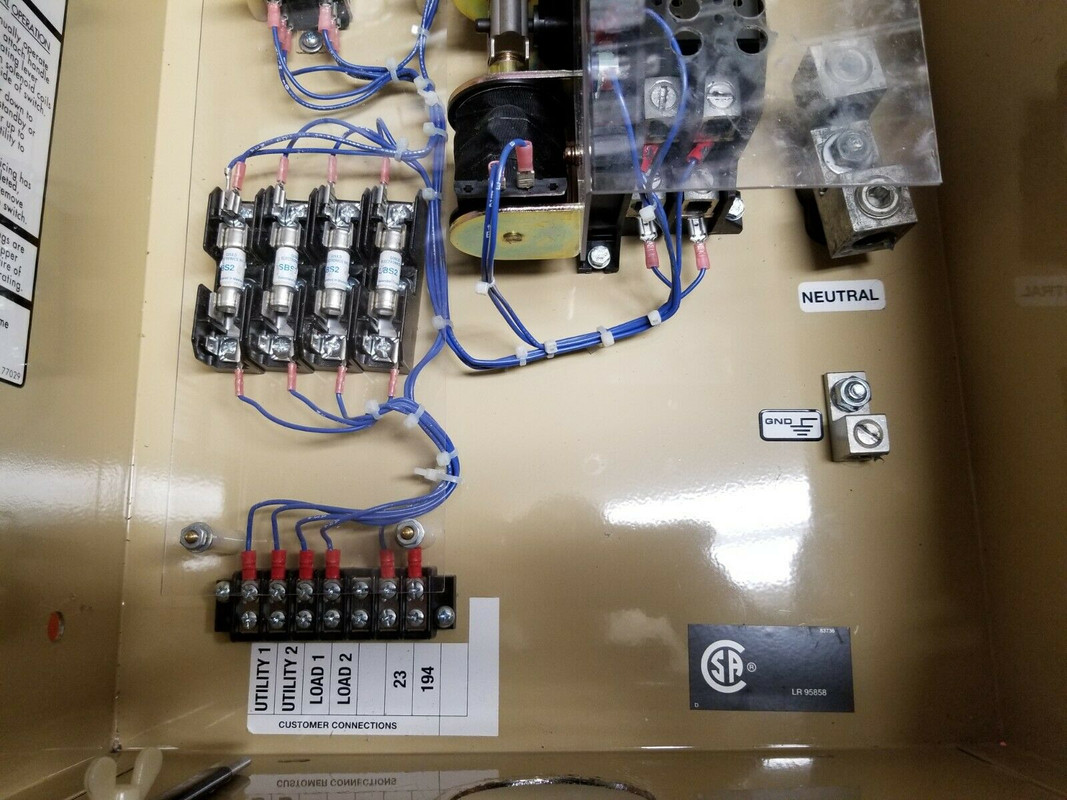
I'm not sure yet where to FIND those wires inside the transfer switch, but
I think the first (and only?) place I need to look is at what the pins of
that "plastic solenoid" do...
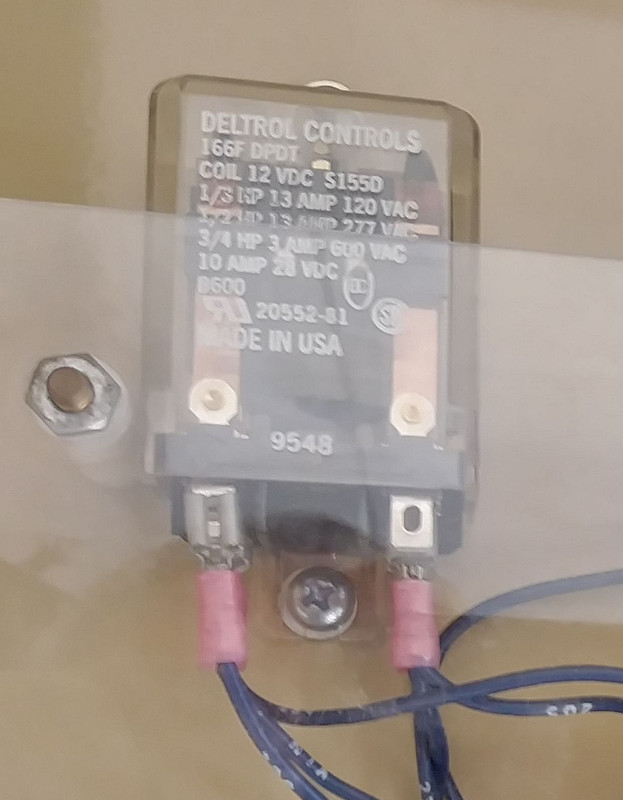
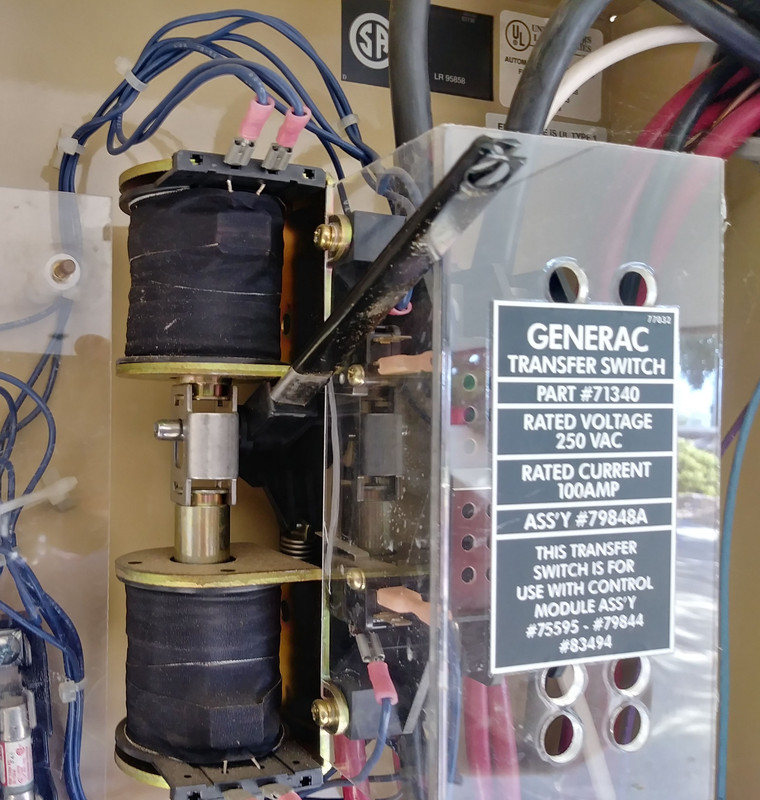
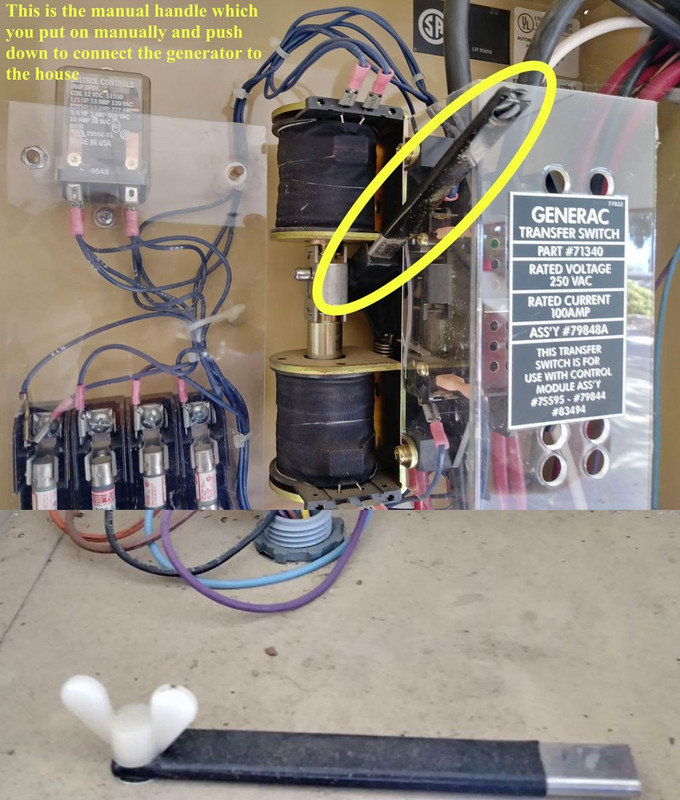
<https://i.postimg.cc/s20K8nkZ/transfer04.jpg>
since that solenoid seems to send the purple and blue wire 12VDC to the
"double-fisted solenoid" to switch power from the mains to the generator.
<https://i.postimg.cc/tgDN6rqM/transfer06.jpg>
 
> that State Electric took one look at the mess and ran away. There
> might be some lower voltage coming from the charger trying to charge a
> dead (shorted) cell.
 
I understand and appreciate this assessment, where there's LOTS I didn't
mention (which is always the case in such things), mainly the fact being I
"think" it was me who pulled those fuses long ago and forgot to put them
back (I think I was testing them but I don't actually recall).
 
Also, you're actually correct that the battery in the generator WAS dead,
since I had disconnected it to charge it, and then I had left it
disconnected where the charge eventually bled off. I actually had to
jumpstart the generator when the power last went out, but I have since
charged the battery (I'm gonna put quick connect clamps on the battery at
some point, which will help in the charging process since I have multiple
spare batteries I swap in and out of that generator).
 
> 2. Every controller I've seen has a self-test and/or test-run
> feature. You should be able to test the transfer switch with the
> test-run button instead of reworking the wiring.
 
This is good to know, for two reasons:
1. This is dangerous stuff so having safe tests is required, and,
2. Most of what I read suggested testing MONTHLY (which is crazy frequent)
 
> feeding the transfer switch should go to a double breaker on the main
> panel. Flip it open, check that there is now no AC on the contacts or
> anywhere in the rats nest of wires, and then troubleshoot.
 
Thanks for that advice, Jeff, as I'm well aware of the power, but I'm not
sure yet how to test a transfer switch. It does seem prudent to test the
transfer switch ISOLATED from BOTH the mains and the generator.
 
Preventing the generator from turning on should be easy as it has a power
switch and it requires the battery so it's easy to prevent it from turning
on.
 
I'm not totally sure simply turning OFF the mains will isolate the transfer
switch - but that's simply because I'm currently ignorant of the wiring
diagram (which is one reason you said to do that first).
 
If the power goes from the power pole to the utility meter to the main 200
Amp breaker switch, and THEN to the transfer switch, then doing all tests
with the main 200Amp circuit breaker off is prudent. (Obviously I'd
doublecheck with the Fluke DMM.)
 
> 2. Draw as schematic diagram and label everything. If this were my
> headache, that's the first thing I would do.
 
Yup. I agree. I had wanted from this question on Usenet to first get a
general idea of how these transfer switches work - which - I think I kind
of now have - but the exact wiring of every connection is still needed
before I can effectively troubleshoot.
 
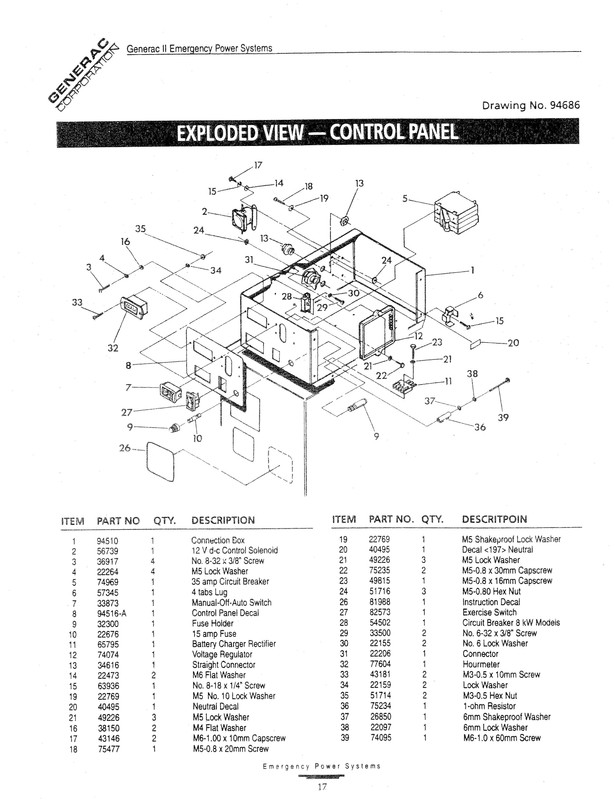
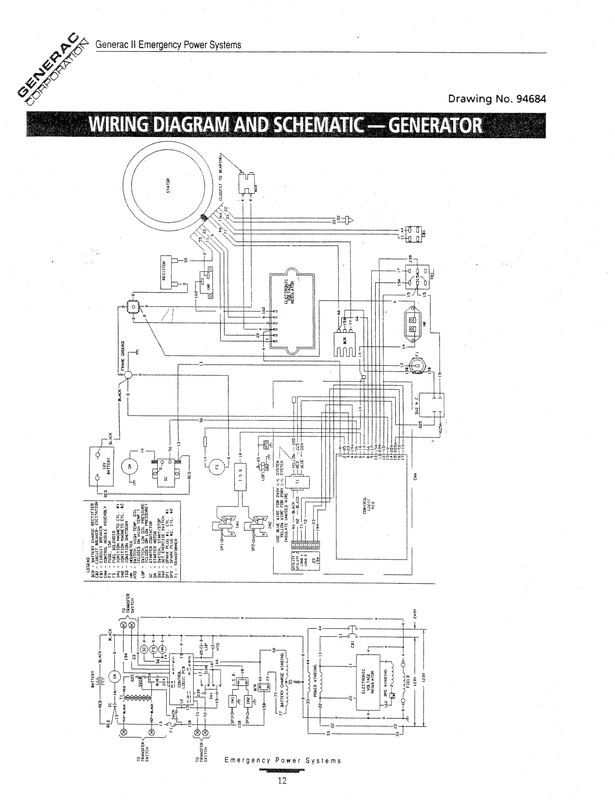
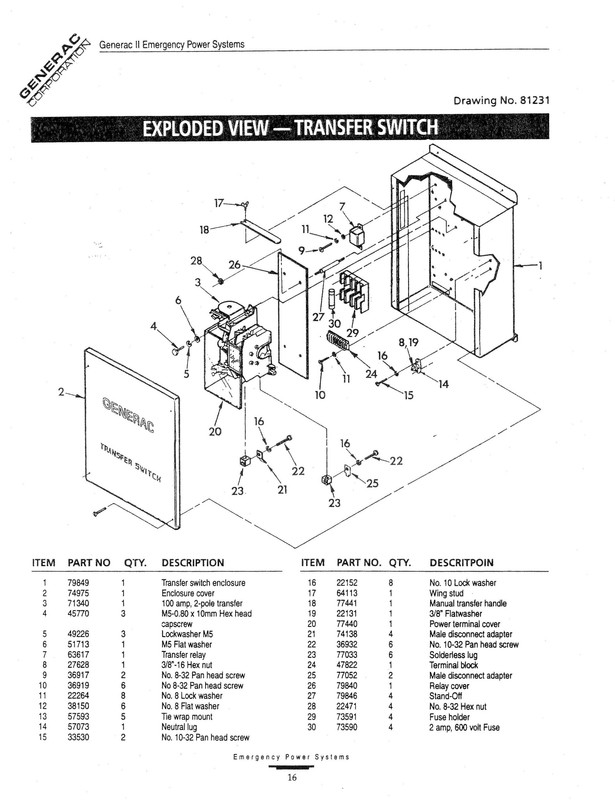
Generac sent me the owners manual for my 09067-9 generator, which contains
exploded diagrams, for example, here's the exploded diagram of the 09067-9
Generator Control Panel:
<https://i.postimg.cc/qq326cBh/Generac-Control-Panel-9067-9-16345-Page-19.jpg>
And the wiring diagram for the 09067-9 generator itself:
<https://i.postimg.cc/wMg9DggX/Generac-Generator-Wiriing-Diagram-9067-9-16345-Page-14.jpg>
 
And here's the exploded view for the 79848A transfer switch:
<https://i.postimg.cc/Hx4VqSLt/Generac-Transfer-Switch-Exploded-Diagram-9067-9-16345-Page-18.jpg>
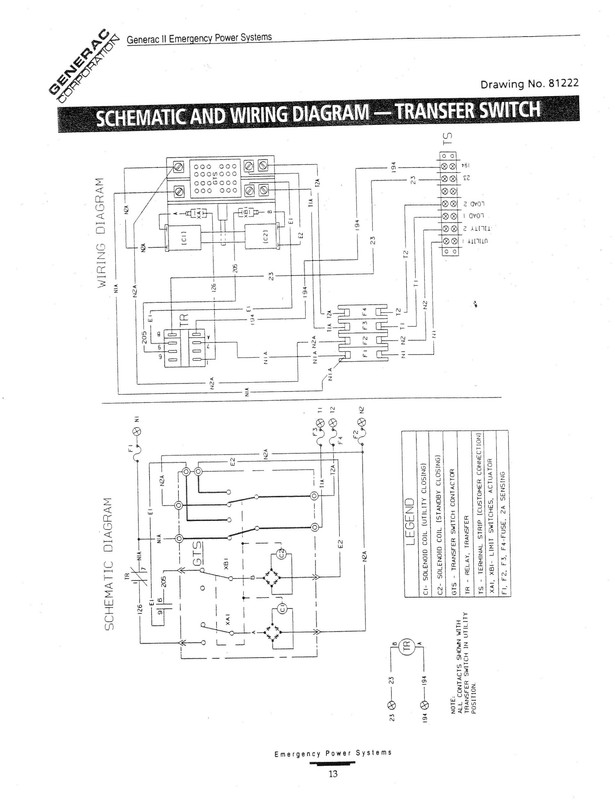
And the wiring diagram for the 79848A transfer switch:
<https://i.postimg.cc/1XFTVs7N/Generac-Transfer-Switch-Wiring-Diagram-9067-9-16345-Page-15.jpg>
 
> 3. If you know a local electrician, who won't turn you in to the
> county, have him look at the wiring and make some recommendations.
 
Once, I called a well pump guy, and told him I had a problem, which he
fixed, but I told him before he came out to charge me based on the fact I
would be standing there right next to him as he debugged, asking him
questions while he did the work in front of me.
 
It was then that I noticed he simply replaced entire circuit boards, simply
by the process of pulling them out, putting the new one in, and finding
that it worked, so he was about to take the old circuit board "home" with
him, where I said if I'm paying for the new one, I want the old one (I
still have it). Some day I'll figure out specifically what's "wrong" with
it. :)
 
A similar thing happened with the heater repairman, who simply replaced the
main circuit board, but he insisted that there was a core charge which _he_
wanted back - and that he's have to charge me for that - so he got the core
charge, not me.
 
I learned from that that these guys replace the entire board rather than
figure out what's wrong ON the board.
 
Given that replacing things seems to be what the repair techs do also, in
this case, I think I have three options, two of which are what many people
use, while the third option is the approach I'm currently trying:
1. Replace everything, one by one, until the damn thing works
2. Pay State Electric or Spiess Electric to fix it (in my presence)
3. Debug the damn thing (after first figuring out how it works)
 
Personally, I like to debug first, where simply UNDERSTANDING how the
circuit works usually causes the offending part to SCREAM OUT that it's
broken.
 
To that end, I'll follow your advice and start marking up the panel with a
label of the purpose of each of the myriad connections.
"Arlen G. Holder" <arlingholder@nospam.net>: Jul 18 06:46PM

> saying but long term I would get the one they spec. You could go to an
> electrical supply or order them online. Home Depot is only going to
> have the most popular sizes and ratings.
 
Thanks for that helpful advice where I gave up trying to source at a local
hardware store since I had tried three local box stores, none of which sold
the Buss BBS-4 or BBS-5 600V fuses
o Ace, Home Depot, Lowes
 
I called Generac today, where I was surprised to find that they don't have
an "opening" time - their customer support is open 24/7/365, which is
surprising in this day and age, don't you think?
o 888-GENERAC (888-436-3722) extension 4, extension 2 (or 262-544-4811)
 
They confirmed there is no separate manual for the 79848A transfer panels;
the transfer panels are covered in the 32-page owners manual (PN 98374) for
the Generac 09067-9 8KW propane generator itself (where the manual is
mostly about the generator but it does have a few pages about the transfer
switch).
 
There IS a parts diagram though, which gave me the Generac part numbers
o PN 63617 Transfer Relay <https://i.postimg.cc/s20K8nkZ/transfer04.jpg>
o PN 73590 BSS-2 Fuse 2A <https://i.postimg.cc/DwTNdMhv/transfer05.jpg>
o PN 71340 100Amp 2pole Relay <https://i.postimg.cc/TYq0GY8x/transfer03.jpg>
etc.
 
Generac told me the cheapest place to get the parts is usually
o <https://www.jackssmallengines.com/>
But they also said there is a good Generac parts lookup engine at
o <https://www.ordertree.com/>
 
Where I ran a quick price survey of the three parts above for reference:
o PN 63617 Transfer Relay $18 at Jacks, $25 at Tree
o PN 73590 BSS-2 Fuse 2A $6 at Jacks, $9 at Tree
o PN 71340 100Amp 2pole Relay $243 at Jacks, $287 at Tree
etc.
 
The nice thing about Usenet is that I like to give back to the team, as
you're aware (where I respond to all that are helpful at the same time I
try to ignore the worthless trolls) - where these two outfits "seem" to be
generally useful to source manufacturure parts for MORE than just Generac.
o <https://www.jackssmallengines.com/>
o <https://www.ordertree.com/>
 
Do folks here know of other outfits useful for sourcing common brand name
part numbers for these types of electrical parts (pumps, motors, openers,
etc.)?
Jeff Liebermann <jeffl@cruzio.com>: Jul 18 06:36PM -0700

On Thu, 18 Jul 2019 18:45:43 -0000 (UTC), "Arlen G. Holder"
><https://i.postimg.cc/qq326cBh/Generac-Control-Panel-9067-9-16345-Page-19.jpg>
>And the wiring diagram for the 09067-9 generator itself:
><https://i.postimg.cc/wMg9DggX/Generac-Generator-Wiriing-Diagram-9067-9-16345-Page-14.jpg>
 
The wiring diagram of the generator shows the (missing) controller,
with all the connections to the automatic transfer switch. Pg12 of
the manual, lower schematic, shows wires 23 and 194 going to the
transfer switch. Since the other end of these wires goes only to the
solenoid (relay) coil, I would presume that these should have 0V
across them when the transfer switch is on utility power, and 12VDC(?)
when it on generator power. Put an LED and resistor across both
solenoid coil terminals so you can see what's happening without
fumbling with a volts guesser.
 
Unfortunately, there's no schematic for the controller logic board
which runs the show. Near the controller logic board is SW1, which is
the "start/stop" switch. That should NOT activate the relay on the
transfer switch. This is the generator test switch which I previously
indicated was on all such autostart generators.
 
SW2 is labeled "Set Exercise Switch" which is something like a "test"
switch but also is not intended to test the transfer switch. There
should be something in the manual on how to use this switch. Here's a
video that might offer a clue on what I think is a similar generator:
"How To Set Exercise Time on Generac Air Cooled Generator Pre Nexus
Controller APSwrap"
<https://www.youtube.com/watch?v=Go0qt4n0dhs>
There's quite a bit on how a proper test switch should operate:
<https://www.google.com/search?q=automatic+transfer+switch+test>
 
This is a typical generator test which demonstrates proper operation:
"Home Generator Transfer Test"
<https://www.youtube.com/watch?v=im1a-fST3cE>
 
Also on the schematic is the fuse F1 (15A), which appears to protect
the controller 12VDC battery line. Check this fuse if you have a good
12VDC battery, but no controller function. If this 15A fuse is
actually blown, you potentially have a high current short somewhere in
the generator on the 12VDC line. Be careful tracking this one down.
 
><https://i.postimg.cc/Hx4VqSLt/Generac-Transfer-Switch-Exploded-Diagram-9067-9-16345-Page-18.jpg>
>And the wiring diagram for the 79848A transfer switch:
><https://i.postimg.cc/1XFTVs7N/Generac-Transfer-Switch-Wiring-Diagram-9067-9-16345-Page-15.jpg>
 
Remember, you have but one life to give for your backup power system.
 
 
--
Jeff Liebermann jeffl@cruzio.com
150 Felker St #D http://www.LearnByDestroying.com
Santa Cruz CA 95060 http://802.11junk.com
Skype: JeffLiebermann AE6KS 831-336-2558
"Ron D." <ron.dozier@gmail.com>: Jul 19 09:32AM -0700

1. Note that it's a "Transfer Switch" and not an "Automatic Transfer Switch"
 
A Transfer switch is noting but a "BIG Relay" which is designed so mains and utility power CANNOT be connected at once if a part failed.
 
Emergency panel
 
If the generator is too small for the house, then you put the loads that need power in an emergency on a single panel. (e.g. refrigerator, sump pump etc)
 
The "automatic" part might do a number of things such as:
1. monthly/weekly test
2. monitor oil level
3. Exercise generator or generator and transfer.
4. make sure utility power is stable before taking generator offline.
5. Implement cool down phase.
6. The generator exercise period may top off the battery.
7. Monitor voltage/frequency
8. manage starting
 
So, voltage and frequency out of range will prevent transfer.
Oil level will prevent generator from starting automatically.
 
You may have two sub-panels and a pool. The pool does not get generator backup.
Looks like your missing stuff like fuses. You may just have a 12 V signal that tells it to transfer. It may or may not need power to keep it in one position.
I did not look at the details.
Stu jaxon <stankowalski02@gmail.com>: Jul 19 06:06AM -0700

On Thursday, July 18, 2019 at 7:14:06 AM UTC-4, John-Del wrote:
 
> with tv on, no 12v on either side of fb, with lvds disconnected, i got zero ohms, so it's a bad tcon board, that's shorted.. ?
 
> With the LVDS harness disconnected, run the TV one more time and make sure you have 12V on the harness. Most of the time, a shorted TCON will cause the 12V supply that feeds it to shut down, but there's a chance the 12V source could have been damaged as well. If there's no 12V, check the main for an open surface mount fuse (these are generally white on Vizios with a letter on them).
 
> If you get 12V on the disconnected LVDS connector, then just a TCON should get you going. If you have the time, you can check for shorted chip caps. These are brown, about the size of that ferrite bead, and have no markings. One way is to feed a current regulated supply set to 2 amps right at that ferrite bead to force feed the TCON to see what gets hot. A frost covering from a can of freeze spray will often give you a visual of what's drawing the current (whatever thaws first).
 
if your talking about the harness connector cn702, I get 11.97v on green wire, 11.98 v on the yellow wire. nothing on the red and orange wires. 5v on brown wire. and just for your info I got a little anxious and ordered the tcon board arrive yesterday, got nothing no pic... the main board is recently purchased also from ebay .. I think i got both from electroparts..
John-Del <ohger1s@gmail.com>: Jul 19 07:18AM -0700

On Friday, July 19, 2019 at 9:06:08 AM UTC-4, Stu jaxon wrote:
 
> > With the LVDS harness disconnected, run the TV one more time and make sure you have 12V on the harness. Most of the time, a shorted TCON will cause the 12V supply that feeds it to shut down, but there's a chance the 12V source could have been damaged as well. If there's no 12V, check the main for an open surface mount fuse (these are generally white on Vizios with a letter on them).
 
> > If you get 12V on the disconnected LVDS connector, then just a TCON should get you going. If you have the time, you can check for shorted chip caps. These are brown, about the size of that ferrite bead, and have no markings. One way is to feed a current regulated supply set to 2 amps right at that ferrite bead to force feed the TCON to see what gets hot. A frost covering from a can of freeze spray will often give you a visual of what's drawing the current (whatever thaws first).
 
> if your talking about the harness connector cn702, I get 11.97v on green wire, 11.98 v on the yellow wire. nothing on the red and orange wires. 5v on brown wire. and just for your info I got a little anxious and ordered the tcon board arrive yesterday, got nothing no pic... the main board is recently purchased also from ebay .. I think i got both from electroparts..
 
 
Did you try your original main board back in with the new TCON? You may have added a problem where none existed before.
 
There are two 12V inputs going to that TCON/FRC board. The CN702 four wire connector (which will have 12V , 5V, and ground) and the larger LVDS harness CN4404 where the ferrite bead smd component is.
 
So on CN 702, you have the 12V and 5V, so that's OK.
 
On the ferrite bead near the LVDS, you should have 12v as well. I don't know if they're sourced from the same 12V supply or not, but you should have 12V on that ferrite bead. Your earlier post said you did not have 12V on that ferrite bead and were reading a short to ground. Is this correct? If you unplug the LVDS harness, the short on the ferrite bead to the TCON ground will either go away or remain. If it goes away, the problem is on the main. If it stays, the short is on the TCON.
 
Be aware that fair percentage of boards bought on-line are defective regardless of where they're purchased. There are no new parts available for these, so any part you buy is from a recycled donor, and none of these mass parts sellers check them. They strip the carcass of it's boards, sell them, and replace or refund the money if they get a complaint. If the donor TV failed with the same defective board you have, you'll have the same issue.
 
This is why we go through several tests before estimating the job for the customer, and why we repair about 95 percent of the boards we see.
 
There are several guys in our association that sell parts on ebay, but these guys are technicians who will only sell verified boards.
 
The good news is that Electroparts is a good company and they'll replace or refund without question.
Richard Edwards <ejb@fastmail.fm>: Jul 18 05:55PM -0700

On Saturday, July 13, 2019 at 8:53:53 PM UTC+10, Richard Edwards wrote:
 
> if anyone can help me out or point me in the right direction that would be greatly appreciated.
 
> Regards
 
> Richard
 
Thanks to everyone for the responses and offers. I think I have enough to go on. Will update once/if i resolve...
Pat <forums@greensdomain.com>: Jul 18 06:11PM -0400

On Thu, 18 Jul 2019 09:49:23 -0400, "Percival P. Cassidy"
>nothing at all: it does not struggle to cut but simply does nothing; it
>appears to be totally dead.
 
>Perce
 
To the OP: "Slowing down" vs "working one second and totally off the
next" is a function of battery chemistry (and how the electronics
handle state of charge). I've used Craftsmen and Ryobi tools for a
long time. The older NiMH amd NiCd batteries would slow down but
still be usable for that one last cut. However, the Li-ion batteries
are designed to protect themselves from being overly discharged. If
the voltage gets too low, the battery is disabled until it is
recharged. As others have stated, yours sounds like it needs to be
replaced.
 
Pat
You received this digest because you're subscribed to updates for this group. You can change your settings on the group membership page.
To unsubscribe from this group and stop receiving emails from it send an email to sci.electronics.repair+unsubscribe@googlegroups.com.

Digest for sci.electronics.repair@googlegroups.com - 22 updates in 6 topics

"Arlen G. Holder" <arlingholder@nospam.net>: Jul 18 04:22AM

On Wed, 17 Jul 2019 23:34:03 -0400, Clare Snyder wrote:
 
> The transfer switch needs to be sized fir the total LINE capacity, not
> just the genset
 
Thanks Clare. That makes sense then as to why the puny generator is only 67
Amps, but since the Mains is 200 Amps, it needs two transfer switches of
nominally 100 Amps each.
 
> mal-adjusted. If the genset voltage does not reach a specified value
> it will NOT switch over. That voltage may be adjustable or the sensor
> may be shot,
 
Thanks for that analysis, which I can't argue with.
 
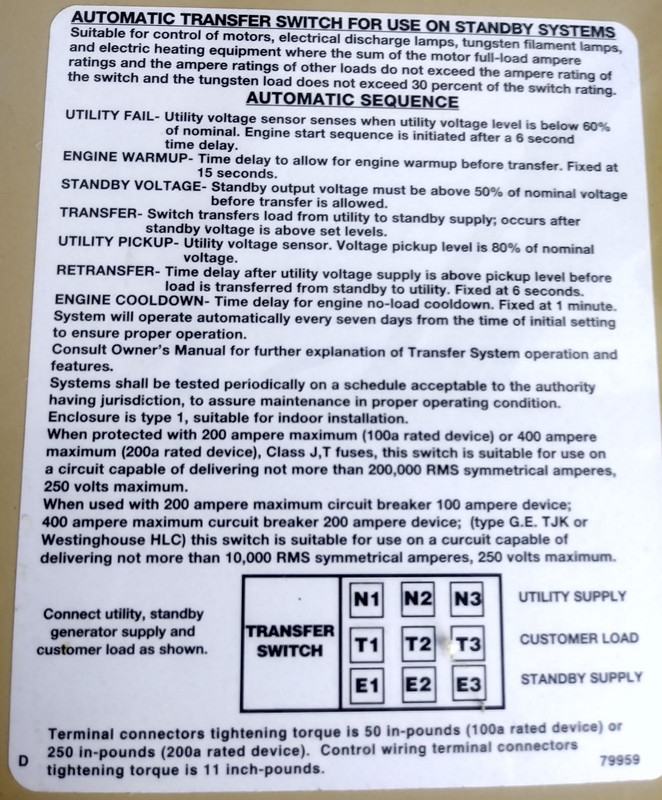
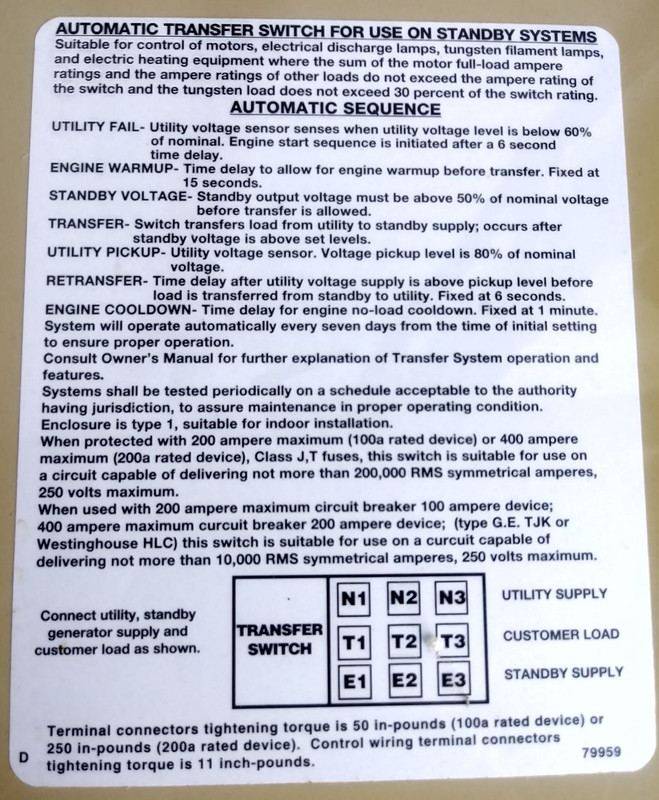
Some of these voltages appear to be hard coded, based on this sticker
<https://i.postimg.cc/Jn85TgZg/transfer11.jpg>
 
> Was a blown chip onthe board that was no longer available for
> replacementby Flight Systems - the only facility in North America that
> services the board which has been obsolete since 2015
 
I'll start looking up where to source spare parts, after calling Generac
tomorrow (1-800-GENERAC) to see if they still sell parts for this 79848A.
 
One problem I realized is that I lost 2 of the Buss fuses, which "may" be
why both transfer switches aren't turning on when the power goes out and
the generator turns on.
 
Funny thing is that advertisement for a similar transfer switch seems to
have the "green" Buss 600Volt fuses spec'd at 2 Amp based on this picture
of the Buss SBS-2 (green color code) for sale
<https://www.picclickimg.com/00/s/MTIwMFgxNjAw/z/LgUAAOSw64NckUJ-/$/Generac-Transfer-Switch-100-Amp-250-VAC-One-_57.jpg>
<https://i.postimg.cc/1X200QR3/transfer21.jpg>
 
Notice those are "SBS-2" green 600Volt fuses (not BBS!).
 
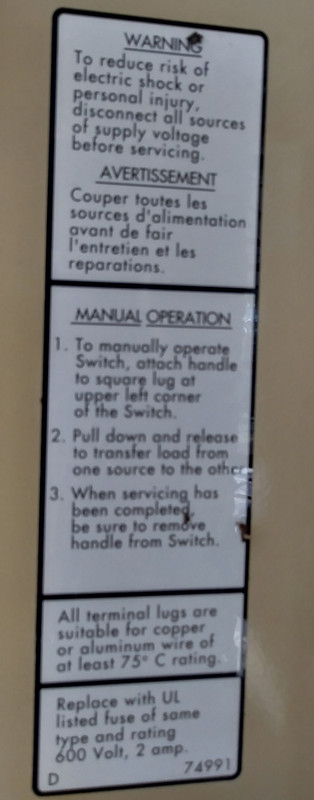
The sticker on the side panel of that transfer switch for sale, and on my
side panel both say the same thing, which "implies" 2 amp fuses at 600VAC.
<https://i.postimg.cc/KzWDDzcG/transfer09.jpg>
 
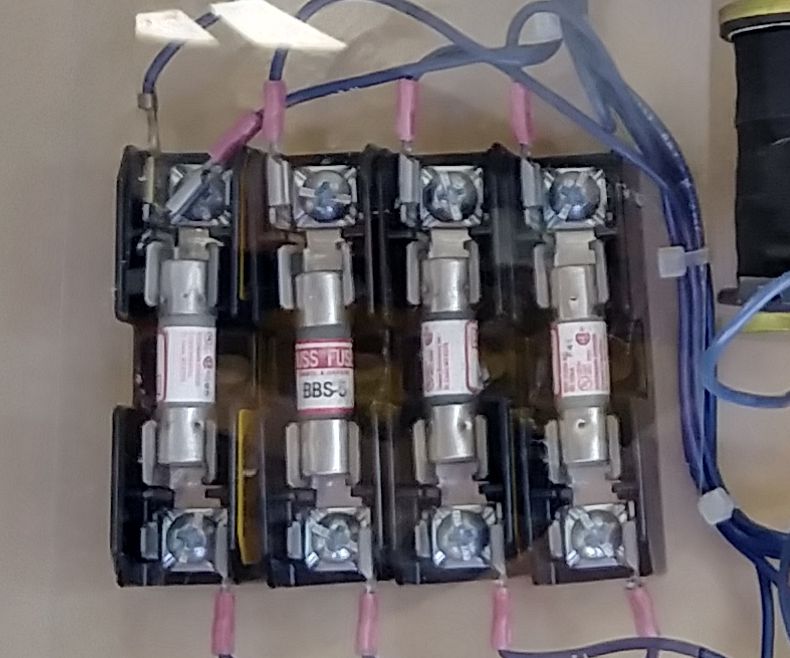
My fuses appear to be red (not green), and they appear to be
o BBS-4 (not SBS)
o BBS-5 (not SBS)
 
So what's odd is that mine are higher amperage, but also a different three
letter code (mine are BBS while the one for sale is SBS).
 
I tried to get these fuses at Home Depot, Lowes, and Ace today, but none of
them stock these fuse sizes in the 600 VAC rating.
<https://i.postimg.cc/DwTNdMhv/transfer05.jpg>
 
I realized I'm _missing_ two fuses, where, I don't recall, but maybe I
removed them to test them and never put them back? It would have been a
long time ago (a year or two) so the _first_ thing I'm gonna do is source
those Buss fuses after figuring out why some are 4amp and some are 5amp.
 
I'm not sure _why_ some are the red 4 amp and some are 5 amp though (while
the originals seem to be green 2 amp).
 
Googling, SBS does NOT stand for "slow blow" but for fast-acting!
<https://www.ferrazfuses.com/cms_admin/fckeditor/editor/filemanager/connectors/php/bin/Midget%20Gen%20Pur%20SBS.pdf>
Jeff Liebermann <jeffl@cruzio.com>: Jul 17 09:25PM -0700

On Thu, 18 Jul 2019 03:22:39 -0000 (UTC), "Arlen G. Holder"
>label on the outside panel, which I found buried under stuff.
 
>This DEFINITELY WORKED so it's NOT miswired. The only problem is that the
>solenoids are not automatically kicking on.
 
Let me guess... State Electric Generators formerly in Harvey West
Park? They moved to Scotts Valley:
<https://www.stategen.com>
High prices and so-so work. You could do worse. State does much
better work than what I saw in your photos which suggests that they
were fixing something.
 
>If I switch the SECOND one also, then I get the full house.
 
>So my main problem is troubleshooting why the double-fisted solenoid is not
>automatically turning on.
 
Try this video. Notice that the relays switch based on the condition
of one input wire labeled "transfer".
"Generac automatic transfer switch explained, demo"
<https://www.youtube.com/watch?v=rT_3JYZS9Mg>
The "transfer" line on the terminal strip comes from the electronics
that detects that the utility power has dropped and that the generator
has produced stable power for XX number of seconds. When it gets both
of those, it grounds the "transfer" wire, which closes the relay, etc.
In other words, your problem is not in the relay box, but rather in
whatever you're using for electronics to detect utility and generator
power (and timers). In the above video, it's the black box with all
the terminals and colorful labels. I don't see such a box full of
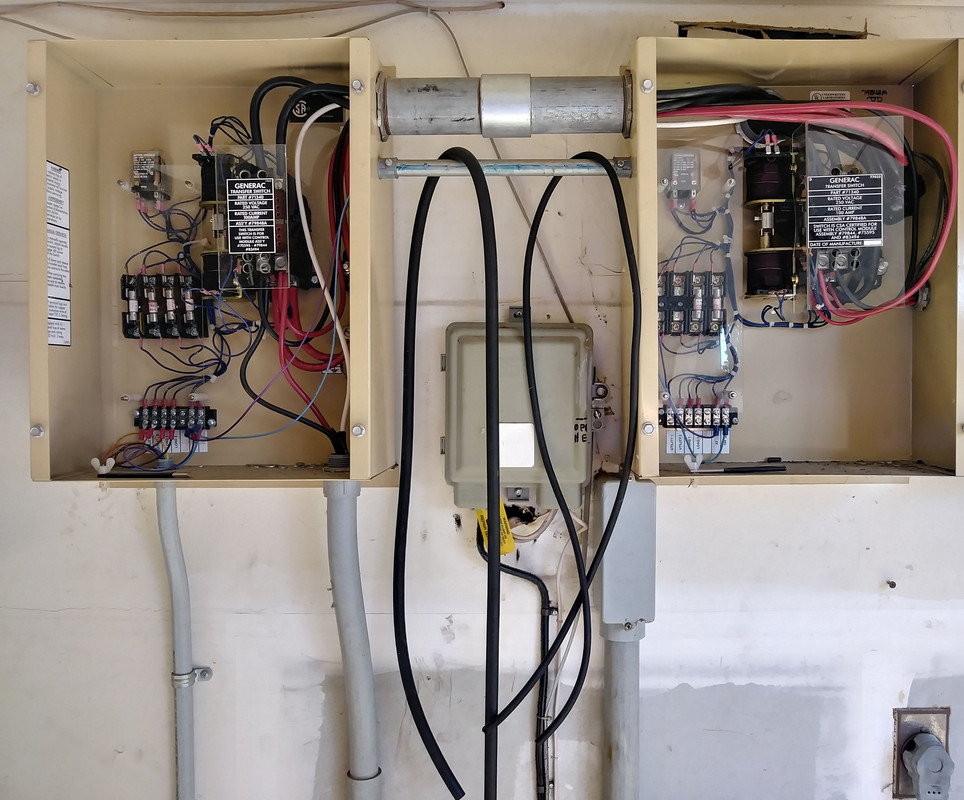
electronics in your photo:
<https://i.postimg.cc/c49KfVwY/transfer01.jpg>
Find the "transfer" terminal, disconnect whatever is connected to it,
ground it, and see if it acts like the relay in the video.
 
Incidentally, 200A service should use 2/0 copper (or 4/0 Aluminum or
CCA) minimum. In some counties, it's 3/0 copper minimum. That
doesn't look like 2/0 in the photo. More like #4. Color me very
suspicious.


--
Jeff Liebermann jeffl@cruzio.com
150 Felker St #D http://www.LearnByDestroying.com
Santa Cruz CA 95060 http://802.11junk.com
Skype: JeffLiebermann AE6KS 831-336-2558
"Arlen G. Holder" <arlingholder@nospam.net>: Jul 18 05:01AM

On Wed, 17 Jul 2019 21:25:30 -0700, Jeff Liebermann wrote:
 
> High prices and so-so work. You could do worse. State does much
> better work than what I saw in your photos which suggests that they
> were fixing something.
 
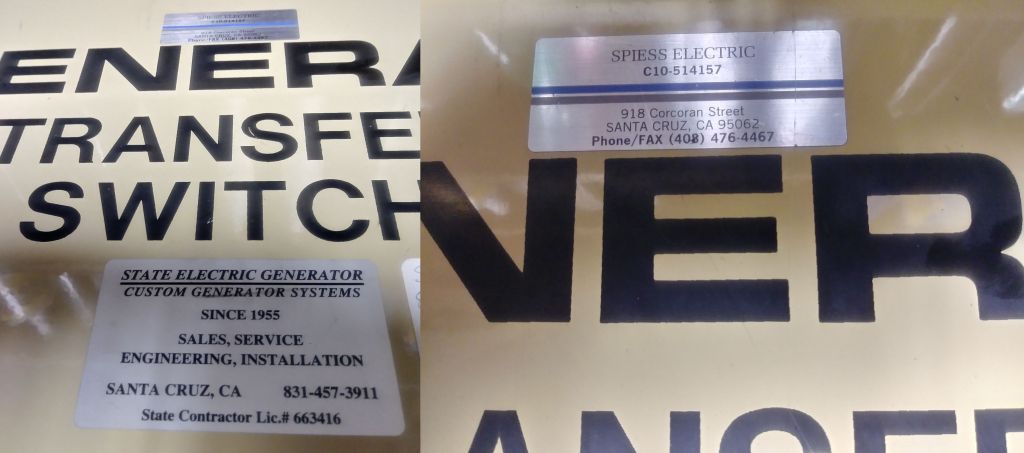
You are pretty good Jeff, as these are the two stickers on the cover
<https://i.postimg.cc/GmMxjVLY/transfer27.jpg>
 
I generally obfuscate where I live, but suffice to say I can probably see
your house from where I am, or close to it. :)
 
> of one input wire labeled "transfer".
> "Generac automatic transfer switch explained, demo"
> <https://www.youtube.com/watch?v=rT_3JYZS9Mg>
 
I'm glad the narrator said he couldn't find out how it worked online, which
is exactly the type of answer I'm asking about here.
 
At 34 seconds he explained what that cryptic "194" meant!
<https://youtu.be/rT_3JYZS9Mg?t=34>
And he explained what that cryptic "23" meant on my panel!
<https://i.postimg.cc/tgDN6rqM/transfer06.jpg>
Where:
o 23 === ground
o 194 === +12VDC
So I can now test the two-fisted solenoid by putting 12 VDC across them,
which is what the generator should do, which will "transfer" the power from
line power to generator power. (This is what I've been doing manually with
the mechanical lever.)
<https://i.postimg.cc/HxWxgCnd/transfer28.jpg>
 
The narrator then showed that when the PG&E power is restored, the
generator will _remove_ that 12VDC, which flips the two-fisted solenoid
back to "line" power.
 
The one bit of confusion is that he said at 90 seconds that each solenoid
is controlling 240 volts, but I think it might only be controlling 120
volts (but I'm not sure if it's controlling 120V or 220V yet).
<https://youtu.be/rT_3JYZS9Mg?t=90>
 
He then explained the transfer is controlled from the "plastic relay".
<https://i.postimg.cc/s20K8nkZ/transfer04.jpg>
 
> the terminals and colorful labels. I don't see such a box full of
> electronics in your photo:
> <https://i.postimg.cc/c49KfVwY/transfer01.jpg>
 
I agree his box is different than mine, where mine is just like this one:
<https://picclick.com/Generac-Transfer-Switch-100-Amp-250-VAC-One-153421838181.html>
 
Mine and that one for sale are "simpler" looking than his is.
 
> Find the "transfer" terminal, disconnect whatever is connected to it,
> ground it, and see if it acts like the relay in the video.
 
I think it should be easy to put 12VDC onto pins 23 & 194, but I need to
get a bunch of those BBS-4 and BBS-5 fuses first.
 
So my current plan is:
a. Source the two missing BBS-4 (or?) BBS-5 fuses.
b. Then test with 12VDC to see if the double-fisted solenoid operates
 
If that makes it work, then my problem is likely the "sensing" circuitry,
where this sticker explains all that sensing circuitry is hard coded, I
think: <https://i.postimg.cc/Pr7zGN11/transfer12.jpg>
 
> CCA) minimum. In some counties, it's 3/0 copper minimum. That
> doesn't look like 2/0 in the photo. More like #4. Color me very
> suspicious.
 
You have a good eye, where all I can say is that I didn't wire it.
I did INCORRECTLY say it was 300 Amp mains service, where, when I shined a
light on it and put chalk on the mains breaker, it turns out to be 200Amp
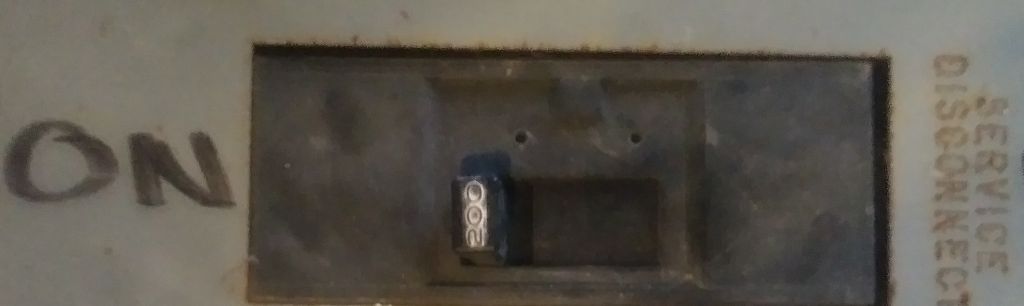
service. <https://i.postimg.cc/g2VRj758/transfer25.jpg>
 
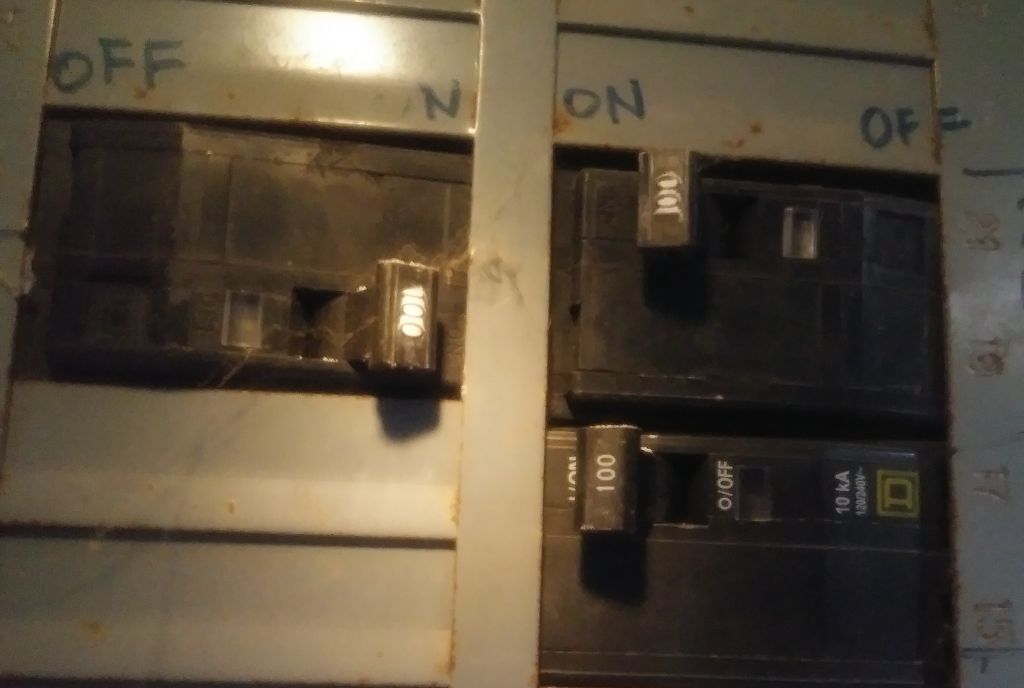
What's odd is that there are _three_ 100 Amp sub panels!
<https://i.postimg.cc/NFX84jNP/transfer26.jpg>
 
Which seems kind of strange, but I didn't wire anything and all the permits
that were pulled were closed, so, it must make sense (code wise).
 
Two of those 100 Amp panels are in the house, and one is at the pool.
 
I need to call Generac (800-GENERAC) where I'm confused about the fuses
o Why BBS-4 _and_ BBS-5 fuses?
<https://i.postimg.cc/DwTNdMhv/transfer05.jpg>
 
Once I source those hard-to-get fuses, I will test the 12VDC at cryptic
pins 23 & 194.
<https://i.postimg.cc/tgDN6rqM/transfer06.jpg>
 
If the double-fisted solenoid does not trigger...
<https://i.postimg.cc/TYq0GY8x/transfer03.jpg>
 
then we know that the sensing circuit isn't working to put 12VDC across
those two pins. <https://i.postimg.cc/s20K8nkZ/transfer04.jpg>
 
Thanks for that wonderful video.
 
I'm a bit leery of what I can test with the MAINS connected though, since
the power is currently running fine ... so I will need to be careful since
it's only once a month that the PG&E power goes out for me to run the full
test.
"Arlen G. Holder" <arlingholder@nospam.net>: Jul 18 05:45AM

On Thu, 18 Jul 2019 05:01:27 -0000 (UTC), Arlen G. Holder wrote:
 
> I agree his box is different than mine, where mine is just like this one:
> <https://picclick.com/Generac-Transfer-Switch-100-Amp-250-VAC-One-153421838181.html>
 
This is closer, but not exactly either, I think:
<https://www.generator-parts.com/manuals/home-standby/078590.pdf>
 
Apparently, they recommend testing the transfer switch _monthly_
<https://www.ecmweb.com/contractor/test-transfer-switch>
 
This has a transfer switch testing sequence
<https://testguy.net/content/227-Transfer-Switch-Testing-and-Maintenance-Guide>
 
I found a paper copy of the 32-page owners manual, part number 98374 which
is titled "Generac II Emergency Power Systems Owner's Manual" (revision 0,
dated 11/22/1995) and which contains a generic parts list and exploded
diagram for both the generator and transfer switch (apparently they come as
a matched set).
 
The four fuses in the exploded diagram just say 2 Amps 600Volts, but I
wonder if mine are double that because there are two transfer switches
(where on the net, the video Jeff provided _also_ used red 4 amp fuses!).
<https://youtu.be/rT_3JYZS9Mg?t=123>
 
I found that two outfits will sell generac parts to the public online:
<https://www.jackssmallengines.com/>
<https://www.ordertree.com/>
 
I'll call Generac tomorrow to get more details.
888-GENERAC (888-436-3722) extension 4, extension 2
1-262-544-4811
Micky-Bob <micky-bob@internet.net>: Jul 18 06:03AM -0400

On 7/17/19 10:37 PM, Fox's Mercantile wrote:
> This is just another one of your long rambling posts that
> goes on and on so you can listen to yourself.
 
> Kindly go fuck yourself.
 
+1
"pfjw@aol.com" <peterwieck33@gmail.com>: Jul 18 04:22AM -0700

Don't Feed The @#$%^&*()_)(*&^%$ Troll!
"jew pedophile Ron Jacobson (jew pedophile Baruch 'Barry' Shein's jew aliash)!" <rj@TheWor1d.com>: Jul 18 05:29AM -0700

On Wed, 17 Jul 2019 16:28:13 -0700, "fake vet Afro-Eyetalian Scatboi
 
>> Got a schematic of how you wired it? If not, trace the wires and make
>> one.
 
>Liebermann? Is that jewish?
 
What if it is some jew asshole? Are you 'anti-semitic'®™ or
something???
"pfjw@aol.com" <peterwieck33@gmail.com>: Jul 18 05:36AM -0700

See what trolls drag in their wake?
Jeff Liebermann <jeffl@cruzio.com>: Jul 18 08:11AM -0700

On Thu, 18 Jul 2019 05:01:27 -0000 (UTC), "Arlen G. Holder"
 
>If that makes it work, then my problem is likely the "sensing" circuitry,
>where this sticker explains all that sensing circuitry is hard coded, I
>think: <https://i.postimg.cc/Pr7zGN11/transfer12.jpg>
 
Methinks your first problem is finding the box that controls the
automagic transfer switch (which contains the sensing, timing, and
switching logic). Something like this:
"Automatic Transfer Switch Controller Tutorial"
<https://www.youtube.com/watch?v=NeqhhcRAwTM>
It's probably inside the generator enclosure. Just look for another
rats nest of wires. The thresholds, timing, interlock, etc settings
are usually adjustable.
 
I have two guesses:
 
1. The +12VDC that runs the relay is probably missing because the
starter battery in the generator is dead, or the fuse that protects it
is blown. That might explain the missing fuses. It might also be
that State Electric took one look at the mess and ran away. There
might be some lower voltage coming from the charger trying to charge a
dead (shorted) cell.
 
2. Every controller I've seen has a self-test and/or test-run
feature. You should be able to test the transfer switch with the
test-run button instead of reworking the wiring.
 
Also, I have some suggestions:
 
1. Don't play with the transfer switch with the utility AC power
applied. The life you save may be your own. The undersized wires
feeding the transfer switch should go to a double breaker on the main
panel. Flip it open, check that there is now no AC on the contacts or
anywhere in the rats nest of wires, and then troubleshoot.
 
2. Draw as schematic diagram and label everything. If this were my
headache, that's the first thing I would do.
 
3. If you know a local electrician, who won't turn you in to the
county, have him look at the wiring and make some recommendations.
 
--
Jeff Liebermann jeffl@cruzio.com
150 Felker St #D http://www.LearnByDestroying.com
Santa Cruz CA 95060 http://802.11junk.com
Skype: JeffLiebermann AE6KS 831-336-2558
"pfjw@aol.com" <peterwieck33@gmail.com>: Jul 18 09:07AM -0700

Jeff:
 
The creature that calls itself Arlen G. Holder is trying hard for a Darwin Award.
 
For its sake, and ours, please let it win!
 
Peter Wieck
Melrose Park, PA
"Colonel Edmund J. Burke" <Your_Colonel@usa.com>: Jul 18 09:08AM -0700

On 7/18/2019 5:29 AM, jew pedophile Ron Jacobson (jew pedophile Baruch 'Barry' Shein's jew aliash)! wrote:
 
>> Liebermann? Is that jewish?
 
> What if it is some jew asshole? Are you 'anti-semitic'®™ or
> something???
 
Only when it comes to you, you self-hating jew cunt!
ehsjr <ehsjr@verizon.net>: Jul 18 01:40AM -0400

On 7/17/2019 4:15 PM, Percival P. Cassidy wrote:
> powering still run at full speed/power? For the short time that it does
> work, it performs well even with a circular saw in thick plywood.
 
> Perce
 
 
Yup. You said 5 paralleled pairs. Think what happens if say four of
those pairs have high internal resistance and one pair is good.
You'll be able to get high current for a short time from the good
pair, which will discharge way more rapidly under load than it
would if all the pairs were good. As it discharges, it can no longer
maintain the high current so the tool slows.
 
Ed
"Percival P. Cassidy" <Nobody@NotMyISP.net>: Jul 18 09:49AM -0400

On 7/18/19 1:40 AM, ehsjr wrote:
 
> pair, which will discharge way more rapidly under load than it
> would if all the pairs were good. As it discharges, it can no longer
> maintain the high current so the tool slows.
 
The tool does not slow with this battery. I make a couple of cuts, and
then a few minutes later when I want to make another cut, there is
nothing at all: it does not struggle to cut but simply does nothing; it
appears to be totally dead.
 
Perce
Fox's Mercantile <jdangus@att.net>: Jul 18 09:04AM -0500

On 7/18/19 8:49 AM, Percival P. Cassidy wrote:
> then a few minutes later when I want to make another cut, there is
> nothing at all: it does not struggle to cut but simply does nothing; it
> appears to be totally dead.
 
It's worn out, not repairable.
Buy a new one, or two.
<https://www.ebay.com/itm/192048790357>
 
 
--
"I am a river to my people."
Jeff-1.0
WA6FWi
http:foxsmercantile.com
"pfjw@aol.com" <peterwieck33@gmail.com>: Jul 18 07:17AM -0700

I am not so sure I would trust my tools with an after-market knock-off of dubious parentage and entirely unknown origin.
 
Peter Wieck
Melrose Park, PA
N_Cook <diverse@tcp.co.uk>: Jul 18 08:06AM +0100


> Now, on a couple of occasions, a local machine in operation stepped all over the locks nearby. One being an open MRI machine, the other being a defective hyfrecator. Both cases were solved with by installing shielded locks (and the hyfrecator was also replaced, of course). Do you have any unusual equipment within about 20' of that lock, especially something that is intermittent in use?
 
> Peter Wieck
> Melrose Park, PA
 
Interesting , I could see electronics connected to metalwork set in a
wooden door, being susceptible to electronic smog, but only the decoding
side of things or all , not just the power side of the delatching.
But over much the same time as this problem, they installed a unit that
uses the LoRaWAN structure , <>850MHZ. It has enough power for city-wide
data capture but limited to a short data-squirt ,probably less than
10KB, every 15 minutes, unlikely to affect this codelock over 30/40
attempts I'd have thought, but it would explain the intermittency. Also
the RF from its external antenna and external generation, has to pass
through an external wall and 1 or 2 internal walls to get to this door.
Whether there is insufficient/lack of choking on the DC supply wiring to
this unit and large amount of RF being propogated over the mains wiring
of the building 4 times an hour , unknown.
 
--
Monthly public talks on science topics, Hampshire , England
<http://diverse.4mg.com/scicaf.htm>
"pfjw@aol.com" <peterwieck33@gmail.com>: Jul 18 04:35AM -0700

All it takes is one component within the lock to be sensitive to the interference - and to be "stunned" for some period after the initial hit to explain your 30/40 attempts.
 
Otherwise, the gremlins have it in for you, personally.
 
Peter Wieck
Melrose Park, PA
N_Cook <diverse@tcp.co.uk>: Jul 18 01:43PM +0100


> Otherwise, the gremlins have it in for you, personally.
 
> Peter Wieck
> Melrose Park, PA
 
There is no ferrite ring or clamp-over on any of the visibly exposed
part of the DC cable to the external monitor+transmitter.
I have to wonder how any hyfrecator gets thru EMI/RFI compliance tests.
 
 
--
Monthly public talks on science topics, Hampshire , England
<http://diverse.4mg.com/scicaf.htm>
"pfjw@aol.com" <peterwieck33@gmail.com>: Jul 18 05:59AM -0700

On Thursday, July 18, 2019 at 8:43:55 AM UTC-4, N_Cook wrote:
 
> I have to wonder how any hyfrecator gets thru EMI/RFI compliance tests.
 
They don't. Medical equipment for specialty surgical use. Not subject to compliance requirements.
 
Peter Wieck
Melrose Park, PA
John-Del <ohger1s@gmail.com>: Jul 18 04:14AM -0700

On Wednesday, July 17, 2019 at 8:11:46 PM UTC-4, Stu jaxon wrote:
 
> > U4402 and u4407 should have something like 3.3 on one, and 1.8 volts on the other (typical Vizio reg voltages) measured at the tabs.
 
> > If those voltages are missing, check voltages on CN4402. There should be 12V and 5V on that connector. If either/both are missing, check for shorts to ground as you did with the ferrite bead. If there are no shorts and no voltages, I'd suspect the main.
 
> > If the 12 and 5 volt inputs are there on the connector, and the 12 volts is on the ferrite bead, and you can view differential activity on the LVDS connector with a scope, and you can't get a half picture with either display ribbon removed, indications are very strong towards the TCON/FRC board.
 
with tv on, no 12v on either side of fb, with lvds disconnected, i got zero ohms, so it's a bad tcon board, that's shorted.. ?
 
With the LVDS harness disconnected, run the TV one more time and make sure you have 12V on the harness. Most of the time, a shorted TCON will cause the 12V supply that feeds it to shut down, but there's a chance the 12V source could have been damaged as well. If there's no 12V, check the main for an open surface mount fuse (these are generally white on Vizios with a letter on them).
 
If you get 12V on the disconnected LVDS connector, then just a TCON should get you going. If you have the time, you can check for shorted chip caps. These are brown, about the size of that ferrite bead, and have no markings. One way is to feed a current regulated supply set to 2 amps right at that ferrite bead to force feed the TCON to see what gets hot. A frost covering from a can of freeze spray will often give you a visual of what's drawing the current (whatever thaws first).
Phil Allison <pallison49@gmail.com>: Jul 17 11:50PM -0700

three_jeeps wrote:
 
> I have a few lightning-usb cables that have a damaged lightning plug.
> Is there any place to buy just the plug so I can replace the damaged one?
> Thanks
 
** FYI:
 
The word lightning refers to a weather event.
 
There is a data plug trade marked "Lightning" that I suspect you are referring to.
 
The name "USB" should also be in capitals, as it too is a trade mark.
 
I doubt anyone sells rewireable version of the Lightning plug.
 
 
.... Phil
ehsjr <ehsjr@verizon.net>: Jul 18 01:53AM -0400

On 7/17/2019 6:29 PM, HW wrote:
> have been the root cause of the problem, the analysis does not quite
> add up. Maybe there is an intermittent problem somewhere?
 
> Thank you everyone for your comments.
 
Without a schematic you can't say for certain, but this is
a possibility: with the bad cap in there it may be that the
Mosfet was turned on 100% of the time, thus a dead short
through the inductor to ground, instead of sending pulses
to the inductor to charge it. The fuse saved the Mosfet
and/or the inductor.
 
Ed
You received this digest because you're subscribed to updates for this group. You can change your settings on the group membership page.
To unsubscribe from this group and stop receiving emails from it send an email to sci.electronics.repair+unsubscribe@googlegroups.com.