http://groups.google.com/group/sci.electronics.repair?hl=en
sci.electronics.repair@googlegroups.com
Today's topics:
* wholesale all brand(UGGBOOTS,SHOES,CLOTHES,HANDBAG,WATCH,JEANS,JERSEY,T-
SHIRT,SHIRTS,HOODY,EYEGLASS,CAP,SHAWL,WALLT) and so on. - 1 messages, 1 author
http://groups.google.com/group/sci.electronics.repair/t/e2b55497fe5b2c3f?hl=en
* OT Re: CFLs - retrofitting low ESR capacitors - 11 messages, 7 authors
http://groups.google.com/group/sci.electronics.repair/t/4b33f31f667954a0?hl=en
* Where do I find rechargeable batteries? - 2 messages, 2 authors
http://groups.google.com/group/sci.electronics.repair/t/9444fff861b4d63a?hl=en
* way OT: thrashing swap file in W2K - 8 messages, 6 authors
http://groups.google.com/group/sci.electronics.repair/t/42a5df77841d8177?hl=en
* No sync crt Tv - 1 messages, 1 author
http://groups.google.com/group/sci.electronics.repair/t/78e3ce8e9b81dc17?hl=en
* Need help with switching power supply repair - 1 messages, 1 author
http://groups.google.com/group/sci.electronics.repair/t/efc81d21dede85df?hl=en
* Rechargable batteries - 1 messages, 1 author
http://groups.google.com/group/sci.electronics.repair/t/bed135e0d97b3dff?hl=en
==============================================================================
TOPIC: wholesale all brand(UGGBOOTS,SHOES,CLOTHES,HANDBAG,WATCH,JEANS,JERSEY,T-
SHIRT,SHIRTS,HOODY,EYEGLASS,CAP,SHAWL,WALLT) and so on.
http://groups.google.com/group/sci.electronics.repair/t/e2b55497fe5b2c3f?hl=en
==============================================================================
== 1 of 1 ==
Date: Sun, Sep 25 2011 12:06 am
From: amy
There are branded
apparel,shoes,bags,underwear,pant,accessories,sunglasses,scarves,belts,
jackets,hoodies,t-shirts,short,bikini,watches,jewelry,boots,nike
jordan,jeans,jerseys,wallets,
handbags,sandals,slippers,display shoes,perfume at reasonable
price.All the products nete with original boxes,tags,label and all
it's accessories.We have our own shipping network,which enables us to
ship goods to customers conveniently and promptly.
our products have reasonable price,high quality.we have good
service,fast shipment,paypal payment.We will offer customize service
for you,welnete to get more details from our website: welcome to
visit,just do it as soon as possible!!!
please look our website : www.24hour-buy.com have more mode shoes
clothing hat cap bags!
There are brand NY,CA,LA&A,ED Hardy,DC,Superman,Polo,Smet
Bape,NBA,AFF,Caddice hats and caps in our products showroom.Please go
ahead: www.24hour-buy.com to find what you want.
Email: people-trade@hotmail.com
==============================================================================
TOPIC: OT Re: CFLs - retrofitting low ESR capacitors
http://groups.google.com/group/sci.electronics.repair/t/4b33f31f667954a0?hl=en
==============================================================================
== 1 of 11 ==
Date: Sun, Sep 25 2011 12:46 am
From: TonyS
On 25/09/2011 2:37 PM, Mick DaDik wrote:
> Hi Tony,
>
>> I have, for now, substituted 2 of the halogens with LED lights from Deal
>> Extreme (MR16 4-LED 360-Lumen 3500K Warm White Light Bulb (12V)
>> Item Number 39027 49.5mm, $8.30) which consume only 6W (6W instead of 35
>> is a strong argument). They are bright enough but the yellowish colour
>> really needs to get used to. I don't know if I will keep them or get
>> some more white ones instead. Maybe someone has tried some more and
>> different ones? Let us know what you think. There is just too many too
>> chose from.
>
> I have replaced 6 x 50w Halgens in our kitchen with 6 x these ones 3.8w
> each
>
> http://www.dealextreme.com/p/mr16-3-8w-60-led-6500k-360-lumen-light-bulb-white-12v-30825
>
>
> and I have to say I am happy on several fronts.
>
> firstly it consumes only 23w compared to 300w of the originals.
> secondly they run cool not burning hot
> thirdly the light is WHITE not yellow and floods the kitchen rather than
> being directional like the halogens were.
>
> Our ceilings are 9ft and the halogens created a bright area that was
> very narrow and left deep shadows to the sides of the area...
>
> These LEDs `flood' the whole area and in effect create a daylight
> environment much more pleasing to me.
>
> I will add that whilst they ran on AC 12V they had a slight flicker I
> found disturbing so I now run them off 12Vdc and they are great.
>
> mick
Thanks Mick.
They are a bit more expensive, but worth a try.
(Even though with Deal Extreme I never know for sure if I get what's in
the description.)
Tony
== 2 of 11 ==
Date: Sun, Sep 25 2011 12:54 am
From: "Trevor Wilson"
Arfa Daily wrote:
> <snip>
>
>>
>> On the other hand, an
>>> incandescent bulb uses - what - seven, eight maybe components, each
>>> of which could be totally accurately pinned down on their production
>>> energy costs. Bear in mind that the processes to produce the
>>> components are also very simple and straightforward, unlike the
>>> processes required to make the components of a CFL.
>>
>> **Your point being?
>>
>> It's not impossible to pin down the cost of manufacturing the
>> relatively small number of components in a CFL. Car manufacturers
>> routinely do just that, for what is a dramatically more complex
>> device.
>
>
> But we're not talking cost here. We're talking energy budgets and
> planetary pollution from industrial processes.
**Exactly. Large numbers of products, including automobiles, are carefully
costed, WRT energy consumption. They need to be in such a cut-throat market.
Any fool can say "this
> transistor costs us 20 cents. This capacitor costs us 5 cents" and so
> on. But it's an awful lot more complex to start looking into the
> energy budget for refining the silicon.
**And yet, it is routinely done. For all manner of products. Bean counters
are very good at these sorts of things. That's why companies employ them.
For turning the silicon into
> P and N types. For refining the plastic from the oil. For getting the
> oil out of the ground. For getting the iron ore out of the ground.
> For refining the iron out of the ore, and then converting it to
> steel. Transporting all the constituents. Manufacturing them into a
> transistor. Then shipping that transistor to the CFL maker. And on
> and on. And that's just one component out of a considerable number -
> see
> http://www.pavouk.org/hw/lamp/en_index.html
>
> My point obviously being that in comparison, an incandescent has a
> very few constituent parts, all of which are simple, and have simple
> well defined manufacturing processes, that could easily be energy
> budgeted.
**And CFLs can be energy badgeted just as well, if not with slightly more
complexity.
>
>
>>
>>>
>>>
>>>>
>>>> Let's put that into some kind of perspective:
>>>>
>>>> A typical 100 Watt IC lasts for 1,000 hours (at best).
>>>> A typical 15 Watt CFL lasts for 5,000 hours (I've certainly
>>>> exceeding that figure quite comfortably).
>>>
>>> I have to say that in my experience, you have been extremely lucky
>>> to get that sort of life from CFLs.
>>
>> **Luck has nothing to do with it. I only buy quality CFLs and I have
>> 19 of the suckers in service. If I had (say) 2 in service and not
>> experienced a failure, then I might agree with you. I have NINETEEN
>> of them in and around my home. And, FWIW: several of them are not
>> installed according to manufacturer's instructions. They are
>> surviving nicely. I have used all sorts over the
>>> years, from cheap to expensive, and have never obtained anything
>>> like that length of service from any of them, with the exception of
>>> some very early ones that I installed in a day nursery that we once
>>> owned. They were Dulux globe CFLs and very expensive. We owned that
>>> nursery for twelve years, and most of them were still going when we
>>> sold it, so I don't dispute that it is possible to make
>>> long-lasting CFLs. I just don't think that overall, taken across
>>> the whole raft of qualities and costs, they are doing it any more.
>>
>> **I confess that I have not purchased a CFL for several years, so I
>> can't confirm. The damned things are so incredibly long lasting that
>> I simply have not had to purchase replacements. In fact, I fully
>> expect LEDs to be appropriately priced by the time I need to make
>> any changes.
>
> Well, good luck with that one. As long as they have to keep putting
> any kind of control electronics in them to make them run from AC line
> voltage, then as long as they are not subsidised, they are never
> going to get as cheap as incandescents, or have as low an energy
> budget to produce.
**I don't know what the energy cost of manufacture is, for LEDs, but I'll
bet it is lower than CFLs. Moreover, since a large chunk of the energy cost
involves the cost of aluminium, since that aluminium is infinitely
recyclable, the total energy cost would likely be very competitive.
Whilst there have been some major advances in
> recent years in the light output and efficiency of LEDs , they still
> have relatively poor colour rendition qualities for home use, and
> still struggle to produce even omni-directional light as is required
> for general lighting, due to the fact that the light is produced at a
> flat surface.
**Wrong on all counts. In my kitchen, I use a range of lighting, depending
on what I need to do. The low Voltage halogens provide excellent, high
intensity light, but with poor dispersion. I also use an 11 Watt T5 fluoro
for day-to-day bench work. I recently purchased some of these:
http://www.dealextreme.com/feedbacks/BrowseReviews.dx/sku.80310
Not only is light output almost double that of the fluoro (measured with a
light meter), but it does so on-axis and all off-axis positions too (easily
100+ degrees of spread). Colour temperature is very close to that of the
halogens. I already have a number applications planned for them. I don't
know how long they'll last. Further: I've been buying these things for many
years (at least 10 years):
http://www.ledsales.com.au/catalog/index.php?main_page=index&cPath=148_190
They're inexpensive, good quality, long lasting and have a respectably wide
light spread.
Of course, there has been the venerable Luxeon emitters, which are available
in up to 120 degree spread and have been for many years.
As to not experiencing the same longevity as you with
> my CFLs, I thought that I carefully explained that I have purchased
> all qualities of the things, and have not found the expensive
> 'quality' names to be any longer lived than the cheapos. This seems
> to be the findings of others on here, as well.
**I suggest you read this:
"After 6000 hours (December 2010), several good performers were still going
strong. All had dimmed since the start of our test, but the best performers
had dimmed comparatively little - if you had one of these in your home, its
gradual dimming over three (or more) years would probably not be
noticeable."
The test involved a large mnumber of lamps. Quite a different scenario to
yours and mine.
>
> <snip>
>
>>> are now gas or nuclear
>>
>> **Philips cite 6,000 hours for their lamps. Most manufacturers of IC
>> lamps cite an average of 750 - 1,000 hours for their standard IC
>> lamps. These can be made to last longer, but at the cost of
>> efficiency. Fundamentally, however, I take issue with your constant
>> reference to cheap, crappy lamps. I have CONSISTENTLY stated that I
>> refer only to quality lamps (like Philips). It would be like you
>> trying to argue that automobiles are fundamentally unsafe,
>> unreliable and uneconomical, by using ONLY Tata automobiles as your
>> reference. You should be using Toyota, Honda, Mecedes, Hyundai and
>> the others as part of your reference. No more talk of cheap, shitty lamps
>> please. Whilst they are are
>> available and fools will buy them, they are not representative of
>> state of the art in quality or longevity.
>
> Well no. That is an unfair slant in favour of the CFL argument. As
> long as cheap crappy ones are available, *most* people - not just
> "fools" as you so disparagingly refer to them - will buy them over
> the expensive quality ones, because they don't understand the
> difference, as we do. It's human nature to buy cheap, which is why
> the Chinese are doing so well on the back of world-wide sales of
> cheap - and often crap quality - electronic goods, offered for sale
> through all our nations' supermarkets. This is where the whole thing
> breaks down as an argument about the eco validity of any of this
> technology. The manufacturers of the cheap CFLs are in it purely to
> make money.
**I would posit that ALL manufacturers of CFLs (and ICs) are in it for the
money.
They have no concern at all for the 'green' credentials
> of their products, except in as much as they will sell in their
> millions, irrespective of their quality, just because the *are* CFLs.
> So whilst it is true what you say in that the cheapo ones are not
> representative of the state of the art, unfortunately, they *are*
> representative of what is being sold in quantity to the general
> public, and their contribution to the validity of the discussion,
> cannot be ignored until *all* CFLs that are offered for sale, are
> indeed representative of the state of the art. I'm sorry if that
> offends your sensibilities, but it *is* part of the overall equation.
**It doesn't offend me in the slightest. Just as there are a number of
quality manufacturers of automobiles, like Hyundai, Honda and Toyota, there
are also a number of manufacturers of crap automobiles, like Chery and Tata.
A prospective buyer has access to the same information about these vehicles
that I do and anyone who buys a Tata or a Chery does so in the knowledge
that they are crap automobiles. Same deal with CFLs. I've made the mistake
of buying some cheap CFLs. I will not do so again.
> In fact, your analogy with the cars, is self-defeating, because you
> could look at it from the other angle, and say that if you take say
> BMW as your reference, then all other cheaper makes are invalid
> because they are not 'state of the art', and people who buy them are
> fools.
**Not so. I would posit that BMW buyers are fools. BMW cars have a average
reputation for reliability, average fuel economy, ordinary stylinbg (IMO),
expensive spare parts and are no safer than (say) a Toyota/Lexus. Even a
Hyundai can probably beat the BMW in a number of areas. Particularly price.
The cheaper makes will always be bought by the general public,
> because not everyone can afford the safety and performance of a BMW,
**Not everyone wants to be gouged by their local BMW dealer either. BMW is
legendary for it's greed WRT spare parts, service and a host of other issues
(here in Australia).
> just like not everyone can afford to pay £5 or whatever for a bulb to
> replace an incandescent that they are used to paying 50 pence for.
**Let's try to put that into some kind of perspective:
The quality CFL costs around AUS$5.00, not 5 Quid.
A quality, 100 Watt, (1,000 hour) IC lamp used to cost around AUS$1.00. The
replacement halogens are more expensive (about $3.50).
If UK residents are paying 5 Quid for quality, government subsidised CFLs,
then there is something seriously wrong with the system. We can land them
way across the other side of the planet (mine were made in China) for less
than you can buy them.
If
> there is a CFL costing 50 pence on the shelf alongside the £5 one,
> you tell me, which one are most uninformed people going to buy ?
**There is something seriously wrong with your prices. They're far too high
for CFLs. Our prices are much lower and there's no subsidies.
And
> it is for precisely this reason that the whole CFL thing, taken on a
> world-wide basis, falls apart.
>>
>>>
>>>
>>>>
>>>> And this does not take into pollution created at the point of
>>>> manufacture. That is an issue that should be dealt with locally.
>>>>
>>>>>
>>>>> If people want to use CFLs in the belief - mistaken in my opinion
>>>>> - that they are in some way helping the world to use less energy,
>>>>> then that's fine.
>>>>
>>>> **It's not a mistaken belief. It's a fact. CFLs use FAR less energy
>>>> than incandescents. From cradle to grave. Vastly, hugely less
>>>> energy.
>>>
>>>
>>> On the face of it, they appear to, and as I said before, that is the
>>> *only* angle that's been exploited by the greenies, to try to gain
>>> them widespread acceptance.
>>
>> **Incorrect. ALL green groups have expressed reservations about the
>> proper disposal of CFLs.
>
>
> But that is actually another comparatively minor issue. Important
> from the pollution point of view, yes, but insignificant compared to
> the manufacturing energy budgets and pollution-causing manufacturing
> processes, that are NEVER mentioned by these groups, because they
> never even consider these 'hidden' aspects.
**Never say "never".
>
>
>>
>>
>> Personally, I believe that the situation
>>> is far less clear than this rather simplistic assumption, when you
>>> factor in the *true* costs.
>>
>> **Fair enough. Cite these "true" costs you speak of. Numbers please.
>
>
>
> I cannot give numbers,
**OK. I can't provide you with any more data than I already have. If you
cannot counter my data, then we must accept that mine is the most accurate
available. Your 'gut feel' doesn't count.
because there are none that FULLY analyse ALL
> energy inputs and pollution outputs for the hundreds of processes
> involved. And when I say "costs", I am not talking monetary ones, as
> I explained earlier. As I said, I am sure that it is just too
> complicated a situation to ever be able to arrive at a real figure,
> but no matter how much you don't want to believe it, you have to
> accept that there *are* many hundreds of process steps and transport
> steps involved in CFL manufacture, compared to incandescent
> manufacture, which *must* add up to a very significant amount,
**It does add up. A CFL costs around 6 times as much, energy-wise, to make,
compared to an IC lamp.
that
> is being totally ignored in making the 'green' case for the things.
> Whether it can be accurately quantified or not, if you stop and think
> about it, it is common sense.
**You keep neglecting that it was _me_ who provided the data regarding the
energy costs of production of the two lamps.
>
>
>>
>> Almost certainly, they use less energy if
>>> you accept the simple picture, get the projected life from them, and
>>> believe the equivalence figures for light output, that they put on
>>> the boxes. And again, on this score, I understand that they are now
>>> trying to legislate over here, to mark the boxes in lumens or some
>>> such, probably because users are starting to doubt the quoted
>>> equivalence figures. In reality, if you have a genuine like for like
>>> in terms of light output, factor in the *real* costs of producing,
>>> transporting, and disposing of properly at the end, and get the more
>>> typical average service life of 2000 hours from them, then the
>>> saving becomes much less significant, and for me, insufficient
>>> reason to ban me from using incandescents.
>>
>> **My CFLs are averaging far more than 2,000 hours. Do you have any
>> data to supplort your notion that QUALITY CFLs manage an average of
>> 2,000 hours? Are you aware of any consumer legal action against
>> Philips? After Philips cite a 6,000 hour life for their product.
>> Here in Australia, the penalties are severe for companies engaged in
>> misleading advertising of that nature. Recently, LG was penalised
>> several hundred thousand Dollars for making misleading claims about
>> the efficiency of their refrigerators. I'm certain the legislators
>> would be happy to tackle Philips, if you can supply solid supporting
>> evidence to back your claims (about QUALITY CFLs).
>
>
> See my earlier comments regarding quality CFLs versus the reality of
> what people *actually* buy ...
**I was directly addressing your claims that CFLs had a life-span that was
considerably less than that claimed. Here in Australia (and, presumably, in
Europe) such data must be able to be justified to consumer regulators.
Severe fines can result for manufacturers who fail to live up to the claims
of their products. AFIK, Philips has not been fined for their longevity
claims. Moreover, the article I directed you to has indicated that most
samples were very reliable.
>
>
>>
>>>
>>>
>>>>
>>>> If it's really the case, then CFLs will win out the day
>>>>> in the end.
>>>>
>>>> **By a massive margin, in fact.
>>>
>>>
>>> Distorted by the fact that CFLs are effectively government
>>> sponsored,
>>
>> **Not in Australia. They compete in the market, like any other
>> product. They cost approximately 5 times as much as an equivalent IC
>> lamp. They last 5 times longer and use 1/5th as much energy.
>>
>> his might prove an intgeresting read for you:
>>
>> http://www.choice.com.au/consumer-action/sustainability/energy-efficiency/compact-fluorescent-lightbulbs.aspx
>>
>>> and that I cannot buy the bulbs I want any more, because they have
>>> banned them to make sure that I can't. If it was still incandescents
>>> vs CFLs on a level playing field, the take up of CFLs would be much
>>> less, which was the reason in the first place that they found it
>>> necessary to legislate to force people to use them.
>>
>> **I agree with that. Most people are, fundamentally, greedy,
>> self-serving, fools. They'll choose the cheapest, upfront solution,
>> without regard to longevity or running costs.
>
>
> I don't understand this. By saying that, you make my case for me, and
> utterly destroy your own ...
**Er, nope. I understand EXACTLY why people want IC lamps. They're cheap.
Upfront. That, of course, is the short-sighted approach.
>
>
>>
>>>
>>>
>>>>
>>>> But I think that it is utterly wrong that the existing
>>>>> technology has been banned completely on thin evidence and a less
>>>>> than truthful declaration of the energy required to make and
>>>>> dispose of the things, the only factor being pushed, being the
>>>>> lower energy consumption when they are in use, as though this is
>>>>> the be-all and end-all of their right to exist, and to be forced
>>>>> on us.
>>>>
>>>> **Your opinion is duly noted. That comment is a political issue. I
>>>> recall EXACTLY the same arguments were made, here in Australia,
>>>> when leaded petrol was legislated out of existence. I susepct
>>>> that, in 20 years, when we look back at this whole discussion, it
>>>> will appear to be a non-event. More efficient lighting will be the
>>>> standard, incandescents will be relegated to specialised
>>>> applications (oven lighting, etc) and the whole issue will be
>>>> viewed for what it really is - a storm in a teacup.
>>>
>>>
>>> I fail to see how you equate leaded petrol to the situation with
>>> CFLs. It is a different issue entirely, with very clear motives and
>>> outcomes. You would have to be brain dead not to understand that
>>> putting huge quantities of lead into the atmosphere at ground level
>>> and in a form that people could breathe, is bad in every way.
>>
>> **As is feeding excessive CO2 into the atmosphere. Too much CO2 is
>> causing excessive warming of this planet.
>
>
> That is by no means proven in science.
**Bollocks! Read this:
Read AR4 IN FULL. If you feel that AR4 is in error, then you should submit a
page by page rebuttal.
Only in the media.
**Er, nope. SCIENCE has released the data. The media publishes whatever
their editorial people or owners tell them to. Scientists cite data.
There are
> many reputable scientists who believe otherwise.
**Er, no, there isn't. There are a bunch of liars, charlatans and those who
are employed by the fossil fuel industry who publish cherry-picked and
misleading information. In fact, a goodly amount is nothing but lies.
>
>
>>
>>> Removing lead from petrol had little if any impact on the general
>>> public, because it was already possible to build engines that had no
>>> requirement for lead in their fuel, without compromising
>>> performance.
>>
>> **That was not the case here in Australia. Manufacturers had to alter
>> their production systems, costing millions of Dollars to cope. Most
>> automobiles suffered a performance fall when switched to unleaded
>> fuel. Those who retained their leaded fuel autos have to use
>> expensive additives to compensate.
>
>
> There is little difference between engines that burn leaded and
> unleaded fuel.
**Bollocks. One vehicle I have some familiarity with is the Mitsubishi
Corida Turbo. The leaded version delivered 110kW with premium leaded fuel.
The unleaded version delivered 90kW with premium unleaded.
For sure, there had to be some modification to the
> production and design processes, but these occur for the
> manufacturers every time they bring out a new model or engine. The
> monetary costs of doing this are factored into a new design, so will
> actually not have been any particularly burdensome problem for the
> manufacturers.
**It was for manu Australian manufacturers. One had to tool up to use alloy
heads, whilst another just gave up and imported (at huge cost) Japanese
alloy head engines, rather than tooling up.
Drops in performance of existing engines when
> converted to run on unleaded fuel were actually fairly minor, and
> most people here, at least, did not even bother converting because
> leaded petrol was available alongside unleaded, for a reasonable time
> period. Back when all this happened, cars were not that long-lived
> anyway, so unless you had only just bought a new one, it was no great
> shakes that the next one you bought would be produced with an
> unleaded petrol engine, already designed in. The manufacturers knew
> this was coming, and had plenty of time to carry out the required
> design alterations, and actually to amortise the costs in their
> existing production, in readiness for the legislation.
**Again: Not here in Australia.
>
>
>>
>>
>>> It was, unlike CFLs, a classic example of a genuine *replacement*
>>> technology, which suffered no disadvantages over the technology that
>>> it was replacing.
>>
>> **Not here in Australia. Costs rose for buyers.
>>
>> There was not even any need to challenge this bit
>>> of legislation, because the advantages were very clear to see in
>>> large cities the world over. Even if you clung on to your car that
>>> needed leaded petrol, this was still available at the pumps for some
>>> years after unleaded came in, and after it was finally removed from
>>> sale, there was still LRP (lead replacement petrol) available for
>>> some long time after that. Finally, if you still wanted to run your
>>> vintage engine, this could be achieved in most cases by the simple
>>> expedient of altering the ignition timing, and in the worst case,
>>> reducing the compression ratio a little, by fitting a thicker head
>>> gasket.
>>
>> **Incorrect. Leaded fuel vehicles require an additive to allow
>> correct operation of valves (seats). The simple expedient of
>> altering timing is only for making up for differences in octane, not
>> lead.
>
>
> The lead was in the petrol as an anti-knock agent, as I recall
**And as a lubricant for valves.
>
>
>>
>> CFLs are nothing like this. They are a substitute technology
>>> which is unable to replace incandescents in a number of areas - such
>>> as decorative light fittings - and having many other shortcomings in
>>> comparison to incandescents, in exchange for the dubious possibility
>>> that they in some way help to save the planet.
>>
>> **Specialised IC lamps are still available in Australia. I don't know
>> about Europe. Fancy lamps, oven lamps and others are still
>> available. For those who refuse to change, halogen replacements are
>> still available.
>
> Nope. Pretty much all outlawed here.
**Apparently not:
And:
And:
You can't get a proper golf ball
> or candle any more. You haven't been able to get pearlised bulbs of
> any description for a long time. Truly specialised ones for ovens etc
> are still available, because it is simply impossible to replace them
> with anything else. Halogen 'Apollo nose-cones' are still available
> at the moment, and capsule halogens still are, but only in clear
> envelopes, which are pretty useless compared to frosted ones. I was
> looking around the other day to see if I could still find any halogen
> replacements (the type where a halogen capsule bulb is incorporated
> into a 'traditional' shaped incandescent envelope), and the only ones
> of those that I could find were clear. These give a very harsh light,
> whereas the pearlised ones, gave a very nice even light
**They do, indeed.
--
Trevor Wilson
www.rageaudio.com.au
== 3 of 11 ==
Date: Sun, Sep 25 2011 12:55 am
From: "Phil Allison"
"kreed"
** FFS - learn how to trim !!
>The one advantage they have over incandescents is that they are not
> affected by vibration.
** Low voltage incandescents are genuinely not affected.
But most CFLs are easily damaged by it.
After time, the glue fails and the glass tubes or spirals come loose from
the plastic case.
Then with vibration or handling, the feed wires break.
There simply is no quality control and a myriad of things to go wrong.
And the Chinese are making them.
.... Phil
== 4 of 11 ==
Date: Sun, Sep 25 2011 1:20 am
From: "Phil Allison"
"Trevor Wilson"
> **I suggest you read this:
>
> http://www.choice.com.au/reviews-and-tests/household/energy-and-water/saving-energy/compact-fluorescent-lightbulbs.aspx
** A laughably worthless test, not in any way related to normal use.
Something the rabid green lunatics at Choice are FAMOUS for !!!
Look at the pic - all the CFLs are suspended in mid air !!
No light fittings, not even a ceiling above them.
The room is air conditioned too.
And NO on /off cycling at all !!!!!!!!!!!!!!!!!!!!!!!!!!!!!
Not ONE of the KNOWN issues with CFLs will be revealed in such a test.
BTW:
One reason that Choice did not cycle the CFLs is that they found it VERY
difficult to do.
If you try to switch on 10 or more CFLs at once, it will trip the lighting
circuit breaker ( 8 amp) regularly - with over 200 it will not even be
possible at all.
CFLs have large inrush surges, up to 20 amps peak or more for long enough to
active the magnetic trip on lighting breakers.
Looks like the CFLs in that test were powered from a wall outlet (ie using a
16 amp breaker) and brought on in groups of 10 ( using several multi-way
power boards) until they were all lit and left like that for 12 months.
Total Bollocks.
The other green lunatic drivel quoted in the article makes me wanna puke.
.... Phil
== 5 of 11 ==
Date: Sun, Sep 25 2011 1:28 am
From: kreed
On Sep 25, 5:55 pm, "Phil Allison" <phi...@tpg.com.au> wrote:
> "kreed"
>
> ** FFS - learn how to trim !!
>
> >The one advantage they have over incandescents is that they are not
> > affected by vibration.
>
> ** Low voltage incandescents are genuinely not affected.
>
That is true (IE, automotive bulbs) , but to clarify to everyone, I
was referring to standard 240v domestic ones
> But most CFLs are easily damaged by it.
>
> After time, the glue fails and the glass tubes or spirals come loose from
> the plastic case.
>
> Then with vibration or handling, the feed wires break.
>
> There simply is no quality control and a myriad of things to go wrong.
>
> And the Chinese are making them.
>
> .... Phil
Yes, that is the worst part. Also means that they can claim anything
and not deliver and be immune. Would love to see anyone manufacturing
in Australia try that and get away with it.
== 6 of 11 ==
Date: Sun, Sep 25 2011 1:40 am
From: kreed
On Sep 25, 6:20 pm, "Phil Allison" <phi...@tpg.com.au> wrote:
> "Trevor Wilson"
>
> > **I suggest you read this:
>
> >http://www.choice.com.au/reviews-and-tests/household/energy-and-water...
>
> ** A laughably worthless test, not in any way related to normal use.
>
> Something the rabid green lunatics at Choice are FAMOUS for !!!
>
> Look at the pic - all the CFLs are suspended in mid air !!
>
> No light fittings, not even a ceiling above them.
>
> The room is air conditioned too.
>
> And NO on /off cycling at all !!!!!!!!!!!!!!!!!!!!!!!!!!!!!
>
> Not ONE of the KNOWN issues with CFLs will be revealed in such a test.
>
Not only that, but by the time the 9000 hours (375 days @ 24H a day)
was up, most of the CFL bulbs tested would have been obsolete and
would have been superseded by other designs, or sourced from another
Chinese manufacturer who was now the cheapest, and while they may look
the same, they would likely use a different circuit, and probably
different parts as well - again sourced from who is now the cheapest
supplier.
Economic crisis would make this situation worse, with companies
involved closing and downsizing all over the place.
It would be like doing longevity tests on motherboards or hard drives.
None of the units tested would still be current or on sale by the time
the test was finished.
> BTW:
>
> One reason that Choice did not cycle the CFLs is that they found it VERY
> difficult to do.
>
> If you try to switch on 10 or more CFLs at once, it will trip the lighting
> circuit breaker ( 8 amp) regularly - with over 200 it will not even be
> possible at all.
>
> CFLs have large inrush surges, up to 20 amps peak or more for long enough to
> active the magnetic trip on lighting breakers.
>
> Looks like the CFLs in that test were powered from a wall outlet (ie using a
> 16 amp breaker) and brought on in groups of 10 ( using several multi-way
> power boards) until they were all lit and left like that for 12 months.
>
> Total Bollocks.
>
> The other green lunatic drivel quoted in the article makes me wanna puke.
>
> .... Phil
You would have loved 4 corners last week then, I had never seen such
blatant propaganda in support of the Gillard government and the carbon
tax.
== 7 of 11 ==
Date: Sun, Sep 25 2011 1:50 am
From: "Phil Allison"
"kreed"
> But most CFLs are easily damaged by it.
>
> After time, the glue fails and the glass tubes or spirals come loose from
> the plastic case.
>
> Then with vibration or handling, the feed wires break.
>
> There simply is no quality control and a myriad of things to go wrong.
>
> And the Chinese are making them.
Yes, that is the worst part. Also means that they can claim anything
and not deliver and be immune.
** Absolute nonsense.
Importers are liable for false advertising in exactly the same way that
manufacturers are.
The claims I see on CFL packs are vague and very limited or non existent.
Egs
What the fuck does " non dimmable " mean ??
What does " not suitable for wet environments " mean ??
IMO, the people making the FALSE CLAIMS are the stinking greenies.
.... Phil
== 8 of 11 ==
Date: Sun, Sep 25 2011 6:41 am
From: "William Sommerwerck"
"Phil Allison" <phil_a@tpg.com.au> wrote in message
news:9e889vF3iuU1@mid.individual.net...
> What the fuck does "non-dimmable" mean?
It means the manufacturer does not >>claim<< "dimmability".
In practice, at least some CFLs are dimmable that don't claim to be -- for
example, the top-rated Home Depot lamps are.
> IMO, the people making the FALSE CLAIMS are the stinking greenies.
And those false claims would be...?
I can think of one false claim -- that using less electricity puts less CO2
into the air. This is true if reduced consumption results in building fewer
hydrocarbon-powered electric plants. But, given load levelling across the
grid, and the need to run the steam generators at a constant level, I assume
there's little or no variation in the amount of CO2 put out by any one
plant.
I'm very much in favor of reduced CO2 emissions, and the development of
cheap, sustainable energy. But our society's basic problem is that we use
too much of everything, and generate too much waste of all sorts.
Portland General Electric is currently running an ad thanking its customers
for the "virtual" power plants said customers have "built" by using less
electricity.
== 9 of 11 ==
Date: Sun, Sep 25 2011 6:53 am
From: "Phil Allison"
William Sommerwanker = FUCKWIT "
> "Phil Allison"
>
>> What the fuck does "non-dimmable" mean?
>
> It means the manufacturer does not >>claim<< "dimmability".
** But all CFLs are dimmable.
>> IMO, the people making the FALSE CLAIMS are the stinking greenies.
>
> And those false claims would be...?
** All of them.
The main one being that they can replace any incandescent bulb.
The makers make no such claim.
> I can think of one false claim -- that using less electricity puts less
> CO2
> into the air.
** False.
The makers make no such claim.
> I'm very much in favor of reduced CO2 emissions,
** Then, FFS - kill yourself.
== 10 of 11 ==
Date: Sun, Sep 25 2011 9:54 am
From: "Arfa Daily"
Well, I guess we're never going to agree on any aspect of this. You seem
predisposed to take the wrong way, a number of points that I have repeatedly
made, but ho-hum, it's been an interesting line of chat, and at least it
hasn't descended into a screaming match as is so often the case in these
discussions :-)
As to the bulbs you have found online, I must admit that I hadn't managed to
come up with the eco halogens in a pearl envelope - if indeed they actually
have got one when the item is in your hand. All the rest of the ones that
you found, have clear envelopes, as I said, because the pearl envelopes have
been banned, though Christ knows for what eco-bollox reasons. I have a bar
of 4 R50 spots in the room I am in right now, and another two as wall
mounted uplighters in my lounge. These used to do a lovely job of providing
targeted light in the computer room, and accent light in the lounge, or
reduced light for TV watching, when they had a pearlised front. Since they
banned the pearlised ones, the clear-fronted version that is now the only
one available, looks awful. Instead of a nice even light - the whole purpose
of pearlising in the first place - you now get a harsh uneven set of rings
of light wherever they are pointing, and images of the filament. Trust me,
it is now very hard to find to find any light bulbs here, with the correct
physical size and glass properties, to make them acceptable in decorative
light fittings.
And not all CFLs are subsidised. Only the ones that are dirt cheap in the
first place. Then subsidised via the power companies under government
direction, via green taxes levied through our energy bills. These taxes are
also been extracted from us and wasted on the useless windmills and other
eyesore technologies, that are also excuses for companies to make obscene
amounts of money from the green mist hysteria that prevails now throughout
the civilised world. So, we have a cheap crappy CFL that is being made even
cheaper by the false price that's being set on it, to get people to buy
them. If you look at energy saving lightbulbs on the Homebase site that you
linked to, you will see that the 'quality' CFLs that you refer to, are all
up in the £3.50 to £5 bracket, as I said. Then, B&Q are flogging cheapo
subsidised ones for between 10 pence and a quid. Which ones, in the cash
strapped times that we are currently suffering, are most people going to
buy, given that they can no longer buy what they *really* want ?
Anyway, enough time spent on this now. Been enjoyable.
Arfa
== 11 of 11 ==
Date: Sun, Sep 25 2011 10:20 am
From: Jeff Liebermann
On Sun, 25 Sep 2011 17:54:07 +0100, "Arfa Daily"
<arfa.daily@ntlworld.com> wrote:
>Anyway, enough time spent on this now. Been enjoyable.
>Arfa
Humor me for a moment. Take a digital camera photo of your favorite
CFL lamp. Turn off all the other sources of light. What color do you
get? Here's mine:
<http://802.11junk.com/jeffl/crud/FEIT-23w.jpg>
See a problem perhaps?
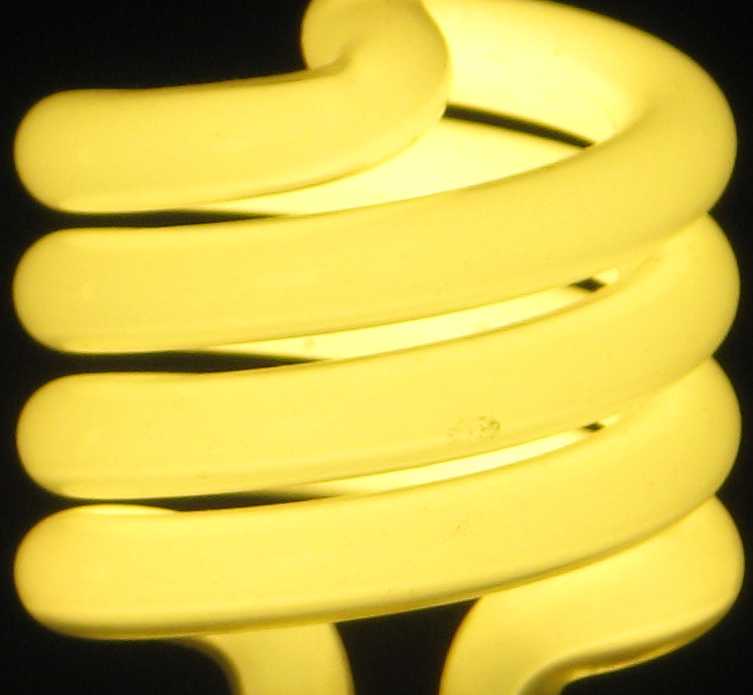
Extra credit. Find various sheets of blank paper with an assortment
of brightness from about 85 to 105. Photograph those using either a
CFL lamp and an incandescent lamp source. What colors do you get?
(Note that the 105 brightness contains phosphors resulting in the
reflected light actually being brighter than the incident light).
You might want to buy a cheap LED UV flashlight and a diffraction
grating, for more fun with lighting.
<http://www.scientificsonline.com/holographic-diffraction-grating-film-10036.html>
--
Jeff Liebermann jeffl@cruzio.com
150 Felker St #D http://www.LearnByDestroying.com
Santa Cruz CA 95060 http://802.11junk.com
Skype: JeffLiebermann AE6KS 831-336-2558
==============================================================================
TOPIC: Where do I find rechargeable batteries?
http://groups.google.com/group/sci.electronics.repair/t/9444fff861b4d63a?hl=en
==============================================================================
== 1 of 2 ==
Date: Sun, Sep 25 2011 1:00 am
From: E. Normark Sørensen
Please Phil and John.
Don't make flamewar but be nice boys.
I had no idea who this Alfred E. Neumann is, but then I looked him up on
google, and I must say, that I envy his hair, as I don't have much left.
Could we go back to battery cells?
I have now bought the four cells I needed, but would now also like, if I can
get some spares for my cordless drill batterypack.
They are longer. They measure 42 mm x 22 diameter.
Any links for them or a good search word /part number as they are only
marked "Huan You Ni-MH Sc 1300 mAh 1,2 V"
Ebbe
"Phil Allison" skrev i meddelelsen news:9
dncelFtr7U1@mid.individual.net...
"John-Del"
I can't see how....
** Gone blind from wanking ?
Piss off.
== 2 of 2 ==
Date: Sun, Sep 25 2011 1:28 am
From: "Phil Allison"
"E. Normark S�rensen"
** Please do not top post.
Grrrrrrrrr..............
> I had no idea who this Alfred E. Neumann is, but then I looked him up on
> google,
** FFS - I posted a link for you.
Alfred E. Newmann is an Icon of Sanity in a world gone MAD !!
> They are longer. They measure 42 mm x 22 diameter.
** That is the very popular Sub C size.
Google will get you millions of hits.
Go with Sanyo brand.
.... Phil
==============================================================================
TOPIC: way OT: thrashing swap file in W2K
http://groups.google.com/group/sci.electronics.repair/t/42a5df77841d8177?hl=en
==============================================================================
== 1 of 8 ==
Date: Sun, Sep 25 2011 6:28 am
From: "William Sommerwerck"
I'm looking for a likely solution from someone who's seen the same problem
and fixed it -- not theoretical speculations.
I expect to buy a new computer early next year, (presumably) eliminating the
problem. The obvious fix -- putting in a new drive and reinstalling
everything -- would easily take a week, time I don't have for an obsolescent
OS and hardware. (The thought of having to download and install 100+ OS
updates from the Microsoft site pretty much puts the kibosh on the whole
idea.)
Over the past few years (not weeks or months -- years), my W2K-based PC has
been running slower and slower. It started when the OS began appropriating
additional swap-file space, something that rarely, if ever, happened during
the first few years. Oddly, the more space it took, the slower it became.
This slowness manifested itself as "grinding to a near halt" when switching
among applications. Once the switch occurred, the computer appeared to run
normally.
In recent months, the slowdown has become what I can only call appalling.
When I move to another application -- particularly when moving among FireFox
tabs -- the drive light will come on and stay on for several /minutes/.
Again, once the move has occurred, the machine generally runs at a
reasonable speed -- for a while.
It sometimes slows noticeably when loading -- or even displaying -- e-mail.
It just took nearly a minute to download a 2K message -- but is now running
normally.
The problem doesn't appear to be caused by malware. Though that possibility
can't be ruled out, neither the Task Manager nor Process Explorer (which I
highly recommend) reveal anything "nasty".
The Performance and Processes displays don't show anything odd. CPU usage is
"normal", even when the drive light is on continuously.
The paging (swap) files are set to 128MB to 768MB on the boot drive (C:),
and to 768MB to 1280MB on drive F:, a partition that uses the drive space
left after C:, D:,and E: were partitioned to give the minimum cluster size.
In case you're wondering... I periodically empty out the trash bin, and run
C[rap]Cleaner (another highly recommended free product). Otherwise, the boot
drive would be quickly overrun.
Thoughts, anyone?
Thanks in advance.
--
"We already know the answers -- we just haven't asked the right
questions." -- Edwin Land
== 2 of 8 ==
Date: Sun, Sep 25 2011 6:55 am
From: "Phil Allison"
"William Sommerwanker the FUCKWIT TROLL "
> I'm looking for a likely solution from someone who's seen the same problem
> and fixed it -- not theoretical speculations.
** Whaaaaaaaaattttt !!!!!!
ROTFLMFAO !!!!!!!!!!!!!!!!!!!!
FFS what a classic example of :
" Do as I say, NOT as I do. "
== 3 of 8 ==
Date: Sun, Sep 25 2011 8:52 am
From: Ralph Wade Phillips
There's two rather critical bits of information missing here.
1) What's the PHYSICAL memory installed?
2) What's the TOTAL COMMIT after it's been thrashing like this?
I'd bet that you've got a TC of about 2 to 3 times (possibly more!) of
physical memory. Which would cause it to thrash the page file.
More RAM is the best suggestion I could make, without those two
extremely critical bits of information.
RwP
== 4 of 8 ==
Date: Sun, Sep 25 2011 9:26 am
From: "hrhofmann@att.net"
On Sep 25, 8:28 am, "William Sommerwerck" <grizzledgee...@comcast.net>
wrote:
> I'm looking for a likely solution from someone who's seen the same problem
> and fixed it -- not theoretical speculations.
>
> I expect to buy a new computer early next year, (presumably) eliminating the
> problem. The obvious fix -- putting in a new drive and reinstalling
> everything -- would easily take a week, time I don't have for an obsolescent
> OS and hardware. (The thought of having to download and install 100+ OS
> updates from the Microsoft site pretty much puts the kibosh on the whole
> idea.)
>
> Over the past few years (not weeks or months -- years), my W2K-based PC has
> been running slower and slower. It started when the OS began appropriating
> additional swap-file space, something that rarely, if ever, happened during
> the first few years. Oddly, the more space it took, the slower it became.
>
> This slowness manifested itself as "grinding to a near halt" when switching
> among applications. Once the switch occurred, the computer appeared to run
> normally.
>
> In recent months, the slowdown has become what I can only call appalling.
> When I move to another application -- particularly when moving among FireFox
> tabs -- the drive light will come on and stay on for several /minutes/.
> Again, once the move has occurred, the machine generally runs at a
> reasonable speed -- for a while.
>
> It sometimes slows noticeably when loading -- or even displaying -- e-mail.
> It just took nearly a minute to download a 2K message -- but is now running
> normally.
>
> The problem doesn't appear to be caused by malware. Though that possibility
> can't be ruled out, neither the Task Manager nor Process Explorer (which I
> highly recommend) reveal anything "nasty".
>
> The Performance and Processes displays don't show anything odd. CPU usage is
> "normal", even when the drive light is on continuously.
>
> The paging (swap) files are set to 128MB to 768MB on the boot drive (C:),
> and to 768MB to 1280MB on drive F:, a partition that uses the drive space
> left after C:, D:,and E: were partitioned to give the minimum cluster size.
>
> In case you're wondering... I periodically empty out the trash bin, and run
> C[rap]Cleaner (another highly recommended free product). Otherwise, the boot
> drive would be quickly overrun.
>
> Thoughts, anyone?
>
> Thanks in advance.
>
> --
> "We already know the answers -- we just haven't asked the right
> questions." -- Edwin Land
Could there be bad sectors on the disk so it is hunting to find good
ones????
== 5 of 8 ==
Date: Sun, Sep 25 2011 10:49 am
From: Phil Hobbs
On 09/25/2011 09:28 AM, William Sommerwerck wrote:
> I'm looking for a likely solution from someone who's seen the same problem
> and fixed it -- not theoretical speculations.
>
> I expect to buy a new computer early next year, (presumably) eliminating the
> problem. The obvious fix -- putting in a new drive and reinstalling
> everything -- would easily take a week, time I don't have for an obsolescent
> OS and hardware. (The thought of having to download and install 100+ OS
> updates from the Microsoft site pretty much puts the kibosh on the whole
> idea.)
>
> Over the past few years (not weeks or months -- years), my W2K-based PC has
> been running slower and slower. It started when the OS began appropriating
> additional swap-file space, something that rarely, if ever, happened during
> the first few years. Oddly, the more space it took, the slower it became.
>
> This slowness manifested itself as "grinding to a near halt" when switching
> among applications. Once the switch occurred, the computer appeared to run
> normally.
>
> In recent months, the slowdown has become what I can only call appalling.
> When I move to another application -- particularly when moving among FireFox
> tabs -- the drive light will come on and stay on for several /minutes/.
> Again, once the move has occurred, the machine generally runs at a
> reasonable speed -- for a while.
>
> It sometimes slows noticeably when loading -- or even displaying -- e-mail.
> It just took nearly a minute to download a 2K message -- but is now running
> normally.
>
> The problem doesn't appear to be caused by malware. Though that possibility
> can't be ruled out, neither the Task Manager nor Process Explorer (which I
> highly recommend) reveal anything "nasty".
>
> The Performance and Processes displays don't show anything odd. CPU usage is
> "normal", even when the drive light is on continuously.
>
> The paging (swap) files are set to 128MB to 768MB on the boot drive (C:),
> and to 768MB to 1280MB on drive F:, a partition that uses the drive space
> left after C:, D:,and E: were partitioned to give the minimum cluster size.
>
> In case you're wondering... I periodically empty out the trash bin, and run
> C[rap]Cleaner (another highly recommended free product). Otherwise, the boot
> drive would be quickly overrun.
>
> Thoughts, anyone?
>
> Thanks in advance.
>
>
Run defrag lately? Old PCs tend to get low on free space, which causes
fragmentation pretty rapidly.
Cheers
Phil Hobbs
--
Dr Philip C D Hobbs
Principal Consultant
ElectroOptical Innovations LLC
Optics, Electro-optics, Photonics, Analog Electronics
160 North State Road #203
Briarcliff Manor NY 10510
845-480-2058
hobbs at electrooptical dot net
http://electrooptical.net
== 6 of 8 ==
Date: Sun, Sep 25 2011 10:51 am
From: "Michael A. Terrell"
William Sommerwerck wrote:
>
> I'm looking for a likely solution from someone who's seen the same problem
> and fixed it -- not theoretical speculations.
>
> I expect to buy a new computer early next year, (presumably) eliminating the
> problem. The obvious fix -- putting in a new drive and reinstalling
> everything -- would easily take a week, time I don't have for an obsolescent
> OS and hardware. (The thought of having to download and install 100+ OS
> updates from the Microsoft site pretty much puts the kibosh on the whole
> idea.)
>
> Over the past few years (not weeks or months -- years), my W2K-based PC has
> been running slower and slower. It started when the OS began appropriating
> additional swap-file space, something that rarely, if ever, happened during
> the first few years. Oddly, the more space it took, the slower it became.
>
> This slowness manifested itself as "grinding to a near halt" when switching
> among applications. Once the switch occurred, the computer appeared to run
> normally.
>
> In recent months, the slowdown has become what I can only call appalling.
> When I move to another application -- particularly when moving among FireFox
> tabs -- the drive light will come on and stay on for several /minutes/.
> Again, once the move has occurred, the machine generally runs at a
> reasonable speed -- for a while.
>
> It sometimes slows noticeably when loading -- or even displaying -- e-mail.
> It just took nearly a minute to download a 2K message -- but is now running
> normally.
>
> The problem doesn't appear to be caused by malware. Though that possibility
> can't be ruled out, neither the Task Manager nor Process Explorer (which I
> highly recommend) reveal anything "nasty".
>
> The Performance and Processes displays don't show anything odd. CPU usage is
> "normal", even when the drive light is on continuously.
>
> The paging (swap) files are set to 128MB to 768MB on the boot drive (C:),
> and to 768MB to 1280MB on drive F:, a partition that uses the drive space
> left after C:, D:,and E: were partitioned to give the minimum cluster size.
>
> In case you're wondering... I periodically empty out the trash bin, and run
> C[rap]Cleaner (another highly recommended free product). Otherwise, the boot
> drive would be quickly overrun.
>
> Thoughts, anyone?
How much RAM do you have? The computer needs a swap file when it
runs out of physical memory. Go to www.belarc.com/free_download.html
and download Belarc Advisor. It will tell you how much and what type of
RAM you have. The updates you've installed over the years, plus all the
other programs that load at startup use a lot of RAM. That slows down a
computer.
I use Spybot S&D and AdAware to look for spyware. Spybot is from
Safer Networking and Adaware is from Lavasoft.
www.safer-networking.org/en/download/
www.lavasoft.com/products/ad_aware_free.php
> Thanks in advance.
--
You can't have a sense of humor, if you have no sense.
== 7 of 8 ==
Date: Sun, Sep 25 2011 10:54 am
From: "William Sommerwerck"
"Phil Hobbs" <pcdhSpamMeSenseless@electrooptical.net>
wrote in message news:4E7F69A2.10608@electrooptical.net...
> Run defrag lately? Old PCs tend to get low on free space, which causes
> fragmentation pretty rapidly.
Last time was about three months back. About 10% of the boot drive is free.
== 8 of 8 ==
Date: Sun, Sep 25 2011 10:57 am
From: "William Sommerwerck"
"Ralph Wade Phillips" <news@philent.biz> wrote in message
\news:j5nino$804$1@dont-email.me...
> There's two rather critical bits of information missing here.
> 1) What's the PHYSICAL memory installed?
> 2) What's the TOTAL COMMIT after it's been thrashing like this?
> I'd bet that you've got a TC of about 2 to 3 times (possibly more!) of
> physical memory. Which would cause it to thrash the page file.
> More RAM is the best suggestion I could make, without those two
> extremely critical bits of information.
Good questions.
I have a half-gig of RAM. The total swap file space available (as opposed to
being in use) is 1.5 gigs.
The confusing issue is that performance has been gradually deteriorating,
despite the fact that the configuration hasn't changed for years.
I've never seen a clear explanation of how one selects an optimum swap-file
size. I might very well remove the F: swap file, restart the machine, and
see what happens.
Thanks.
==============================================================================
TOPIC: No sync crt Tv
http://groups.google.com/group/sci.electronics.repair/t/78e3ce8e9b81dc17?hl=en
==============================================================================
== 1 of 1 ==
Date: Sun, Sep 25 2011 8:18 am
From: "Dav.p"
I need some help 'cause Italian NG or formus doesn't help me much..
Many years ago i've much probably caused a damage to a Daewoo DTG2997 crt Tv (chassis C1000)
connnecting a computer to it, one 12v may have been connected for error to the ground and came in
to the tv through the RCA video/audio cable's ground, now AV inputs, apart antenna, doesn't work
well, if i put a RGB signal through the SCART AV cable the image is visible but without any sync,
if i put a videocomposite signal the screen is empty/dark (dark grey), so i don't understand why
antenna video signal is displayed well and other inputs not.. (i'm not an expert).
theese are the relevant pages of schematics:
http://img148.imageshack.us/img148/3738/c1000pg10.jpg
http://img600.imageshack.us/img600/6532/c1000pg1.jpg
http://img24.imageshack.us/img24/1968/c1000pg2.jpg
http://img851.imageshack.us/img851/5985/c1000pg3.jpg
http://img834.imageshack.us/img834/9867/c1000pg8.jpg


Many thanks in advance.
==============================================================================
TOPIC: Need help with switching power supply repair
http://groups.google.com/group/sci.electronics.repair/t/efc81d21dede85df?hl=en
==============================================================================
== 1 of 1 ==
Date: Sun, Sep 25 2011 9:02 am
From: "Arfa Daily"
"Franc Zabkar" <fzabkar@iinternode.on.net> wrote in message
news:ehet77tj8mdnnuam8c1houuf8lh9s945u3@4ax.com...
> On Sun, 25 Sep 2011 01:29:05 +0100, "Arfa Daily"
> <arfa.daily@ntlworld.com> put finger to keyboard and composed:
>
>>Typically, the startup supply doesn't come *directly* from the high
>>voltage
>>rail, It is normally fed via a diode, and the self-powering rail is
>>arranged
>>to be a higher voltage than the startup supply. This results in the diode
>>feeding the startup supply, to become reverse biased once the supply fully
>>starts, which then results in the current draw from that supply reducing
>>to
>>as good as zero, and thus likewise dropping the power dissipation in the
>>startup resistor to virtually zero.
>>
>>Arfa
>
> Your comment took me by surprise. Just to make sure I wasn't having a
> brain fart, I consulted an application note:
> http://www.nalanda.nitc.ac.in/industry/AppNotes/Unitrode/slua143.pdf
>
> I confess that I haven't really thought about this subject before, but
> according to page 4 of the PDF, there is no back-biased diode. AISI, a
> diode that is fed from a 170VDC supply cannot become reverse biased by
> a much lower bootstrap voltage.
>
> The app note suggests that the UC3842 will remain in the off state
> until the capacitor on its Vcc pin charges up to the UVLO (under
> voltage lockout) turn-on voltage of 16V. During this time the IC draws
> only 1mA.
>
> After the UVLO turn-on threshold is reached, the IC turns on and
> pulses the chopper. The bootstrap winding then generates the Vcc
> supply for the IC and prevents the capacitor from discharging below
> the IC's UVLO turn-off threshold of 10V.
>
> Fig 31 on page 13 of the same document has an application circuit for
> an isolated +/-12V supply. The 56K resistor (R2) can pass about 3mA.
> This means that 2mA goes toward charging the capacitor. The UC3842
> datasheet specifies a typical operating current of 14mA.
>
> http://www.elektronik.sk/datasheet/UC3842.pdf
>
> If you were to disconnect the bootstrap winding, then the output
> voltage will only remain alive for as long as it takes the Vcc
> capacitor to discharge from 16V to 10V.
>
> I = C . dV/dt
>
> so ...
>
> dt = C x dV / I
>
> = 100uF x (16V - 10V) / (14 - 3)mA
> = 55 msec
>
>
> - Franc Zabkar
Hmmm. OK. I'll buy that. I must admit that I haven't taken too much notice
of how that bit of the circuitry works in recent years. Perhaps I'm just
going back to the early days when I was first taught about these things on
manufacturers' service courses. Maybe there used to be a zener on the end of
the startup resistor, and then a diode. The diode could then be reverse
biased by the self-powering supply, and the current in the startup resistor
would decrease to that of the zener's draw only. I'll have to have a look
back on some of the older schematics for VCRs and DVDs etc
Arfa
==============================================================================
TOPIC: Rechargable batteries
http://groups.google.com/group/sci.electronics.repair/t/bed135e0d97b3dff?hl=en
==============================================================================
== 1 of 1 ==
Date: Sun, Sep 25 2011 10:57 am
From: Jeff Layman
On 25/09/2011 03:57, Phil Allison wrote:
> "Arfa Daily"
>
>>
>> It says that they are NiMH at the the bottom left of the card, and it
>> indicates on the battery body that they are 2400mAH,
>
> ** Nope.
>
> DX2400 is a code that gives the battery type and size.
>
> Seems they are really Sanyo Eneloop AAA cells in a new skin.
>
> So they are 800 mAH.
>
> AAAs are never 2400mAH.
>
The main Amazon page shows AAA batteries. When the image is zoomed it
shows AA batteries!
The back view of the pack cannot be zoomed, but magnifying the image
shows they are 2800 or 2900 mAh.(top right).
--
Jeff
==============================================================================
You received this message because you are subscribed to the Google Groups "sci.electronics.repair"
group.
To post to this group, visit http://groups.google.com/group/sci.electronics.repair?hl=en
To unsubscribe from this group, send email to sci.electronics.repair+unsubscribe@googlegroups.com
To change the way you get mail from this group, visit:
http://groups.google.com/group/sci.electronics.repair/subscribe?hl=en
To report abuse, send email explaining the problem to abuse@googlegroups.com
==============================================================================
Google Groups: http://groups.google.com/?hl=en
No Response to "sci.electronics.repair - 25 new messages in 7 topics - digest"
Post a Comment