
- Anyone have a trick for getting Husqvarna chainsaw brake kickback spring back on? - 6 Updates
- Nobody Would Ever Figure This One (amp) - 2 Updates
- Diode in series with the mains - 2 Updates
- radios hum - 4 Updates
- Car alternator failure -- twice! - 3 Updates
- JVC AL-F353BK Turntable - 1 Update
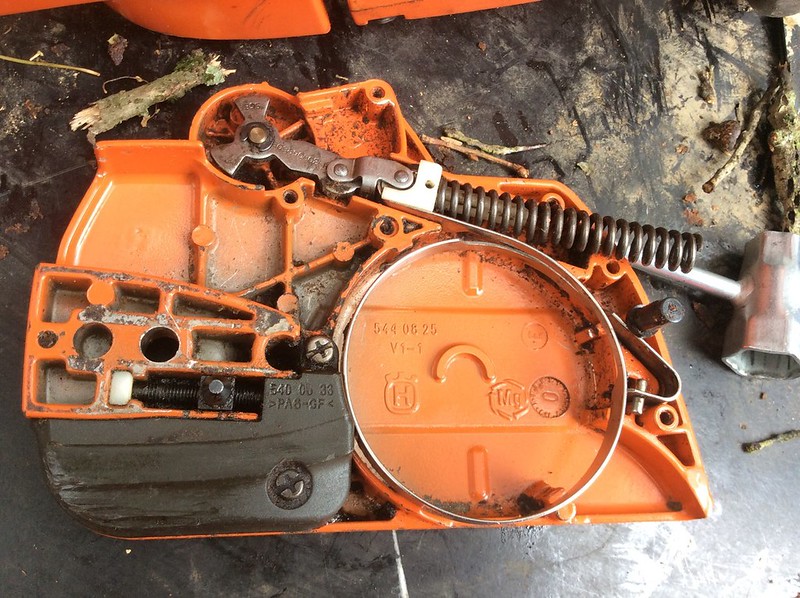
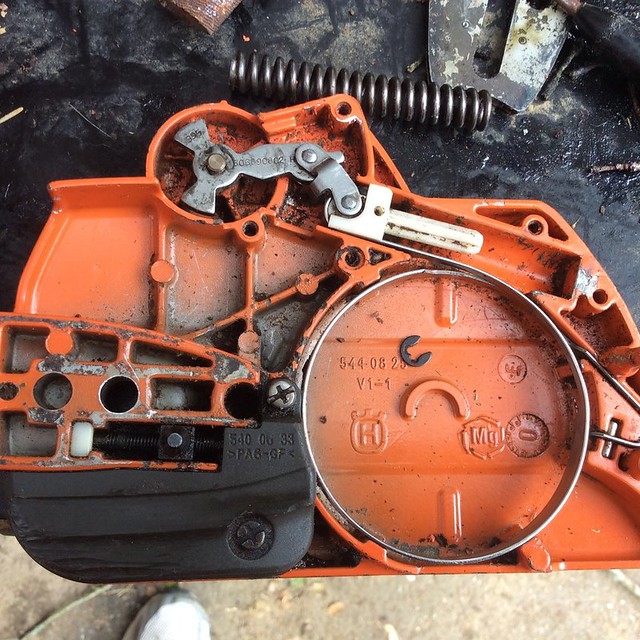
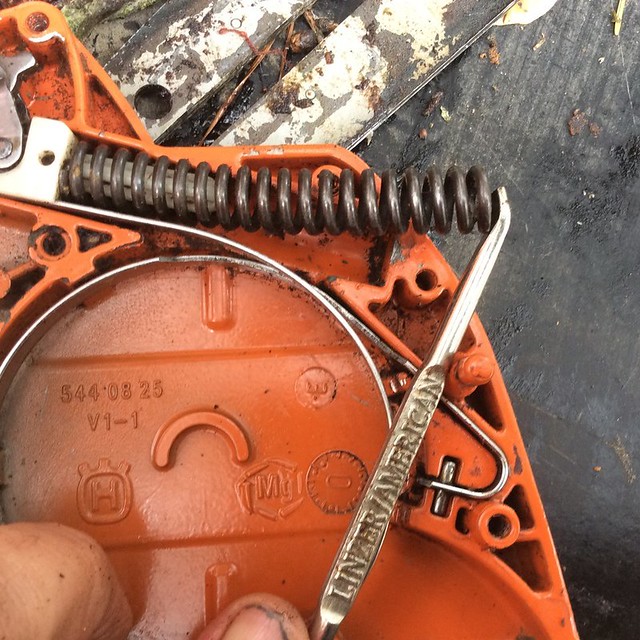
| "Danny D." <dannydiamico@gmail.com>: Feb 19 02:52AM A bunch of trees fell down on my neighbor's property during the last pineapple express, and his little Ryobi 8" electric chainsaw wasn't up to the task because we stripped the hold-down bolt threads: https://c4.staticflickr.com/8/7348/16576214195_edee2d2572_c.jpg So I lent him my Husqvarna 18" chainsaw for chopping up the fallen trees: https://c4.staticflickr.com/8/7455/16388696590_ca981a9d47_z.jpg End result is that the kickback spring mechanism must have jammed hard, I think it happened exactly as this picture was taken, actually: https://c4.staticflickr.com/8/7333/16389857079_8bd6f14257_z.jpg The result is that I had a devil of a time getting the hold-down cover off today because the chain break coil was tightly wrapped around the chainsaw spinning drum: https://c4.staticflickr.com/8/7285/16388368248_c088a7f82c_c.jpg I finally was able to loosen the spring circular kickback clamp, but the spring popped out of his slot in the process: https://c4.staticflickr.com/8/7288/16389735629_1cf166b3b8_c.jpg The problem now, is getting the kickback clamp spring back on: https://c4.staticflickr.com/8/7349/16574371231_5e52e56134_z.jpg I tried all sorts of leverage tools, but that spring is STRONG! https://c4.staticflickr.com/8/7281/16389735569_221282dc75_z.jpg Anyone know the trick to get that super strong spring back on? |
| "Phil Kangas" <pkangas@upalphacomm.net>: Feb 18 10:10PM -0500 "Danny D." > > Anyone know the trick to get that super strong spring back on? Try sliding it down a thin strip of metal. |
| "Tom Miller" <tmiller11147@verizon.net>: Feb 18 10:24PM -0500 "Danny D." <dannydiamico@gmail.com> wrote in message news:mc3j5c$err$2@dont-email.me... > I tried all sorts of leverage tools, but that spring is STRONG! > https://c4.staticflickr.com/8/7281/16389735569_221282dc75_z.jpg > Anyone know the trick to get that super strong spring back on? Search on "coil spring compressor" for some ideas. I would use a couple of washers with some tabs and a long screw, washer and nut to compress it. |
| jurb6006@gmail.com: Feb 19 12:16AM -0800 Fucking Christ. Take a Dremel tool and get rid of that shit and just run it. If you ain't strong enough to run a chainsaw, don't run a chainsaw. Watch your balance, that's all. |
| Stormin Mormon <cayoung61@hotmail.com>: Feb 19 08:08AM -0500 On 2/18/2015 10:24 PM, Tom Miller wrote: >> Anyone know the trick to get that super strong spring back on? > Search on "coil spring compressor" for some ideas. I would use a couple > of washers with some tabs and a long screw, washer and nut to compress it. Did you actually look at the pictures? I'll admit, I only looked at one or two. But, the bolt thing won't do much good here. - . Christopher A. Young learn more about Jesus . www.lds.org . . |
| "Pico Rico" <PicoRico@nonospam.com>: Feb 19 05:29AM -0800 "Danny D." <dannydiamico@gmail.com> wrote in message news:mc3j5c$err$2@dont-email.me... > I tried all sorts of leverage tools, but that spring is STRONG! > https://c4.staticflickr.com/8/7281/16389735569_221282dc75_z.jpg > Anyone know the trick to get that super strong spring back on? do you have a neighbor that is a MAN? |




| jurb6006@gmail.com: Feb 18 10:47PM -0800 This is worse than the adjust vertical height to correct a greyscale problem. Had this JBL Pro powered sub with a Crown 600 WPC amp in it. They did everything they could to make it impossible to service of course but I did it. Model MP418SP. Symptom was that it would power up and then when you put input to it it would start clicking, LOUD. And then it would not stop. Ran it down to a bad connection to one of the main filter caps. the negative one IIRC. Yup, the negative one. Must have been an oscillation set up with the protect and mute curcuits, something like that. I never thought an amp would act like that because of that fault. You know, ther are a few things about Crown, well I am not impressed. It's not just that heir prints are hard to follow, they all are. It's just some of the things they do, especially when it comes to the build. Jaros from Poland told me "Don't use logic to fix things, it does not vork". I am stsarting to think that many times, that statement is correct. I was about to start looking into the active crossover and all this, got the print (well part of it) and all that. Then after hours I ge thte thing apart enough and see this. Damn. If you ever get one of those MP418SPs in be sure to charge alot of money. Of all tthis other shit, they used silicone to put the one corner of the board down, and the rectifier is screwed to the plate where you can't get your hand in there. Well at least the screws were not shitty or easily strippable or stuck. I can give it that much. But really, I hope I never see it again. Tick tick tick, LOUD, and it would not start until you put input to it, and after that it would not stop until power down. How come it even came out of protection in the first place ? Rant over. |
| Phil Allison <pallison49@gmail.com>: Feb 18 10:58PM -0800 > Had this JBL Pro powered sub with a Crown 600 WPC amp in it. They did everything they could to make it impossible to service of course but I did it. Model MP418SP. > Symptom was that it would power up and then when you put input to it it would start clicking, LOUD. And then it would not stop. > Ran it down to a bad connection to one of the main filter caps. the negative one IIRC. Yup, the negative one. ** Always expect parts to vibrate lose with powered speakers. Yep - electros, WW resistors, anything on a PCB heatsink, coils, PCB transformers etc. Bout the only bits that stay put are SMD. .... Phil |
| jurb6006@gmail.com: Feb 18 10:27PM -0800 I don' get it. There have been half wave recifiers off of transformers for a long time and I never heard of this. Does the full wave rectifier let you use a shittier transformer ? the only mechanism by which half wave rectification can do anything bad to the transformer is by core saturation. Then you lose inductance and we all know that story. >"** On the output side? " If we are talking core saturation here, it probably doesn't matter much. Anything polarizes the core's magnetic field should do it, but it should be based on current. No load, no problem. >"**Could be a gotcha there - how does the fan get its power? " That motor draws only a small fraction off the current compared to the heating element. However alot of them DO use a diod for low power, what else ? A resistor would melt the thing and a chopper would just be too much because alot of them are cheap. I don't care if you pay alot for it, that just means they made more money. >"** Suspect half wave loads make them under read a bit. " My Uncle and cousin (his son) tried to do just that. Both into electronics and with better jobs than I actually. But they did it big, the went to shithouse (ESI in Cleveland back when they were in Cleveland, a surplus place) and got these gnarly rectifiers and hooked them up to the elements of an electric furnace. They said it was weird like you could see waves going through the elements when they were first getting up to temp. But the idea was to magnetize the poles/stator or whatever and slo the thing down permanently, or nearly. There is no way to know if they had any success but it was a fun thing they did as a Father/son project. Hey, we never promised to use our powers for good. >-)Youse guy down there don't think that way because they don't fuck you up the ass the way they do here. Our morality is to return the favor until we get caught and then get a good lawyer. In fact the reason so many onventors came here is because of the market and the intellectula property laws - i.e. MONEY. >"Why not try it out while counting turns on the big wheel " That would require separating the load. I used to have a watthour meter but the person's brother who supposedly sod it to me took it. My choices were to shoot him or call the law, and I was pretty sure that watthour meters were not available at the local store. It was probably stolen. these fuckers used it to charge people on their (tube) TV repair bill for test run time. they used to pull like 300 watts and runiong them for eight hours a day lookig for an intermittent cost money. They also were the first ones I know of in the area that charged for chemicals when cleaning pots and switches. Two brothers. One would NEVER pad the parts. He would write a bill with $4.00 parts and $68 labor. theyu other used to but switched to charging "installed" prices and trhe labor became "technical serbvice time" which is supposedly the time to troubleshoot. Of course if the job is done in fiveminutes they still pay. But I am sure a watthour meter can be had. So many of the old style ones have been retired from service that somewhere they must be on eBay or something. I doubt they differ much, in fact you might want a US one because it is designed to be accurat if half the line is loaded or the whol thing. In other countries it is all one sided. Of course that means for the best results in the US we need a rectifier on each side, going opposite directions so it rectifies the same phase of the cycle. Well if you want to run your whole house on it. With newer technology, I bet one could take that rectified 320 volts, build a nice switcher and do just that and run everything. How long you figure before they become illegal ? Or even thosse frequeny convertors that do not rectify, but just use the AC from three phases to pretty much cleanly convert to a higher frequency for VFDs ? Just redesign it to only use one half of the cycle. Those run on three phase and they have to to do what they do because there is always voltage. But we are not converting frequency here. this is just getting AC out of DC. I am not so sure that can be done. ?Have to give it some thought when summer comes and it it air conditioning time. That costs quite a bit less since I changed the run cap in the condensing unit. but now, that thing take 240. What's more it takes quite a bit of amperage and we still have the old style motor driven meter. And, if I can't make it sinosodial, will that just decrease the efficincy to the point where I just wasted my time ? I dunno. Going out for a smoke. |
| Phil Allison <pallison49@gmail.com>: Feb 18 10:37PM -0800 > I don' get it. There have been half wave recifiers off of transformers for a long time and I never heard of this. ** You have misread what the thread is about. > >"** On the output side? " > If we are talking core saturation here, ** You have misread my post. Re-boot and try again. .... Phil |
| Allodoxaphobia <knock_yourself_out@example.net>: Feb 18 06:34PM On Wed, 18 Feb 2015 10:45:31 -0500, Smarty wrote: > Most of these older radios hum when trying to play modern music. > They hum because they don't know the words to the songs. heh... s/know/understand/ |
| dplatt@coop.radagast.org (Dave Platt): Feb 18 11:28AM -0800 >on, a radio program comes out. When I t turn it off, only the hum. In >one case, I put a separate switch on the wire to the speaker, and now >the radio makes no noise when it's off. One possibility is that these radios have some sort of interference-suppression or anti-kickback ("anti-pop") capacitor bridged across the on/off switch. This capacitor would allow a small amount of current to flow "around" the switch contacts when the switch is "off". If the cap is becoming "leaky" with age there might be enough current flowing to partially power up the radio even with the switch in the "off" position. Another possibility is that it's mechanical hum rather than electrical. If the on/off switch is in the secondary (low-voltage) part of the power supply circuit, then there would be mains voltage present on the primary transformer windings at all times. The transformer could then be humming a bit, from magnetostriction, and the speaker cone could convert this mechanical vibration to audible noise. [This wouldn't account for your saying that adding a switch in the speaker wiring got rid of the hum, though.] Do these radios have any sort of clock or light or ??? which would need power at all times, even when the radio is turned off? Model number(s)? |
| Jon Elson <jmelson@wustl.edu>: Feb 18 02:43PM -0600 micky wrote: > on, a radio program comes out. When I t turn it off, only the hum. In > one case, I put a separate switch on the wire to the speaker, and now > the radio makes no noise when it's off. A number of these radios will have 60 Hz (mains-powered) transformers that are always on. The power switch switches low-voltage (either AC or DC) power to turn the radio on or off. probably there is magnetic leakage from the transformer that is getting into the speaker or wiring somehow. If the audio output stage has an audio transformer to drive the speaker, the power transformer might be coupling magnetically to the audio output transformer. Possibly, altering the way the power transformer is mounted might reduce this coupling. Jon |
| Allodoxaphobia <knock_yourself_out@example.net>: Feb 19 02:17AM On Wed, 18 Feb 2015 11:28:07 -0800, Dave Platt wrote: > Do these radios have any sort of clock or light or ??? which would > need power at all times, even when the radio is turned off? Or do they use remote control for volume, tune, etc. If so,they are always "on" (somewhat) -- even when they are off. > Model number(s)? Yes, please! |
| Mike <news@mjcoon.plus.com>: Feb 18 05:23PM -0600 On Wed, 18 Feb 2015 09:46:23 -0500, Rich. wrote: > Typical meter leads have a resistance of 1.5 ohms. ... I hope not a meter that claims to measure currents of (say) 10 amps! Mike. |
| Sparky <see@thesig.net>: Feb 18 05:27PM -0800 > I hope not a meter that claims to measure currents of (say) 10 amps! > Mike. He was speaking of when I measured the resistance of the cables and terminals. Not current. |
| Sparky <see@thesig.net>: Feb 18 06:09PM -0800 A second test of the cables, this time using an ESR meter capable of measuring hundredths of ohms and able to null test lead resistance. (-) battery cable, from battery terminal to chassis: 0.02 ohms; (+) battery cable, from battery terminal to starter solenoid: 0.05 ohms; Alternator cable, from alternator to starter solenoid: 0.33 ohms. These measurements were done with (-) cable disconnected from battery post (no potential across cables) and test leads nulled. So 35 amps charging current over 0.33 ohms pretty much drops the full 12 volts. I'll look into wiring and terminal issues. Thanks to all who helped. |
| jurb6006@gmail.com: Feb 18 05:35PM -0800 Kinda surpised it is different. I know I got tripped up on a Tangberg R2R, it said likje model 9425. Couldn't get a print, couldn't get a print, but found the 9400 all over the place. Turns out it is identical and I guess they use thoe last two digits as sort of a partial serial number. And THE, got this JBL commercial powerd sub. Couldn't even find a model number on the thing so I oculndn't get a print. Well it turns out on those, the firast pert of the serial nember is the model number. So, what is this TT doing ? If it's a speed problem Murphy's law dictates it it a 95 % chance of being the motor, especially if it is direct drive. I do believe the 350 is belt drive so the odds are a little better of it not being the motor. Another thing you could do is download a shitload of mamuals, or at least view them and look for one that has at least the same motor. If you find that, it is very likely to nave the same board, and of not at lesast the same circuit driving the motor. |
| You received this digest because you're subscribed to updates for this group. You can change your settings on the group membership page. To unsubscribe from this group and stop receiving emails from it send an email to sci.electronics.repair+unsubscribe@googlegroups.com. |
No Response to "Digest for sci.electronics.repair@googlegroups.com - 18 updates in 6 topics"
Post a Comment