
- CATV RF Notch Filter - 2 Updates
- Transformer winding direction - 3 Updates
- Anyone have a trick for getting Husqvarna chainsaw brake kickback spring back on? - 7 Updates
- radios hum - 1 Update
- Total Ripoff Pioneer Spares - 10 Updates
- Battery for tablet - 1 Update
- Electric toothbrush. - 1 Update
| Phil Allison <pallison49@gmail.com>: Feb 21 02:27PM -0800 Jeff Liebermann wrote: > > I know the frequency, which by the way is between 200 and 300Mhz. > Do you know the bandwidth needed? If it's fairly wide band, you'll > probably end up with a hipass and lopass filters in series. ** Not likely. It's not an analogue signal so you do not need to remove it all - just a part of it will do, enough to prevent decoding. .... Phil |
| Allodoxaphobia <knock_yourself_out@example.net>: Feb 20 02:21AM On Thu, 19 Feb 2015 13:22:56 -0800, Dave Platt wrote: > open at the far end (and these can be tricky due to parasitic > capacitance, and could also radiate signals from other channels) or a > half-wavelength stub which is shorted at the end. And, be aware that the _open_ quarter wave stub will also demonstrate 'zero' impeadance at all the odd 1/4 wave frequencies -- IOW, at 3X your "200 to 300 MHz" target, and at 5X, etc. >>the digital data "un-usable" (can't decode). Another concern is the width of >>the notch. If it is too wide, it may affect the adjacent channel. > The latter is not at all unlikely. I have made 1/4 wave stubs of High Q out of 1/2" and 3/4" cable TV hardline to eliminate harmonic interference in TVs from nearby (non-TV) transmitters. WFM. HTH Jonesy -- Marvin L Jones | W3DHJ | W3DHJ | http://W3DHJ.net/ Pueblo, Colorado | @ | Jonesy | __ 38.238N 104.547W | jonz.net | DM78rf | 73 SK |
| mike <ham789@netzero.net>: Feb 13 08:31PM -0800 On 2/12/2015 10:30 PM, Phil Allison wrote: > To help with the latter, it could easily be important to wind with the same sense. Also winding multiple, identical secondaries and connecting them in parallel is the way to go plus using other techniques like interleaving and use of strip conductors for the secondary. > Getting 3V at 200Amps is non trivial. > ... Phil Problems I discovered with these welders are: 600W ain't nearly enough power to weld anything substantial. Very thin stuff like battery tabs require very accurate energy delivery. The difference between no weld and blasting a hole thru everything is a small pressure difference holding the weldment together. If you don't turn it on/off at zero crossings, the saturation state of the core can make a great difference in the next weld. I gave up trying to weld with a MOT. CD welders deliver a known energy to the weld and are very much less dependent on contact resistance. |
| Chris Jones <lugnut808@spam.yahoo.com>: Feb 16 12:34PM +1100 On 16/02/2015 04:55, mike wrote: >> ... Phil Although he is rude, Phil is usually right, and this time is no exception. I suggest you get a hall-effect current transducer connected to a DSO so that you can measure inrush current, and try out switching the transformer on at both the peak of the mains voltage, and also at the zero-crossing, and look at the current waveforms. When you run out of working triacs you could also google it. The key to understanding this is to realise that the magnetic flux is proportional to the time-integral of the applied voltage, and that in continuous operation the flux is normally close to zero when the voltage is close to maximum, and the flux is close to maximum when the voltage is close to zero. Have a look at the first link here: www.te.com/commerce/DocumentDelivery/DDEController?Action=srchrtrv&DocNm=13C3206_AppNote&DocType=CS&DocLang=EN http://sound.westhost.com/articles/inrush.htm http://en.wikipedia.org/wiki/Inrush_current#Transformers Chris |
| mike <ham789@netzero.net>: Feb 15 09:07PM -0800 On 2/15/2015 5:34 PM, Chris Jones wrote: >>> ... Phil > Although he is rude, Phil is usually right, and this time is no exception. > I suggest you get a hall-effect current transducer connected to a DSO been there done that AEMC MR461 current probe. TEK TDS540 scope. I designed my first production forward converter ~40 years ago. so > that you can measure inrush current, and try out switching the > transformer on at both the peak of the mains voltage, and also at the > zero-crossing, with the secondary heavily resistively loaded, and look at the current waveforms. When you run out of > continuous operation the flux is normally close to zero when the voltage > is close to maximum, and the flux is close to maximum when the voltage > is close to zero. Have a look at the first link here: Are we talking about inductors or transformers with load resistors that cause a steady state primary current 2X their design rating? > http://sound.westhost.com/articles/inrush.htm > http://en.wikipedia.org/wiki/Inrush_current#Transformers > Chris Thanks for the links. I like to learn new stuff. I'm still trying to get my head around why the graphs in the first link are reversed in time, but if I stand on my head, it looks like the drive signal is optimized to maximize inrush current. I don't have any argument with that. You can certainly manage the drive so the core saturates. My attempts were to arrange the drive signal to MITIGATE inrush current. The key point is in the wikipedia link: "Worst case inrush happens when the primary winding is connected at an instant around the zero-crossing of the primary voltage, (which for a pure inductance would be the current maximum in the AC cycle) and if the polarity of the voltage half cycle has the same polarity as the remnance in the iron core has. (The magnetic remanence was left high from a preceding half cycle)." end quote If you always turn off the current at the current zero crossing with a positive voltage slope, then always turn on the next weld pulse at zero voltage on the positive voltage slope, doesn't that leave you in a remanence position to avoid saturation at the next turn on? If not, why not? The SSR is gonna turn off near zero current. About all I can control is the slope of the voltage sinewave when I give the command. To turn it on it's far easier to sense the zero crossing of the line voltage than the peak. Isn't a major portion of the primary current in phase with the primary voltage due to the resistive secondary load? Isn't it the leakage inductance that causes the phase shift? Under the control conditions described above where we control both ends of the waveform to manage remanence and have a very low value resistive load, how much would I gain by waiting for the peak line voltage at turn on? I'd go look, but it's stored behind a bunch of junk in the garage. As I recall, I didn't make many measurements without load. But with the secondary (almost) shorted in the weld mode, I don't remember any horrible input current transients. I do know that synchronization with the line made a major improvement in the repeatability of the welds. I'm up for some education. My thinking was that, if not for saturation, the SCR would be less stressed if I turned it on at zero voltage when the primary current was zero. And from the unpowered state, the voltage and current can't be anything but zero. And that, if I could arrange the resting place on the B-H curve from the previous pulse such that the first half-cycle wouldn't saturate the core, that's the best I could do easily. Measurements didn't show any horrible first cycle inrush. Welds got more repeatable. Let me say the same thing in different words. If the load is linear resistive, the transformer current and voltage will be approximately in phase. If the SCR shuts off at zero current, the voltage will also be near zero volts (plus whatever the leakage inductance allows). Case 1, you start the next pulse in a nanosecond. Isn't the initial current still pretty near zero? Isn't the point on the B-H curve still about the same? Case 2, you start the next pulse next week at the zero crossing of the input voltage headed in the same direction. What's the initial current? What's the initial point on the B-H curve? How is restarting it synchronously significantly different from just leaving it running? I'm not disputing the articles you posted. I'm not saying anything about the general (worst) case. I'm suggesting that this is how you engineer a spot welder using a MOT. Where did my thinking go wrong? |
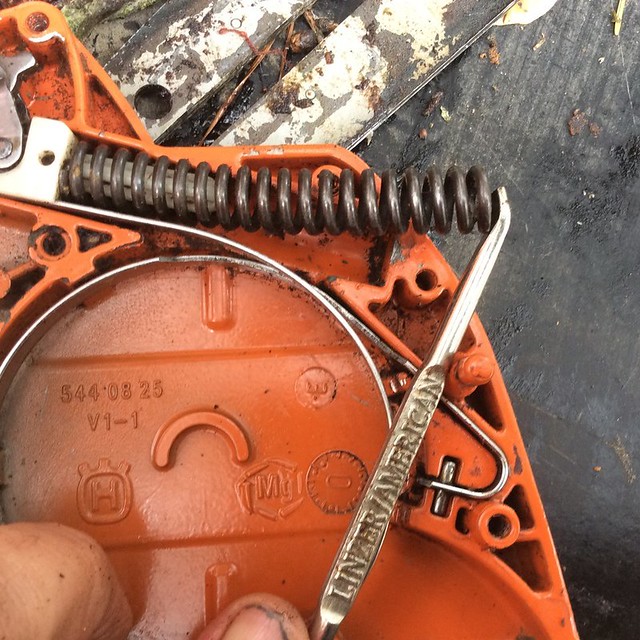
| Jeff Liebermann <jeffl@cruzio.com>: Feb 21 09:35AM -0800 On Sat, 21 Feb 2015 08:01:42 +0000 (UTC), "Danny D." >> Trying to do the same with a text search is much less useful. >That found this video, which, I must say, is doing things the hard way: >https://www.youtube.com/watch?v=9PIDvWmJEo4 Good find. I rather like the way he did it. However, he was lucky that the spring didn't fly off. Actually, I don't really like the screwdriver which might slip putting a hole in my other hand. I used pliers, which will make a smaller hole. I also don't like your "easy way" of pushing the spring from the other end using the plastic parts. The spring could bend and break the projecting white prong thing as it is bent into position. While it takes more brute force to shove the spring in place as in the above video, there's less risk to breaking plastic parts. -- Jeff Liebermann jeffl@cruzio.com 150 Felker St #D http://www.LearnByDestroying.com Santa Cruz CA 95060 http://802.11junk.com Skype: JeffLiebermann AE6KS 831-336-2558 |
| "Danny D." <dannydiamico@gmail.com>: Feb 21 07:14PM Jeff Liebermann wrote, on Sat, 21 Feb 2015 09:35:54 -0800: > projecting white prong thing as it is bent into position. While it > takes more brute force to shove the spring in place as in the above > video, there's less risk to breaking plastic parts. Hi Jeff, I don't disagree with you that there is a risk of breaking the nylon insert. The biggest risk, I would think, is that you have to do the procedure about a dozen times before you realize the key elements to avoid, most of which revolve around the spring bouncing all over the garage. That spring flew into the air at least a half-dozen times on me, and, I was amazed. You don't see it. You may hear it land, but each time it flew, there was absolutely no way I could *see* where it went. I'm surprised the thing moves that fast. Today I cut a trail about 500 feet down a mountain. I have another 2000 feet or so to go, and I'll have a dandy shortcut! Whew! Time to wash off that poison oak covering my body. I have a secret formula: 1. I shower with Dawn detergent over every inch of my body (surfactant). 2. I splash a very dilute solution of bleach (to oxidize the alcohol/oil). 3. I soap down with Dawn (or Palmolive) again, to wash off the alcohol/oil. Seems to work. |
| Oren <Oren@127.0.0.1>: Feb 21 01:45PM -0800 On Sat, 21 Feb 2015 08:01:42 +0000 (UTC), "Danny D." >That found this video, which, I must say, is doing things the hard way: >https://www.youtube.com/watch?v=9PIDvWmJEo4 Looked easy. I wonder how he lost part of his left thumb? |
| Oren <Oren@127.0.0.1>: Feb 21 01:52PM -0800 On Fri, 20 Feb 2015 21:45:30 -0800, Jeff Liebermann <jeffl@cruzio.com> wrote: >claims there's a "special tool" for reinstalling the brake spring. >I'll ask the local dealer or rep for the specifics. It's no in the >catalog. From your image link, I found this tool made to compress the spring. "...made a tool up to compress the spring back in place. This works with the handle off, with the handle on, with the brake spring in place and the spring out with little effort." <http://www.arboristsite.com/community/threads/hardest-repair-ever-chain-brake-assembly.90197/page-2> <https://tinyurl.com/qarvqr3> |
| Jeff Liebermann <jeffl@cruzio.com>: Feb 21 04:06PM -0800 On Sat, 21 Feb 2015 19:14:47 +0000 (UTC), "Danny D." >I don't disagree with you that there is a risk of breaking the nylon >insert. On later models, the nylon prong morphed into a metal equivalent: <http://s51.photobucket.com/user/mantidontowel/media/husqvarna/032408offhusqcorespondprocdureil-17.jpg.html> My guess(tm) is that this would not happen unless there was a problem. >The biggest risk, I would think, is that you have to do the procedure >about a dozen times before you realize the key elements to avoid, most >of which revolve around the spring bouncing all over the garage. I was wondering why some of the videos showed little effort involved in retaining the spring after insertion, while others showed a major nightmare keeping the spring from flying away. Looking at a few videos, I found that all the springs had the ends filed flat as in: <http://s51.photobucket.com/user/mantidontowel/media/husqvarna/032408offhusqcorespondprocdureil-15.jpg.html> (Sorry, that's best I could find). Theoretically, that provides even pressure to the case when the spring is inserted. However, the thin part of the ground down spring end provides much less pressure than the thicker part. The vertical part of the end of the slot in the orange case, is also not quite vertical to allow for mold release. That means that different orientations of the spring in the slot offer different side pressure, which is what causes the spring to buckle and fly away. With the heavy part of the ground down end on top, the spring is pushed down, which keeps it from being launched. With the heavy part of the ground down end at the bottom of the slot, the spring will buckle out of the slot, causing the spring launches which you experienced. However, if the end of the slot is radically off vertical, the spring will buckle and launch, no matter how the spring is rotated. Insanity is doing the same thing over and over, and expecting different results. If it doesn't work, either try something different or stop to figure out why it's failing. Methinks "a dozen times" is too many. -- Jeff Liebermann jeffl@cruzio.com 150 Felker St #D http://www.LearnByDestroying.com Santa Cruz CA 95060 http://802.11junk.com Skype: JeffLiebermann AE6KS 831-336-2558 |
| "Phil Kangas" <pkangas@upalphacomm.net>: Feb 18 10:10PM -0500 "Danny D." > > Anyone know the trick to get that super strong spring back on? Try sliding it down a thin strip of metal. |
| "Tom Miller" <tmiller11147@verizon.net>: Feb 18 10:24PM -0500 "Danny D." <dannydiamico@gmail.com> wrote in message news:mc3j5c$err$2@dont-email.me... > I tried all sorts of leverage tools, but that spring is STRONG! > https://c4.staticflickr.com/8/7281/16389735569_221282dc75_z.jpg > Anyone know the trick to get that super strong spring back on? Search on "coil spring compressor" for some ideas. I would use a couple of washers with some tabs and a long screw, washer and nut to compress it. |


| Allodoxaphobia <knock_yourself_out@example.net>: Feb 18 06:34PM On Wed, 18 Feb 2015 10:45:31 -0500, Smarty wrote: > Most of these older radios hum when trying to play modern music. > They hum because they don't know the words to the songs. heh... s/know/understand/ |
| "Gareth Magennis" <gareth.magennis@ntlworld.com>: Feb 21 08:05PM "Martin Crossley" wrote in message news:ssmdnf28SYQTmHXJnZ2dnUVZ7tednZ2d@brightview.co.uk... Phil Allison wrote: > Words like "tight-arse", "con-artist", "hassler" and "whinger" cover > most of them while the rest are straight out crims or drug dealers. > ... Phil Aye, literally a world apart.... The knobs are indeed very dear for what they are, but at least they are available and not so outrageously expensive as to render the units Beyond Economical Repair for a fair charge for obtaining and fitting a couple of them. Martin. Well I don't have the quote to hand now, but I originally ordered 1 switch, 1 pot, 1 SMD CAT5 socket and 4 knobs. The total was well over £100 - that's well over $150 of your dollars if you live in North America, and well over $200 if you descend from a criminal and live in Australia and hate DJ's. I think it was actually in the £130's so add about 30%. So after adding a reasonable mark up on parts and a couple of hours labour, you have a fairly hefty bill for what seems like simply replacing 3 obviously physically broken things and 4 knobs. Not much brains required to diagnose the faults even. I don't like that much cos it looks like I am ripping them off when I certainly am not. Pioneer are. Harrumph. Gareth. |
| "Gareth Magennis" <gareth.magennis@ntlworld.com>: Feb 21 08:18PM Oh, and even the CAT5 socket is non standard. It is considerably longer than any you can buy from Farnell etc. I know, I spent a long time trying to find one. Cuh. Gareth. |
| Trevor Wilson <trevor@SPAMBLOCKrageaudio.com.au>: Feb 22 08:05AM +1100 On 21/02/2015 2:35 PM, Phil Allison wrote: > ** Crikey !!! > AD must deal with a whole different kind of "DJ" to the ones I come across. > Words like "tight-arse", "con-artist", "hassler" and "whinger" cover most of them while the rest are straight out crims or drug dealers. **That has been my experience with these scum too. When I've dealt with them, I have felt an uncontrollable need to check my valuables and have a good bath. -- Trevor Wilson www.rageaudio.com.au --- This email has been checked for viruses by Avast antivirus software. http://www.avast.com |
| John-Del <ohger1s@aol.com>: Feb 21 01:48PM -0800 On Saturday, February 21, 2015 at 6:27:41 AM UTC-5, Mark Zacharias wrote: > and the white nylon rack gear at the top slips and ratchets. The disc cannot > eject until I help it by lifting up the clamper with my finger. Requires > quite a bit of extra "help". Any chance a spacer is missing on the clamper or turntable? Years ago I ran into something similar to this and I think a stick-on rubber disc slipped off the turntable allowing the space between the clamper magnet and the turntable to be reduced increasing the clamping force. |
| "Arfa Daily" <arfa.daily@ntlworld.com>: Feb 21 10:13PM > good bath. > -- > Trevor Wilson Then there must be something really odd about the profession in your country. I have found them to be nothing of the sort here. Either that, or we're not talking about the same group of people ... Arfa |
| "Gareth Magennis" <gareth.magennis@ntlworld.com>: Feb 21 10:37PM "Arfa Daily" wrote in message news:Vp7Gw.918734$ci4.848257@fx39.am4... > good bath. > -- > Trevor Wilson Then there must be something really odd about the profession in your country. I have found them to be nothing of the sort here. Either that, or we're not talking about the same group of people ... Arfa No we are not talking about the same group of people. I've been working within the Pro DJ/Club community since 1991. I understand it, and love a great deal about it. It's a shame that so many are prepared to label DJ's with that "scum of the earth" tag, whilst never actually knowing how that part of the Universe actually operates. Gareth. |
| Trevor Wilson <trevor@SPAMBLOCKrageaudio.com.au>: Feb 22 09:45AM +1100 On 22/02/2015 9:13 AM, Arfa Daily wrote: > country. I have found them to be nothing of the sort here. Either that, > or we're not talking about the same group of people ... > Arfa **I suspect the pros in the UK are quite different to those over here. Drugs are inextricably intertwined with discos here. The money in drugs far exceeds that of how much professional DJs are paid. Still, I am well out of that scene at my stage in life. My dealings with DJs has been at what i would term 'serious amateur' level only. IOW: The people have a weekday job and DJ at night or on weekends for a bit of extra cash. I have seen the odd Pommy DJ turn up on the nightly news and they are treated at rock stars by the young fools who imagine they have talent (musicians are the ones who generally have the talent, not the guys who play their music). Then again, maybe I'm just getting old and grumpy. [ASIDE]: I recall visiting a trendy disco about 2 decades ago. Curious about the music, I asked the DJ what it was (I could sorta recognise it). "Oh, that's a 45RPM Visage single. We're playing it at 33. Cool, huh?" It's a very weird industry. -- Trevor Wilson www.rageaudio.com.au --- This email has been checked for viruses by Avast antivirus software. http://www.avast.com |
| "Gareth Magennis" <gareth.magennis@ntlworld.com>: Feb 21 10:57PM Look, here's a GIRL! Doing some stuff on that, there, Pioneer things! https://www.youtube.com/watch?v=hU0wTLnsSXU Blimey. Gareth. |
| Phil Allison <pallison49@gmail.com>: Feb 21 03:06PM -0800 Trevor Wilson wrote: > **That has been my experience with these scum too. When I've dealt with > them, I have felt an uncontrollable need to check my valuables and have > a good bath. ** Back in the mid 70s when disco took off in Australia, I had quite a few customers who hired out DJ equipment - some of these systems were large enough to double as a PA for bands. The failure rate of the amplifiers was very high and so I got plenty of repair work on SAE 2200s & 2400s, Phase Linear 400s & 700s and Yamaha 2200 power amplifiers and many others. I even designed a good quality DJ mixer that was produced in quantity and sold as JAI Sound. When the disco craze started to wane in the late 80s, things turned nasty and a lot of crims entered the business - mostly as DJs who has bought their own gear. One of my regular customers disposed of all his DJ hire stock cos he was getting constant death threats from competitors. It was that nasty. Disco use is the hardest use of amps and speakers I know of - add take away hire to almost anyone and you have a disaster looing for somewhere to happen. IME, DJs are equipment wreckers and thoroughly nasty people. .... Phil |
| "Arfa Daily" <arfa.daily@ntlworld.com>: Feb 22 02:03AM "Trevor Wilson" <trevor@SPAMBLOCKrageaudio.com.au> wrote in message news:cksg7qFsp5nU1@mid.individual.net... > It's a very weird industry. > -- > Trevor Wilson We are talking apples and oranges here, Trevor. We are not talking about 'discos' and part time people standing behind a pair of decks at a birthday party at all when referring to the pro DJ community. These are not 'record spinners' but professional entertainers on the club scene. You clearly don't understand what they do, or how much they get paid for doing it. A friend of mine's son is one such DJ, and quite famous. He is most certainly not any kind of "scum" , "con artist", "hassler" or any of the other derogatory terms that you are leveling at these people. They are not "crims" or "drug dealers" either. The amount of money that he can command for a single spot during an evening, is eye watering compared to what the likes of you and I can earn in a week. And they do not just play other people's music, and to suggest that they have no talent is just your total misunderstanding talking. They actually create new and unique tracks 'on the fly' and out of their own heads using a combination of two or more existing sources, sampling, mixing, looping and many other techniques. If you think that they have no talent, then I suggest that you try watching one at work. I would defy you to even work out what they are doing, let alone be able to reproduce it. The reason that they are treated as 'rock stars' is because, in their own sphere of entertainment, they are ... Arfa |
| "Ian Field" <gangprobing.alien@ntlworld.com>: Feb 21 06:38PM "Lord Bergamot" <lb@dot.net> wrote in message news:D4GdnTWSAYhdrXXJnZ2dnUU7-UmdnZ2d@giganews.com... > There is plenty of room for a larger size battery, longer, wider, > and even thicker. It would be easy enough to measure, I just > forgot to when I had the case open. Just guessing - but its probably not unlike a laptop battery, in which case almost certainly lithium. Do not mess with lithium cells unless you know what you're doing! Particularly multiple cells. They require a charge balancing system - if any one cell gets over charged, it can go exothermic with a fairly entertaining end of life performance. |
| "Ian Field" <gangprobing.alien@ntlworld.com>: Feb 21 06:31PM The rechargeable battery died on my electric toothbrush - after a few minutes looking at prices online, I reached for the Dremel! A 4x AAA battery holder and some hot melt glue, and its working again, the difficulty arises from the 4x 1/3 AA battery assembly was as if a core to the pick up coil for the no leads charging stand. Unfortunately I neglected to refit the scrap battery, so the pick up coil no longer has a big fat shorted turn in the middle of it - when I stood it in the charging stand, the charge LED looked a bit over-bright. I could just take out the AAA cells and put them in a regular charger, but I kind of like the convenience of the charging stand. How bad can it be?! Thanks for any advice. |
| You received this digest because you're subscribed to updates for this group. You can change your settings on the group membership page. To unsubscribe from this group and stop receiving emails from it send an email to sci.electronics.repair+unsubscribe@googlegroups.com. |
No Response to "Digest for sci.electronics.repair@googlegroups.com - 25 updates in 7 topics"
Post a Comment