
- How best to dilute gasoline to use in a kitchen sink? - 17 Updates
- OTA TV reception problems - 4 Updates
- Engine Management Units - 3 Updates
- Speaking of fake electronics - 1 Update
| Robert Bannon <rbannon@yahoo.spam.nowhere.invalid>: Nov 19 12:05AM Any suggestions of common household chemicals that can dilute gasoline? I use gasoline as a home goo-gone substitute for removing labels. Most often I do it outside, because of the stink, but I want to keep it inside in tiny amounts, diluted as much as possible. I've already tried all the common home chemicals from alcohol to acetone to lemon juice to engine degreaser to dish detergent to brake cleaner to windex to automatic-transmission fluid and MAF cleaner, all of which work sometimes but all of which fail often (either because they melt the container or they don't dissolve the goo). I've even tried common flavorings such as orange blossom extract, rose water, pure lemon extract, coconut oil and walnut oil, which, surprisingly, are totally useless (but they do smell the best!). I've found, through decades of experience, that gasoline, which also fails sometimes, works more often than any other household common chemical. But gasoline has all the problems that most of you will love to "teach" me, but that's not the question (so please don't try to teach me why gasoline vapors are flammable and why I should goo-be-gone outdoors because I know that). Also please don't try to teach me that there are commercial lemon-oil solutions. I just want to dilute the gasoline and I already know that even the diluted gasoline vapors will be flammable. We take risks sometimes when working around the house and not being a pussy about it all the time. So I plan to keep a small jar of gasoline properly labeled under the kitchen sink (let's not go into the dangers of doing that, because properly diluting it won't solve that danger for the most part). Without being a pussy about the question, do you have any suggestion that you think might work best to dilute the gasoline 10:1 (or even 100:1) so that I'm using the minimum effective amount of gasoline indoors? What can I 'cut' the gasoline with that will mix with the gas and dilute it (maybe 10:1 or even maybe 100:1)? Any suggestions of common household chemicals that can dilute gasoline? |
| Stormin' Norman <norman@schwarzkopf.invalid>: Nov 19 12:22AM >What can I 'cut' the gasoline with that will mix with the gas and dilute it >(maybe 10:1 or even maybe 100:1)? >Any suggestions of common household chemicals that can dilute gasoline? Ethanol, 2 cycle engine oil, methanol. That said, you are better off using wd-40, turpentine or mineral spirits instead of gasoline. WD-40 does a great job removing labels. |
| Ed Pawlowski <esp@snet.net>: Nov 18 07:25PM -0500 On 11/18/2016 7:05 PM, Robert Bannon wrote: > that). > Also please don't try to teach me that there are commercial lemon-oil > solutions. Nope, won't even call you an idiot for using gasoline in the house. For liability reasons though, I won't tell you what can dilute it because none are truly safe. I bet the guys down at the firehouse know what to use. You should go down and ask them. |
| JC <Chipbee40_SpamNo@yahoo.com>: Nov 18 07:35PM -0500 On 11/18/2016 7:05 PM, Robert Bannon wrote: > What can I 'cut' the gasoline with that will mix with the gas and dilute it > (maybe 10:1 or even maybe 100:1)? > Any suggestions of common household chemicals that can dilute gasoline? You are the fucking idiot that ALWAYS turns up at a wet bonfire arn't you. Well if you really want to set fire to your house you can add denatured alcohol, available in walmart but really, gasoline just stinks and I wouldn't want it anywhere in my house. Garage is bad enough. Removing goop/labels. 1) Try WD40 2? Try WD40 and denatured alcohol combined. 3) Dependent on what the goop is on and if its painted add a drop of Acetone (also in Walmart) or use pure Acetone. 4) Isopropyl alcohol 90% (Walmart) shifts stuff 1-3 wont. 5) White spirit is almost as effective as gasoline, again add Acetone if the subject wont be damaged. Don't use gasoline, it stinks and will blow up when your fag smoking missus walks in. |
| "dadiOH" <xico@verizon.net>: Nov 18 07:37PM -0500 "Robert Bannon" <rbannon@yahoo.spam.nowhere.invalid> wrote in message news:o0o515$r7r$1@news.mixmin.net... > Any suggestions of common household chemicals that can dilute gasoline? oil alcohol |
| Frank <"frank "@frank.net>: Nov 18 07:47PM -0500 On 11/18/2016 7:05 PM, Robert Bannon wrote: > What can I 'cut' the gasoline with that will mix with the gas and dilute it > (maybe 10:1 or even maybe 100:1)? > Any suggestions of common household chemicals that can dilute gasoline? I have chemical suggestions but what you want to do is just plain dumb. |
| Robert Bannon <rbannon@yahoo.spam.nowhere.invalid>: Nov 19 12:49AM On Sat, 19 Nov 2016 00:22:22 +0000, Stormin' Norman wrote: > Ethanol, 2 cycle engine oil, methanol. > That said, you are better off using wd-40, turpentine or mineral spirits instead of gasoline. WD-40 does a > great job removing labels. Interesting suggestions! For different reasons. 1. Because I long ago found common household isopropyl alcohol useless as a goo-be-gone substitute, I had forgotten that they "cut" gasoline 15% in cars using corn alcohol, so, why hadn't I thought of cutting the gasoline with "alcohol"? So thanks for that suggestion - but it seems to come with a problem. The problem of course, is that ethanol isn't easy to come by cheaply, even though it, itself, is as cheap as corn. Even in the cheapest grain alcohol that I can find at a liquor store, it's almost certainly gonna be far more expensive than the gasoline that I'm cutting. So, it might work, but it defeats the purpose of a cheap home remedy. (Unless there is a methanol source that is cheap?) 2. Two stroke engine oil. Again, this is a great suggestion (if it works). But it too seems to come with a problem. The problem is that, while we all routinely cut our two-stroke tools' gasoline with 40:1 and 50:1 two-stroke oil, the cutting is in the opposite direction. We're actually cutting the oil with gasoline, and not cutting the gasoline with oil. So, a reverse dilution of 10 parts oil and 1 part gasoline doesn't seem, on first inspection, to be a viable solution (because it may be too oily, which is antagonistic to the original goal). 3. I had tried wd40 in the past and found it not useful but maybe I need to try it again? Like everyone, I grew up with WD-40 and 3-in-one cans always on the garage shelf, but over the years, I have found far too many people suggesting wd40 for far too many things, where, in EVERY CASE I ever investigated, there was a far better miracle-in-a-can than WD-40. WD-40 stinks worse than gasoline, by the way, to me anyway - where it gives me a headache, so, for that reason alone, it would be no good. But even if I could handle the stink of WD-40, from memory, it's just a "displacement fluid" which I don't see *any* use of which doesn't have a better solution for what it does (whether that be cracking nuts or "lubricating" garage springs or whatever). In short, I haven't had WD-40 around in years because I stopped believing in miracles in a can. But if it works at a 10:1 ratio of 10 parts WD40 to 1 part gasoline, maybe that might be feasible? 4. On Turpentime and mineral spirits, I went to the hardware store recently to get MEK and they can't even sell that in California. I think I was looking at the other "solvents" like paint thinner, and they can't sell them either except at "substitutes". I'll have to look again, but I've already tried all the "solvents" that I had in my garage, which is as cluttered as anyone's so I had plenty of paint thinners there (but I didn't mention that in the OP). Still, they may be the BEST bet yet, so I'm glad you brought them up. a. Except in California, they're pretty commonly available b. They're cheap enough to use at 10 parts solvent & 1 part gasoline c. They are solvents so they won't be antagonistic to the original goal I'll head off to the hardware store to see what California chemicals I can find that are cheap and that are solvents that I can cut at a 10:1 ratio of solvent to gasoline. |
| Dean Hoffman <dh0496@windstream.net>: Nov 18 06:50PM -0600 On 11/18/16 6:05 PM, Robert Bannon wrote: > Any suggestions of common household chemicals that can dilute gasoline? No. A question though. Have you tried diesel fuel or kerosene to remove labels? A bunch cut. |
| Oren <Oren@127.0.0.1>: Nov 18 05:15PM -0800 On Sat, 19 Nov 2016 00:05:58 -0000 (UTC), Robert Bannon >I've found, through decades of experience, that gasoline, which also fails >sometimes, works more often than any other household common chemical. Lighter fluid, NAPHTHA! Did you try peanut butter on the labels? |
| Robert Bannon <rbannon@yahoo.spam.nowhere.invalid>: Nov 19 01:23AM On Fri, 18 Nov 2016 19:47:59 -0500, Frank wrote: > I have chemical suggestions but what you want to do is just plain dumb. Men (real men) handle danger. You never worked on a car engine? Or rode a motorcycle? Or used a chainsaw? Men (real men) handle danger. They just make sure they know what they're doing first. That's why I'm asking the question in the first place. |
| Robert Bannon <rbannon@yahoo.spam.nowhere.invalid>: Nov 19 01:23AM On Fri, 18 Nov 2016 19:37:42 -0500, dadiOH wrote: > oil > alcohol The two-stroke oil idea made sense that it will mix with gasoline, but it's oily which seems to defeat the goal. The alchol is almost certainly the best idea, but I was thinking "ethanol", which is only available diluted with water (as vodka, for example), which is too much water in California where even everclear is restricted in concentration by the nanny state (and probably too expensive anyway). But, I did not think about using isopropyl rubbing alcohol, which is cheap and readily available at Costco. The reason I didn't think of it is because it in and of itself didn't work at all, but if I use it to cut the gas at 10 parts alcohol to 1 part gasoline, it might have enough gas to still work. I will try that and let you know. |
| Robert Bannon <rbannon@yahoo.spam.nowhere.invalid>: Nov 19 01:23AM On Fri, 18 Nov 2016 19:35:10 -0500, JC wrote: > You are the fucking idiot that ALWAYS turns up at a wet bonfire arn't you. This is a thinking question for scientists; not a nanny question. > Well if you really want to set fire to your house you can add denatured > alcohol, available in walmart but really, gasoline just stinks and I > wouldn't want it anywhere in my house. Garage is bad enough. I think the methanol suggestion is probably best, but the problem is that getting any alcohol in California is problematic. Looking up "denatured alcohol" for Walmart this says the item is no longer available: Klean Strip Denatured Alcohol, 1qt, Walmart #: 001252149 https://www.walmart.com/ip/Klean-Strip-Denatured-Alcohol-1qt/17208795 > Removing goop/labels. > 1) Try WD40 > 2? Try WD40 and denatured alcohol combined. I have never found WD-40 to be useful, and it stinks (to me) far worse than does gasoline. It gives me a headache. > 3) Dependent on what the goop is on and if its painted add a drop of > Acetone (also in Walmart) or use pure Acetone. I have plenty of acetone but it doesn't work well on most of the goo (but it works great on removing painted stuff on plastic). My kids use my shop acetone as a fingernail polish remover and it works great for that too (but dries their skin). Acetone tends to melt far more stuff than did the gasoline. As I said in the OP, I gave up on the acetone, but, I didn't think of using it as the solution to cut the gasoline. So I will try a small amount of 50:50 acetone to gasoline, which will be my starter fluid. > 4) Isopropyl alcohol 90% (Walmart) shifts stuff 1-3 wont. Since rubbing alcohol didn't work in and of itself, I hadn't thought of using it as the diluent, but it has the best chance of working. So, I think I'll try out a 50:50 mix of rubbing alcohol and gasoline to see how that works and then dilute further from there if it works well. > 5) White spirit is almost as effective as gasoline, again add Acetone if > the subject wont be damaged. It's problematic to get petroleum distillates in California, but they're probably second only to the alcohol for cutting the gasoline. I will head off to the hardware store to see what California spirits are still sold on the shelves. > Don't use gasoline, it stinks and will blow up when your fag smoking > missus walks in. What are you going to tell me when I tell you I actually use a chainsaw in my back yard (without wearing leather pants!!!!!!!!!!!)? Or that I actually climb up on a ladder or on my roof to clean the gutters (without wearing an OSHA harness!!!!!!)? Or that I actually light a fire inside my fireplace using actual matches and wood tinder (without calling the Fire Department hotline ahead of time)? Plus, you didn't even warn me about the gas going in my septic system! |
| Robert Bannon <rbannon@yahoo.spam.nowhere.invalid>: Nov 19 01:23AM On Fri, 18 Nov 2016 19:25:35 -0500, Ed Pawlowski wrote: > I bet the guys down at the firehouse know what to use. You should go > down and ask them. I knew there would be nanny comments which add zero value. I'm surmised you didn't nanny me on septic system comments in addition to the fire house comment though. StorminNormin kept to the scientific point, which was clearly what this thread is about. This is a thinking question for scientists; not a nanny question for pussies. This thread is only about what's the best readily available cheap solvent to cut gasoline with so that the gas remains a solvent but has fewer of its natural deleterious properties. |
| Robert Bannon <rbannon@yahoo.spam.nowhere.invalid>: Nov 19 02:02AM On Fri, 18 Nov 2016 17:15:08 -0800, Oren wrote: > Lighter fluid, NAPHTHA! > Did you try peanut butter on the labels? Butane might cut gasoline, as you suggested. Naptha is almost certain verboten in California. But I'm not sure. It's got to be sold in order for me to use it though. I don't see naptha at Home Depot for example. http://www.homedepot.com/b/Paint-Paint-Thinner-Additives-Solvents-Cleaners-Paint-Thinner-Solvents-Cleaners/Paint-Thinners-and-Strippers/N-5yc1vZc5bmZ1z0t5hf |
| Robert Bannon <rbannon@yahoo.spam.nowhere.invalid>: Nov 19 02:02AM On Fri, 18 Nov 2016 18:50:09 -0600, Dean Hoffman wrote: > Have you tried diesel fuel or kerosene to > remove labels? Gasoline works best so far, but I have not tried home heating oil, but my house is heated by propane. I can try to cut the gasoline with kerosene though, which might be available in California stores. Otherwise, I'm going to have to purchase a yellow container because they won't let you fuel into anything else if I buy it at the pump. |
| Dean Hoffman <dh0496@windstream.net>: Nov 18 08:56PM -0600 On 11/18/16 8:02 PM, Robert Bannon wrote: > though. > I don't see naptha at Home Depot for example. > http://www.homedepot.com/b/Paint-Paint-Thinner-Additives-Solvents-Cleaners-Paint-Thinner-Solvents-Cleaners/Paint-Thinners-and-Strippers/N-5yc1vZc5bmZ1z0t5hf Lantern fuel? |
| Ken Layton <KLayton888@aol.com>: Nov 18 07:09PM -0800 On Friday, November 18, 2016 at 5:15:14 PM UTC-8, Oren wrote: > >sometimes, works more often than any other household common chemical. > Lighter fluid, NAPHTHA! > Did you try peanut butter on the labels? I use common cigarette lighter fluid available everywhere in the tobacco section. |
| amdx <nojunk@knology.net>: Nov 18 02:52PM -0600 On 11/10/2016 11:28 AM, Jeff Liebermann wrote: > On Tue, 8 Nov 2016 13:56:36 -0800 (PST), captainvideo462009@gmail.com > wrote: I would try what the station engineer pointed out. You have a high gain antenna and a 28db amplifier, try it without the amp. I'm 51.9 miles* from a digital channel 36, I cut a folded dipole using 300 ohm twin lead, as I recall about 9.5" long. No Amp. It is no more than 10ft off the ground. I have zero dropouts and no audio problems. WTVY > http://www.tvfool.com/?option=com_wrapper&Itemid=29&q=id%3ddfaf29715115ab Opps, just saw a glitch go by in the video. Mikek *According to TVfool. |
| amdx <nojunk@knology.net>: Nov 18 03:06PM -0600 On 11/15/2016 11:09 AM, Jeff Liebermann wrote: > <http://boston.cbslocal.com/2016/10/22/transmission-issue-causes-outage-for-some-wbz-tv-viewers/> > No clue if it has been fixed, but judging by the lack of updates, > probably not. Well that takes all the fun out of it! But do note my post of good reception at 51.9m miles with cut to length folded dipole, 10 ft off the ground. Channel 36, about 9.5" long. Mikek |
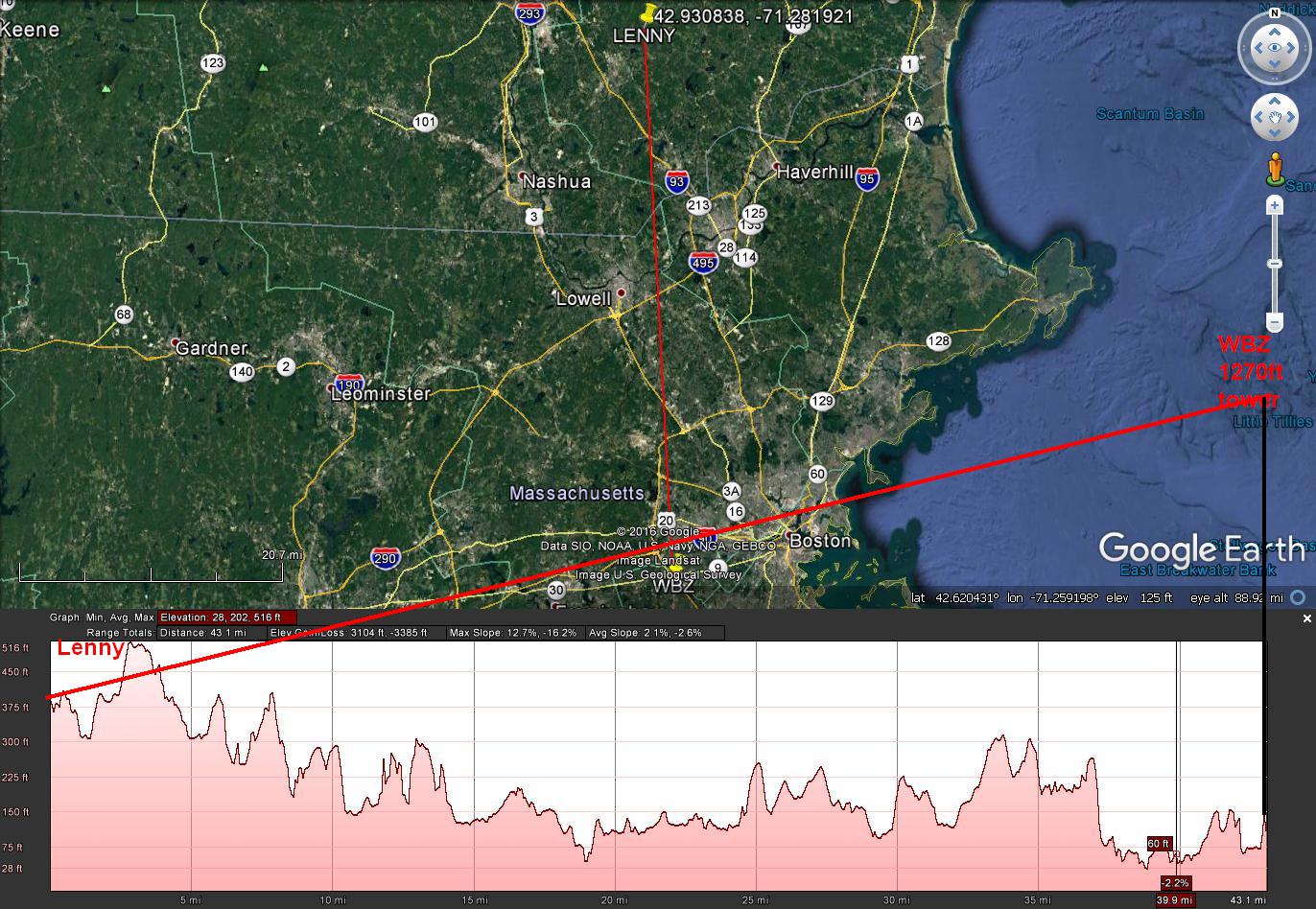
| Jeff Liebermann <jeffl@cruzio.com>: Nov 18 03:02PM -0800 >> No clue if it has been fixed, but judging by the lack of updates, >> probably not. > Well that takes all the fun out of it! Occam's Razor. >cut to length folded dipole, 10 ft off the ground. >Channel 36, about 9.5" long. > Mikek Sure, it can be done at 45 miles depending on tx power and frequency. However, Captain Video has an additional problem in the form of a mound of dirt in between his antenna and the station transmitter. <http://802.11junk.com/jeffl/coverage/KBCZ-WBZ/WBZ-Lenny.jpg> or if you have Google Earth handy: <http://802.11junk.com/jeffl/coverage/KBCZ-WBZ/WBZ%20path.kmz> The above path profile is NOT very accurate. I stopped working on the problem after Captain Video disappeared from the thread. Incidentally, I sometimes can watch KMPH TV from Fresno, CA which is about 200 miles away from Ben Lomond. I live on the side of a hill which helps. The real culprit is atmosheric ducting and edge diffraction from two mountain ranges in between. It only happens a few days per year, usually in the summer, but the picture is 100% perfect. -- Jeff Liebermann jeffl@cruzio.com 150 Felker St #D http://www.LearnByDestroying.com Santa Cruz CA 95060 http://802.11junk.com Skype: JeffLiebermann AE6KS 831-336-2558 |
| amdx <nojunk@knology.net>: Nov 18 06:46PM -0600 On 11/18/2016 5:02 PM, Jeff Liebermann wrote: > diffraction from two mountain ranges in between. It only happens a > few days per year, usually in the summer, but the picture is 100% > perfect. When I was a lot younger living in Kalamazoo Michigan, late one night I received a Wisconsin TV station across lake Michigan. Mikek |
| Cursitor Doom <curd@notformail.com>: Nov 18 07:23PM > http://www.ebay.com/bhp/ecu-programmer may be what you want right out > of the box. Especially if you are going to make a habit of it. Heck no! This is way out of my area of interest. I'd just like to temporarily hack the security on this thing to find out if it actually runs at all without wasting a penny more than I have to on it. > At the same time, you are not going to be able to repair/modify at the > component level without damaging the coating. So, you might just have-at > then repair the coating after the fact. Thank you, Peter. I shall bear that in mind, but what I have in mind is nothing more at this stage than probing for existing voltages in some places and injecting same at others. |
| "pfjw@aol.com" <pfjw@aol.com>: Nov 18 11:54AM -0800 On Friday, November 18, 2016 at 2:23:58 PM UTC-5, Cursitor Doom wrote: > Heck no! This is way out of my area of interest. I'd just like to > temporarily hack the security on this thing to find out if it actually > runs at all without wasting a penny more than I have to on it. The risk you take is, in the words of a friend, turning your CPU/EMU into a brick. They are more-or-less designed not to be overly friendly to hacks, and in some cases, even breathing funny on it can brick it. That is why a programmer with the correct software is infinitely safer than probing more-or-less randomly. Best of luck with it - and, if you have "auto recycling yards" in your neck of the woods, you might try getting an experimental unit there. It will be cheap. Peter Wieck Melrose Park, PA |
| Chris <cbx@noreply.com>: Nov 18 11:45PM > Best of luck with it - and, if you have "auto recycling yards" in your > neck of the woods, you might try getting an experimental unit there. It > will be cheap. This is an issue I personally have with modern cars. If you pick up a replacement unit from a junk yard and try to swap it out, it won't work even if it's in perfect condition 'cos the EMU is coded to the injectors (and god knows what else) so you need one of those fancy communication tools (for big bucks) to re-set the codes so they match. It's a serious PITA. Then you find the next time you need to do the same thing with a different model or make, 99 times out of a 100 you need a different comms tool for that. It's a costly nightmare. |
| antispam@math.uni.wroc.pl: Nov 18 10:00PM > sure the claims are accurate. But something as common and obviously > fake I would think eBay would stop allowing to be sold on their site. > Eric Ebay would stop that if enough buyers complain. But look: such sellers typicall have thousends of five star "reviews". Besides batteries charger specs have little to do with reality: nominally 1A chargers (Apple style flat plug) above 450mA show significant voltage drop and above 500mA voltage drop is way too high to use them at such current. Nominally 2.1A chargers (square plug) tops at 850 mA. Nominally 3.1A charger delivers a bit more than 1A. They have thousends of positive opinions even from folks who know that they perform way below specs. I bought a few and while I did not give them positive opinion I also did not fill a complaint: for one I expected that they perform below specs (but had to measure them to find out real specs). And I still find them good bargain given price and real performance. -- Waldek Hebisch |
| You received this digest because you're subscribed to updates for this group. You can change your settings on the group membership page. To unsubscribe from this group and stop receiving emails from it send an email to sci.electronics.repair+unsubscribe@googlegroups.com. |
1 Response to Digest for sci.electronics.repair@googlegroups.com - 25 updates in 4 topics
3 Researches REVEAL How Coconut Oil Kills Belly Fat.
This means that you actually get rid of fat by consuming coconut fats (in addition to coconut milk, coconut cream and coconut oil).
These 3 researches from major medical magazines are sure to turn the conventional nutrition world around!
Post a Comment