
| RS Wood <rswood@is.invalid>: Nov 07 12:19AM Xeno wrote: > True that. The indy doesn't have access to all the needed info for a > start. Nor the dealer training. They are both important. I disagree but I understand why you say that. You would presume that the dealer knows the most about the car. That hasn't been my experience. The parts guys are horrendously bad and the service guys marginally better. I don't think it stems from ignorance as much as not caring. This is mostly Toyota and BMW I'm talking though, so maybe your dealer is a different brand. |
| RS Wood <rswood@is.invalid>: Nov 07 12:19AM Xeno wrote: > underlying systems, possess a good range of diagnostic equipment and, > finally, know how to use it. For judgemental issues, know first what is > *normal*, then you can easily recognise *abnormal*. Being a diagnostician has always been the challenge. How many times have we seen people throw parts at the problem? That works. For older cars (20 years) it might even be a good idea. Diagnostics is sometimes easy and sometimes hard. It's always hard when you don't fully understand how the system works. It's a lot easier in some cases, especially when you understand how the system works. The hardest things to diagnose are the intermittent's that only happen while moving at speed. |
| kludge@panix.com (Scott Dorsey): Nov 06 07:34PM -0500 >If you think rotors warp in street use then you should be able to find a >ton of references to back up your logic. Rotors warp in street use all the time when the kids at the chain store use impact wrenches instead of a proper torque wrench to take tires off and put them back on. And of COURSE the chain store blames the driver, the tires, the phase of the moon, for it. "You must be going over potholes too hard." --scott -- "C'est un Nagra. C'est suisse, et tres, tres precis." |
| RS Wood <rswood@is.invalid>: Nov 07 12:34AM Xeno wrote: > I have a TV, I also have cable. They are for my wife. > I watch docos, etc on the internet. I prefer to schedule my own viewing. I don't have a TV but the kids have monitors for their consoles which, I guess, could be used as a TV if we had an antenna or cable - but we don't. I get my news off the radio when driving and the Internet and my phone, which is better than TV because I can skim pretty fast (that's one thing I'm better at than the average person for some reason. They had me in a special speed-reading class when I was a kid and the government funded them, and I went to an ivy-league school before completing high school - where speed reading came in handy there also). Point is that TV is too slow for me. The data doesn't come in hard and fast. I liked that someone posted a paper for me to read, but the problem with that paper was that I finished it, and then read it again, and then I had to wonder what kind of logic *they* were using. The paper didn't prove a single thing of what they implied it would. It irks me that people aren't logical. |
| RS Wood <rswood@is.invalid>: Nov 07 12:34AM Ed Pawlowski wrote: > Did I say that is the only way? No, I did not. You are making up > things to suit you. It's ok. You were implying that I'm stupid because I don't watch TV. That's ok. I don't take *anything* personally. What irks me the most is when people can't learn, like with the rotor warp or the friction materials or the real reason for FWD, etc., because they all fall prey to marketing bullshit. That irks me and I get cranky. You can't imagine how many "blue coolant" threads there are on the BMW forums, for example, or "red versus pink" on Toyota. Just like with the drilled/slotted marketing bullshit, there are people who tend not to use logic and there are people who use logic. In the end, I should just plonk those who can't handle logic because I can't fix them. They want to believe in marketing bullshit so badly that they'll believe that an iPhone can do everything an Android phone can do, and that's just marketing bullshit. It can't. Anyone knows that who can think logically. But they can't. The good news is that I don't take names. I don't even look at whom I'm responding to. So he can say something stupid and I'll tell him that's stupid and the next he can say something logical and I'll commend him for using his brain. > You did, however, take the time to infer you know > everything about history, discovery, science, and the rest of the world. I'm very well read. As are many people who have multiple higher degrees and who are many (many) decades old. In the days of yore, people respected the sage wisdom of their elders. :) > Books are great, but seeing some things on TV can be very enjoyable > and educational for those of us that don't know everything.. I don't have anything against TV. My only point is that people always bring up that they have better use for their time than changing oil which is where that issue came up. I said I take my sweet time changing oil and someone said the cliche that they have better use for their time which always means the same thing because they don't use logic when they say it. There is only one person on this planet who can make that argument and that's a person who NEVER does anything but one thing in their entire life (sort of how they say Bernard Montgomery was). Those people who have one and only one interest in their entire lives are the only people who, logically, can say what I was responding to. Anyone else, e.g., someone who watches TV for even one hour a month, has no business, logically, making that idiotic argument about not having time to change their oil. YOU are the one who brought in all the merits of watching TV. Not me. And then you argue with me for responding to YOUR issues. You're not being logical here. > You can watch an episode of "How It Made" and they may do a segment on > piston rings and the latest technology. I watch a *lot* of stuff on the net, so, I can see a lot of how it's made. You failed the simplest logic test. Someone posited that piston rings are far better now than in days of yore. I simply asked for proof. The only proof that came out was a high-school level paper where some kid doing a thesis (yes, I know it wasn't for high school but it may as well have been) with lots of pretty pictures. Whoever proposed it was wowed by all the pretty pictures, but clearly they didn't *read* the paper because I did and it said nothing of the sort. Now did I complain that they wasted my time? No. I simply responded with logic. What you seem to hate, is logic. Why? |
| RS Wood <rswood@is.invalid>: Nov 07 12:35AM Xeno wrote: >> Which is the most reliable? > Gear by far, chain next, belt last. Interesting. Makes sense. Are gears prevalent? If not, is the main reason the cost? |
| RS Wood <rswood@is.invalid>: Nov 07 12:45AM Scott Dorsey wrote: > put them back on. > And of COURSE the chain store blames the driver, the tires, the phase > of the moon, for it. "You must be going over potholes too hard." We covered that in the car forums about three decades ago, where you have to wonder how anyone could say what you just said. I haven't *looked* at the problem you speak of for more than 30 years, but let's take it step by step in really big steps here. 1. How many footpounds *can* you torque a lug nut to before the bolt snaps? 2. Let's put *that* amount of torque on ONE of six bolts, shall we. 3. A rotor isn't solid, but let's assume a solid rotor for a moment. 4. How much torque would it take to *bend* a solid rotor? QUESTION FOR YOU THAT WE ASKED 30 YEARS AGO OF OTHERS: Q: How much torque on one bolt would it take to bend a rotor? |
| clare@snyder.on.ca: Nov 06 07:46PM -0500 On Mon, 06 Nov 2017 10:03:21 -0800, Vic Smith >Sure, so do I. But I don't call that "service." I call it "looking at pad wear." >I sure don't open the MC reservoir. That would expose the fluid to more air than it's seen >in about 20 years of not opening it. And we all know, brake fluid if "hygroscopic." Correct. The "service" is more than checking pads. It's PRIMARILY making sure all moving/sliding parts are free - and knocking off any rust scale build-up on the edges of the rotors. |
| clare@snyder.on.ca: Nov 06 07:53PM -0500 On Mon, 6 Nov 2017 20:36:45 -0000, "Ian Field" >> days. >> The hardest is being a good diagnostician. >Diagnostics can be challenging when *EVERYTHING* rattles................. a hand full of loose nuts and bolts thrown into closed body sections by disgruntled union workers during "job action" was the worst one I had to deal with - AMC in '72?? A friend found a full can of beer inside e tire that wouldn't balance - I believe it was a GM in the sixties? Early in the canned beer era, anyway. |
| Frank <analogdial@mail.com>: Nov 07 12:55AM On Mon, 06 Nov 2017 04:49:21 +0000, RS Wood wrote: >> that chain wear had retarded the timing by that amount. > From a repair standpoint, how long do each typically last? > 1. Chain ? Depends what you mean by "how long does it typically last?" Timing sets on OHV engines typically wouldn't totally fail at under 100,000 miles. Most of those sets were used in the days when cars were junked at about that mileage. Alot of those cars were junked because the timing set failed. But I'd guess timing set wear would retard cam timing around 1/2 to 1 degree every 10,000 miles. If we set an arbitrary failure spec of, say 3 degrees, then the set would have gone out at 30 to 60,000 miles. Of course, the car would run even if the camshaft were retarded more than this and the driver usually became acclimated to the poorer performance and gas mileage. > 2. Belt ? I don't know. My car requires belt replacement every 100,000 miles or six years. I replaced the belt at eight years and it looked perfect. There's no significant timing change as the belt ages, until it fails. An insignificant number fail before the required maintenance time. > 3. Pushrod ? I don't know what you're getting at. Most US pushrod engines drive the cam with sprockets and a chain. A few used gears. A few antique motorcycles used tower shafts and bevel gears. Maybe some auto engines? dunno. > I don't hear anyone talking about pushrods, so, all I see here are that > chains last a *lot* longer in general than do belts, where if either one > broke on an interference engine, expensive things can happen. Pushrod engines can be interference engines. Not sure what you're getting at. >> with the 4 speed auto, the replacement isn't too bad, once you know the >> routine. > If the replacement isn't bad, then the belt isn't 'as' bad. Easiest belt replacement I ever did was on an early Fox body Mustang with the 2.3 liter 4. Take of the drive belts, take off the timing belt cover, swap the belts. With some practice and preperation, it would be a clean, 15 minute job. Much easier and cleaner than replacing a chain timing set!! > Why did the automakers go to belts over chains? > My supposition is that they did it to save them money. > No other reason. Camshaft timing. > The tradoffs are legendary where the owner is the one who loses in the > end calculation. Belts became important when Overhead cams became important. A worn chain in a cam in block engine has, off the top of my head, 10 links between the crank sprocket and the cam sprocket. What about a OHC motor? Say 30 links? 10 worn links might retard cam timing 5 degrees. What about 30 worn links? > what, maybe 10 days out of 365?) > Anyone who mentions snow with FWD is falling directly into marketing > hell. Bullshit. Here in Chicago, traffic flows much better in the snow than it did 30 years ago. In fact, I haven't seen a car stuck in the snow in at least a couple of years. Stuck RWD cars used to impede rush hour traffic on a routine basis. Nowadays, I haven't been late to work because of the snow in those two years. Or, maybe it's the FIRE OF MARKETING HELL that's taking care of the snow. Either way, I'll take it. > The sole reason for belts and FWD is to increase manufacturer's profits. > Everything else is marketing bullshit because the tradeoffs are > legendary. I know. The "donut in a snowy parking lot" crowd is almost extinct. |
| clare@snyder.on.ca: Nov 06 07:58PM -0500 On Tue, 7 Nov 2017 07:59:09 +1100, Xeno <xenolith@optusnet.com.au> wrote: >underlying systems, possess a good range of diagnostic equipment and, >finally, know how to use it. For judgemental issues, know first what is >*normal*, then you can easily recognise *abnormal*. Correct. What I taught all my students (and apprentices). The first step in diagnosis is understanding how it is supposed to work, and why. Then understand what the results of any malfunstion would be - - When you see those symptoms, you have a pretty good idea what has gone bad and where - as well as, very often, WHY. |
| RS Wood <rswood@is.invalid>: Nov 07 01:10AM Frank wrote: > Bullshit. Here in Chicago, traffic flows much better in the snow than it > did 30 years ago. In fact, I haven't seen a car stuck in the snow in at > least a couple of years. People who believe in marketing bullshit never follow basic logic. Here's simple logic (which may be too difficult for you to follow). 1. How many days in a year are you *driving* in *deep* snow? 2. Tell us what percentage that turns out to be. 3. Now, take that percentage and subtract it from one hundred percent. That's the percentage you're getting the *other* handling out of FWD. You may not want to answer the question because it's too logical a question for someone to ask about handling tradeoffs given your extremely carefully cherry-picked hand-crafted situations versus normal situations. |
| AMuzi <am@yellowjersey.org>: Nov 06 07:26PM -0600 On 11/6/2017 6:19 PM, RS Wood wrote: > even the slightest improvement over the years. > It might be there, but saying it's there isn't the same as it being there. > Proof in logic is always very simple. Everything is simple and seems logical when you don't know what you don't know. On a 1965 Chevy small block, measurable improvements can be had with modern ring technology[1]. Here's a big block, but the principles are the same: http://www.superchevy.com/how-to/project-cars/sucp-0404-small-block-chevy-piston-rings-danger-mouse-part-twenty/ check out the chart #5/10! Discussion of materials, coatings, temper, tolerances and fitting on that page as well. That's just a specific engine with which I am very familiar. Web's got thousands of other examples. [1] Not the only improvement to be had, but you mentioned classic vs modern rings. -- Andrew Muzi <www.yellowjersey.org/> Open every day since 1 April, 1971 |
| Frank <analogdial@mail.com>: Nov 07 01:32AM On Mon, 06 Nov 2017 04:48:45 +0000, RS Wood wrote: >> 10W 40 would coke up faster than 10W 30, for what it's worth. > I just mentioned that, but I didn't look for references. > Do we all generally agree that the *spread* is what causes the coking? No. Synthetics have a natural "spread" that conventional oils don't. Conventional oils need additives to achieve their spread. I suppose it's the multigrade additives that coke up the most, not the oil itself. As I understand it, conventional oils are a mishmash of hydrocarbons which react more strongly to temperature. Maybe this doesn't relate exactly, but consider water. The viscosity of water doesn't change much from freezing point to boiling point. The molecules are all the same and they're all acting the same. Ideally, motor oil wouldn't react to temperature. A perfect viscosity oil would flow the same at a cold startup as it does at normal temperature. That doesn't happen, but synthetics are much better in that regard and is why a much wider spread is possible with a synthetic. > If we agree on that concept of coking:spread, then the question is how > much does coking actually matter and under what conditions does coking > matter? Coking matters to the extent that it plugs filters and oil passages. The coke is hard and can abrade bearing surfaces. |
| Xeno <xenolith@optusnet.com.au>: Nov 07 01:18PM +1100 On 7/11/2017 11:34 AM, Scott Dorsey wrote: > And of COURSE the chain store blames the driver, the tires, the phase > of the moon, for it. "You must be going over potholes too hard." > --scott That's been a pet peeve of mine for decades. I hate inappropriate use of air tools - and final torquing nuts with them is one of those peeves. -- Xeno |
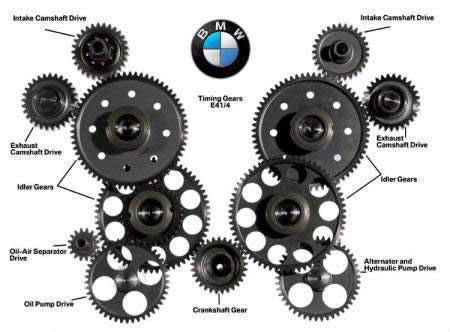
| Xeno <xenolith@optusnet.com.au>: Nov 07 01:44PM +1100 On 7/11/2017 11:35 AM, RS Wood wrote: >> Gear by far, chain next, belt last. > Interesting. Makes sense. > Are gears prevalent? Used to be on cars. Noise was the issue. Phenolic resin gears solved that issue but then gear longevity was sacrificed to the god of noise. Used to change a lot of stripped phenolic resin gears back in the 60s and 70s. > If not, is the main reason the cost? On larger diesel engines noise isn't a factor and longevity is. Cost is less of an issue when long life is the requirement. Or performance with reliability as in this BMW F1 engine http://www.formula1-dictionary.net/Images/F1engine-timinggears.jpg Gears become an issue with distance, as is the case with OHC. In that case you need too many idler gears so a chain or belt is more efficacious. From memory, the Toyota KZ engines had both gears and then a belt to the OHC. -- Xeno |
| Xeno <xenolith@optusnet.com.au>: Nov 07 01:46PM +1100 On 7/11/2017 11:45 AM, RS Wood wrote: > 2. Let's put *that* amount of torque on ONE of six bolts, shall we. > 3. A rotor isn't solid, but let's assume a solid rotor for a moment. > 4. How much torque would it take to *bend* a solid rotor? It is the balance of the torques. > QUESTION FOR YOU THAT WE ASKED 30 YEARS AGO OF OTHERS: > Q: How much torque on one bolt would it take to bend a rotor? Had it happen on a Mazda I owned. I wasn't happy and complained bitterly. You can put a lot more torque of a wheel nut than is required. -- Xeno |
| Ed Pawlowski <esp@snet.net>: Nov 06 10:00PM -0500 On 11/6/2017 7:19 PM, RS Wood wrote: > even the slightest improvement over the years. > It might be there, but saying it's there isn't the same as it being there. > Proof in logic is always very simple. You have not looked http://www.enginelabs.com/engine-tech/mahles-thin-piston-ring-technology-affordable-effective/ http://www.underhoodservice.com/advances-in-piston-ring-technology/ With so many late-model engines running thinner, low-tension moly-faced ductile iron and steel rings, one might think cast iron rings are fading into history. They are at the OEM level, but it looks like cast iron rings will be around for a long, long time in the aftermarket. According to several ring suppliers, there is still a very strong demand for plain cast iron rings. The main reason is that cast iron rings cost less than more durable materials — and they hold up well enough in light-duty stock rebuilt engines. Even so, plain cast iron rings can't provide the durability of a chrome or moly-faced ring set, or a steel or ductile iron ring set that is engineered for high output, late-model overhead cam engines. |
| clare@snyder.on.ca: Nov 06 10:08PM -0500 On Tue, 7 Nov 2017 00:55:08 -0000 (UTC), Frank <analogdial@mail.com> wrote: >100,000 miles. Most of those sets were used in the days when cars were >junked at about that mileage. Alot of those cars were junked because the >timing set failed. I replaced a lot of timing chains and spockets on OHV engines particularly The GMs with the plastic cam sprocket >six years. I replaced the belt at eight years and it looked perfect. >There's no significant timing change as the belt ages, until it fails. >An insignificant number fail before the required maintenance time. Except the little Chevy Optima? where virtuallly NONE made it much bast the recommended change point and many failed well before. Bad korean belt. >cam with sprockets and a chain. A few used gears. A few antique >motorcycles used tower shafts and bevel gears. Maybe some auto engines? >dunno. The early Riley, for one. >Easiest belt replacement I ever did was on an early Fox body Mustang with >the 2.3 liter 4. Take of the drive belts, take off the timing belt >cover, swap the belts. With some practice and preperation, it would be a .>clean, 15 minute job. >Much easier and cleaner than replacing a chain timing set!! I replaced the broken timing belt on the side of the road south of Sydney NS on my '72 Firenza (Vauxhall HC) in less than half an hour after getting a friend of a friend to pick up the only belt available west of montreal - which just happened to be hanging on a nail at the GM dealer in, of all places, Sydney NS - - - Sometimes it's better to be lucky than good!!!! 2 days later I was in the USA - where NOBODY would have had the part because the car was never sold there - - - |
| Frank <analogdial@mail.com>: Nov 07 03:46AM On Tue, 07 Nov 2017 01:10:20 +0000, RS Wood wrote: >> it did 30 years ago. In fact, I haven't seen a car stuck in the snow >> in at least a couple of years. > People who believe in marketing bullshit never follow basic logic. Since you've decided how I'm thinking, what's the logic in responding? > 1. How many days in a year are you *driving* in *deep* snow? > 2. Tell us what percentage that turns out to be. > 3. Now, take that percentage and subtract it from one hundred percent. OK, let's say it's 1% of the days. I don't want to be needlessly late on ANY of those days. More than that, the FACT that traffic is now flowing more smoothly on snowy days makes driving less stressful. I will say that, last year, I was driving home on a snowy day. Traffic was light and what traffic there was, was making safe progress. Some dumbass decided to pass me fast on the right, lost traction on his RWD vehicle and spun his car across three unoccupied lanes and smacked his passenger side wheels against the curb on the opposite side of the road. Pretty uncommon now, but things like that used to happen frequently in the RWD days. I don't miss it. > That's the percentage you're getting the *other* handling out of FWD. Fine. It makes driving safer and smoother a few days out of the year. It is NEVER a detriment to me. For me, there is NO handling downside. > question for someone to ask about handling tradeoffs given your > extremely carefully cherry-picked hand-crafted situations versus normal > situations. For me, there is no trade off. Whatever difference there is, is positive. I didn't need any marketing bullshit to convince me of the superiority of FWD. All it took was getting through the winter. And I like the extra interior room, too. |
| Frank <analogdial@mail.com>: Nov 07 03:59AM On Mon, 06 Nov 2017 22:08:55 -0500, clare wrote: > I replaced a lot of timing chains and spockets on OHV engines > particularly The GMs with the plastic cam sprocket Ford used the same sort of cam sprocket and they failed the same, too. I don't think the timing sets with the cast iron/sintered metal cam sprockets held up much better. Once timing chain wear starts changing the pitch, it's setting itself up to jump a tooth on the crank sprocket even if it can no longer break the teeth on the cam sprocket. Another problem with timing chains is the metal swarf they'd put in the oil as they wore. |
| RS Wood <rswood@is.invalid>: Nov 07 04:19AM Xeno wrote: > It is the balance of the torques. Remember, we covered this in detail DECADES ago. Everyone confuses *runout* with *warp*. They're not the same thing. One requires *permanent bending* of the rotor. You have to do that without snapping the lug bolts. Two logical questions HAVE to be considered: 1. How much torque *can* you apply? 2. How much torque does it take to *bend* a rotor? Without logic - it's just politics or religion. >> Q: How much torque on one bolt would it take to bend a rotor? > Had it happen on a Mazda I owned. I wasn't happy and complained > bitterly. You can put a lot more torque of a wheel nut than is required. There is a huge difference between runout and warp. Are you talking warp? Or runout? I'm only talking pure logic here. Not religion. |
| RS Wood <rswood@is.invalid>: Nov 07 04:19AM Frank wrote: > Coking matters to the extent that it plugs filters and oil passages. The > coke is hard and can abrade bearing surfaces. I have seen what amounts to black sand in the outside sleeve of the crazy BMW dipstick tube which doubles as part of the PCV system but where the clearance is too small (so people drill holes in it to solve that). I had to dig out the "black sand" which was pure carbon it seemed but rock hard and packed in there. |
| Frank <analogdial@mail.com>: Nov 07 04:21AM On Sun, 05 Nov 2017 14:42:50 +0000, RS Wood wrote: > What fails rotors the most (by far) is thickness. Around here, it's the rust that thins the rotors. The braking surfaces don't rust significantly, but the rust just flakes out of the vent holes. Replacing rotors every other brake job is about right in the rustbelt. |
| "David Farber" <farberbear.unspam@aol.com>: Nov 06 10:42AM -0800 N_Cook wrote: > Assuming >2006 then first diagnostic procedure is to waft a bird > feather around the components while powered up, if you've not been > manually touching things inside. There is no date that I could find on the unit. I called the Rickenbacker company in Santa Ana, CA, and was told they don't have schematics for the older amplifiers. They couldn't even tell me the manufacturing date of the amplifer when providing them the model number. My educated guess is that it's from the1990's or older. Thanks for your reply. -- David Farber Los Osos, CA |
| You received this digest because you're subscribed to updates for this group. You can change your settings on the group membership page. To unsubscribe from this group and stop receiving emails from it send an email to sci.electronics.repair+unsubscribe@googlegroups.com. |
No Response to "Digest for sci.electronics.repair@googlegroups.com - 25 updates in 2 topics"
Post a Comment